Reviews & Articles
Image of the day
About Astromart
My Account
New to Astromart?
Register an account...Need Help?
News
Excuse Me While I Kiss the Sky -- Month of November 2025
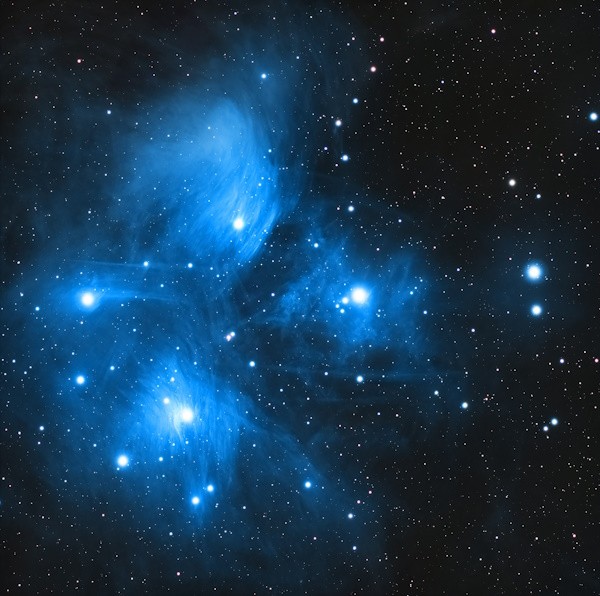
Welcome to the night sky report for November 2025 -- Your guide to the constellations, deep sky objects, planets, and celestial events that are observable during the month. Jupiter, Saturn, and Uranus are visible during the month. Venus and Mars are no longer visible as they are very low in the sky after sunset. Also this month, hunt for the fainter constellations of fall, including Pisces, Aries, and Triangulum. They will guide you to several galaxies, including the spiral galaxies M74 (NGC 628, the Phantom Galaxy) and M33 (NGC 598, the Triangulum Galaxy). The night sky is truly a celestial showcase. Get outside and explore its wonders from your own backyard.
MIT Geologists Discover Physical Evidence of Our Proto-Earth of 4.5 Billion Years Ago
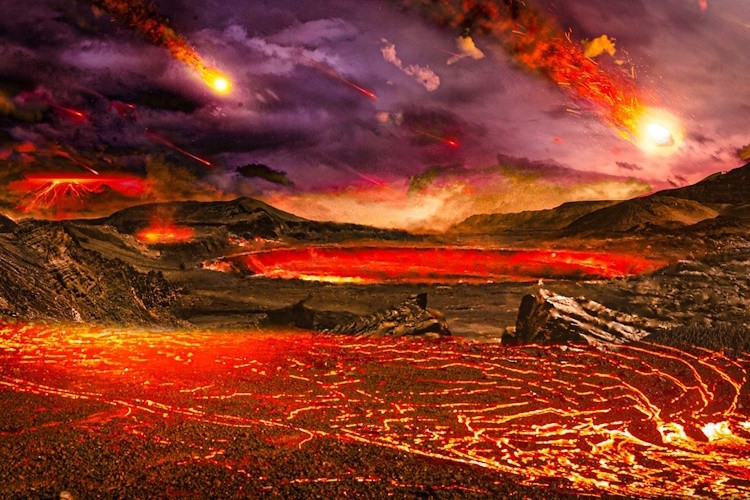
Billions of years ago, the early Solar System was a swirling disk of gas and dust that eventually clumped and accumulated to form the Proto-Earth and its neighboring planets. Scientists at MIT and elsewhere have discovered extremely rare remnants of our “Proto-Earth,” which formed about 4.5 billion years ago, before a colossal collision irreversibly altered the primitive planet’s composition and produced the Earth as we know today. Their findings will help scientists piece together the primordial starting ingredients that forged the early Earth and the rest of the Solar System.
Excuse Me While I Kiss the Sky -- Month of October 2025

Welcome to the night sky report for October 2025 -- Your guide to the constellations, deep sky objects, planets, and celestial events that are observable during the month. During October, a supermoon takes over the sky, the Draconid meteor shower peeks through, and the Orionid meteor shower shines bright. The crisp, clear October nights are also full of celestial showpieces for the deep sky gazer. For example, find Pegasus the flying horse of Greek mythology to pinpoint nice dense globular clusters and galaxies. The night sky is truly a celestial showcase, so get outside and explore its wonders from your own backyard.
The Juno Mission to Jupiter is in serious financial touble, and needs our help!
The upcoming appropriations budget for the ongoing Juno mission, starting October 1, 2025, is being completely defunded - it will be immediately and completely discontinued, right in the middle of the mission, after many years of designing, building, testing and launching have been already accomplished. Talk about a waste! If you believe that it is our country's best interests to continue the Juno mission, your only chance will be to immediately reach out to the key people on the Appropriations committees - here is a list of who to call, and email, and suggestions on what to say.
New Event Horizon Telescope Images Reveal Unexpected Polarization Flips in the Black Hole at the Center of M87
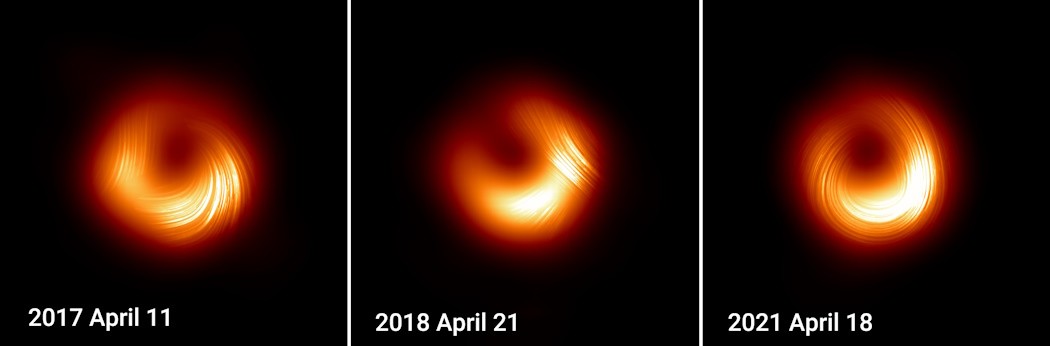
Located about 55 million light-years away from Earth, M87 harbors a supermassive black hole more than six billion times the mass of the Sun. It is designated as M87*. The Event Horizon Telescope (EHT), a global network of radio telescopes acting as an Earth-sized observatory, first captured the iconic image of M87’s black hole shadow in 2019. Now, by comparing observations from 2017, 2018, and 2021, scientists have taken the next step towards uncovering how the magnetic fields near the black hole change over time. The new images reveal a dynamic environment with changing polarization patterns near the black hole. Additionally, the scientists found the first signatures of the extended jet emission near the jet base, which connects to the ring around M87*. These new observations are providing new insights into how matter and energy behave in the extreme environments surrounding black holes.
NASA’s JWST Observes Immense Stellar Jet in the Outskirts of Our Milky Way Galaxy
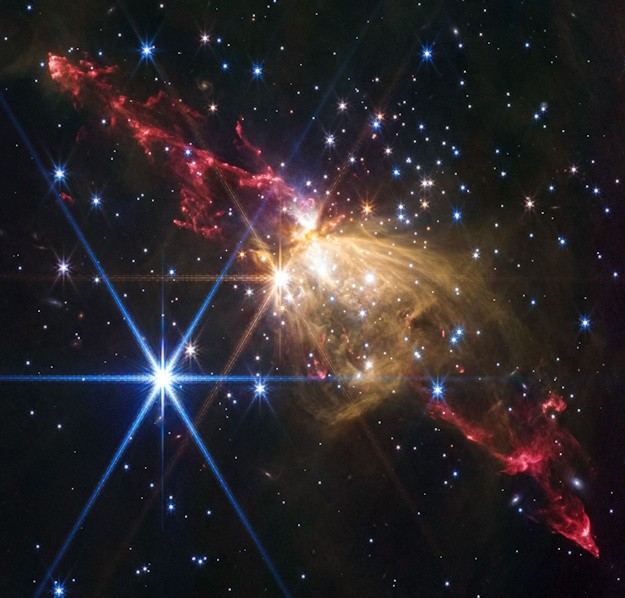
A blowtorch of seething gasses erupting from a volcanically growing monster star has been captured by NASA’s James Webb Space Telescope (JWST). Stretching across 8 light-years, the length of the stellar eruption is approximately twice the distance between our Sun and the next nearest stars, the Alpha Centauri system. The size and strength of this particular stellar jet, located in a nebula known as Sharpless 2-284 qualifies it as rare. The James Webb Space Telescope is the world’s premier space science observatory. Webb studies every phase in the history of our Universe and is unique in that it does not orbit around the Earth like the Hubble Space Telescope. Instead, it orbits the Sun 1.5 million kilometers (1 million miles) away from the Earth at what is called the second Lagrange point or L2.
Excuse Me While I Kiss the Sky -- Month of September 2025

Welcome to the night sky report for September 2025 -- Your guide to the constellations, deep sky objects, planets, and celestial events that are observable during the month. During September, Saturn puts on a spectacular show and a sunrise conjunction shines bright as we ring in the autumnal equinox. Also this month, Pegasus becomes increasingly prominent in the southeastern sky, allowing skywatchers to locate globular clusters M2 (NGC 7089), M30 (NGC 7099), as well as a nearby double star, Alpha Capricorni, which is an optical double (but not a binary pair). The night sky is truly a celestial showcase, so get outside and explore its wonders from your own backyard.
Researchers Use the ISS to Study Rare Transient Luminous Events in the Upper Atmosphere
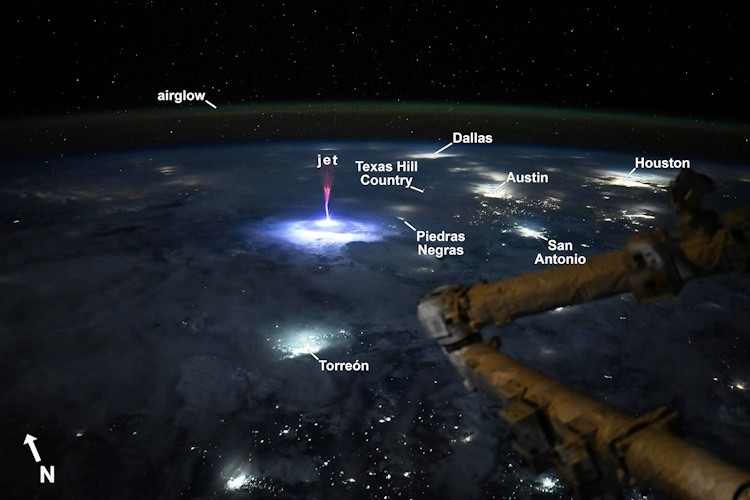
Scientists are using instruments on the International Space Station to study phenomena in Earth’s ionosphere or upper atmosphere including thunderstorms, lightning, and the more rare Transient Luminous Events (TLEs). TLEs take many forms, including blue jets (discharges that grow upward into the stratosphere from cloud tops) and colorful bursts of energy above storms called Stratospheric/Mesospheric Perturbations resulting from Intense Thunderstorm Electrification or SPRITES. TLEs can disrupt communication systems on the ground and pose a threat to aircraft and spacecraft. Understanding these phenomena could also improve atmospheric models and weather predictions. Because these events occur well above the altitudes of normal lightning and storm clouds, they are difficult to observe from the ground, but are more readily observed from space.
A Spinning Enigma – This Unicorn Object Defies Astrophysics
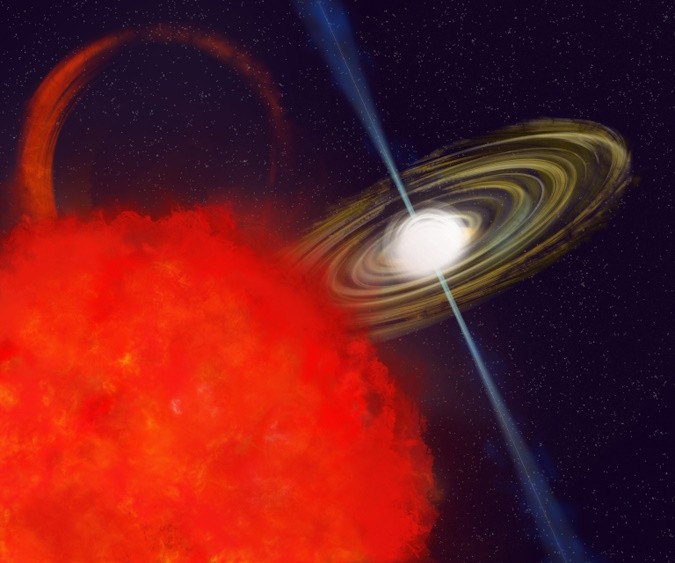
Astronomers have made a groundbreaking discovery using some of the world’s most advanced radio telescopes. Researchers at the National Science Foundation Green Bank Observatory (NSF GBO), have identified an exceptionally unusual cosmic object known as a Long Period Radio Transient (LPT), named CHIME J1634+44. This object stands out as one of the most polarized LPTs ever discovered, and it is the only one observed to be spinning up (meaning its rotation is speeding up) -- a phenomenon never seen before in this class of astronomical objects.
Excuse Me While I Kiss the Sky -- Month of August 2025

Welcome to the night sky report for August 2025 -- Your guide to the constellations, deep sky objects, planets, and celestial events that are observable during the month. Mercury pops up above the horizon during the second half of August and appears very low, below 10 degrees altitude. Venus shines very brightly in the east each morning before sunrise, about 20 to 30 degrees above the horizon. Mars can be observed low in the west during the hour after sunset, appearing about as bright as the brightest stars in the Big Dipper. Jupiter appears in the east each morning, together with Venus, but much less bright. Finally, Saturn is observable late night to dawn and rises around 10:30 PM early in the month and around 8:30 PM by the end of the month. Find it high in the south as sunrise approaches. Also, in August, a number of star-studded figures soar overhead. Look for the constellation Lyra, shaped as a small parallelogram, which points to Epsilon Lyrae and the Ring Nebula (M57, NGC 6720). You can also spot three bright summer stars: Vega, Deneb, and Altair, which form the Summer Triangle. Keep observing around the group of stars commonly known as the Teapot and you’ll be looking toward the center of the Milky Way. In that direction, you can see the Lagoon Nebula (M8, NGC 6523). August is also a great month to learn an easy-to-spot constellation – Cygnus the swan. The night sky is truly a celestial showcase, so get outside and explore its wonders from your own backyard.
Historic Apollo-Soyuz Rendezvous and Docking -- Both Capsules Launched 50 Years Ago Today
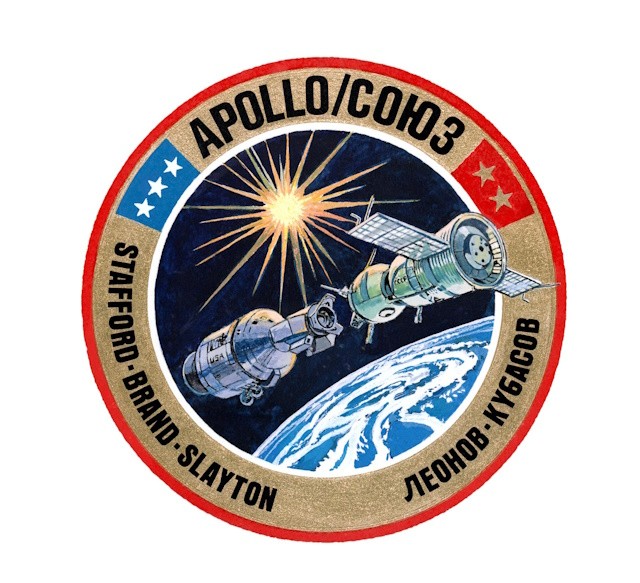
The first international partnership in space wasn’t the International Space Station (ISS). It wasn’t even the Shuttle-Mir series of missions. It was the Apollo-Soyuz Test Project. On July 15, 1975, an Apollo spacecraft launched carrying a crew of three and docked two days later on July 17th with a Soyuz spacecraft and its crew of two. Designed to test the compatibility of rendezvous and docking systems and the possibility of an international space rescue, the nine-day Apollo-Soyuz mission brought together two former spaceflight rivals: the United States and the Soviet Union. The United States launched an Apollo Command and Service Module on a Saturn IB rocket. The Apollo spacecraft was nearly identical to the type that orbited the Moon and later carried US astronauts to Skylab. The Soyuz was the primary Soviet spacecraft used for manned flight since its introduction in 1967. The docking module was designed and constructed by NASA to serve as an airlock and transfer corridor between the two craft. During nearly two days of joint activities, the mission’s two Soviet cosmonauts and three US astronauts carried out five joint experiments and exchanged commemorative items. The successful Apollo-Soyuz Test Project paved the way for future international partnerships.
Supernova Explosions May Have Kicked-off Abrupt Climate Shifts in the Past… And It Could Happen Again
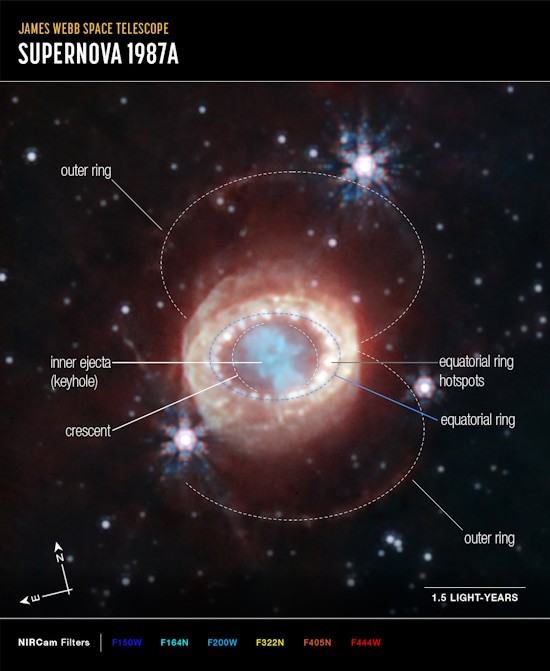
A new University of Colorado study suggests that supernovae in the past may have triggered climate change events here on Earth. According to the model, a sudden influx of high energy photons from a supernova could thin the ozone layer, which shields the Earth from the Sun’s rays. Simultaneously, the radiation could degrade methane in the stratosphere, a major contributor to the greenhouse effect that keeps the Earth warm. Put together, these interactions would dampen greenhouse warming and increase the amount of ultraviolet radiation that reaches Earth from the Sun. The study suggests that knock-on effects could include selective animal extinctions, increased wildfires, and global cooling.
Excuse Me While I Kiss the Sky -- Month of July 2025

Welcome to the night sky report for July 2025 -- Your guide to the constellations, deep sky objects, planets, and celestial events that are observable during the month. Venus shines brightly in the east each morning a couple of hours before sunrise, with the Pleiades and the bright stars Aldebaran and Capella. Mars sits in the west, about 20 degrees above the horizon as twilight fades and sets a couple of hours after dark. Jupiter starts to become visible low in the east in the hour before sunrise after mid-month. You'll notice it rises a bit higher each day through August, quickly approaching closer to Venus each morning. Mercury is visible very, very low in the west the first week or so in July, but sets quickly after sunset. Saturn rises around midnight and climbs to a point high in the south as dawn approaches. July is also a prime time to view the Milky Way in all its glory. Find the constellation Scorpius to identify the reddish supergiant star Antares, which will lead you to the globular star cluster M4 (NGC 6121). M22 (NGC 6656) in the constellation Sagitarius is one of the brightest globular clusters in the sky and is visible to the naked eye. Keep observing around the group of stars commonly known as the Teapot and you’ll be looking toward the center of the Milky Way. In that direction, you can see the Lagoon Nebula (M8, NGC 6523), the Omega Nebula (M17, NGC 6618), and the Trifid Nebula (M20, NGC 6514). Two open star clusters, the Butterfly Cluster (M6, NGC 6405) and the Ptolemy Cluster (M7, NGC 6475), can be found on the end of the constellation Scorpius, just above the stinger. The night sky is truly a celestial showcase. Get outside and explore its wonders from your own backyard.
Vera C. Rubin Observatory Sees First Light and Releases Spectacular Imagery
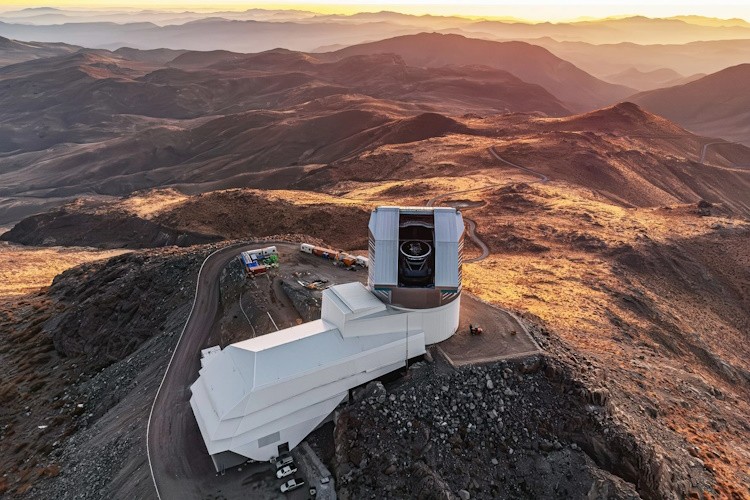
The Vera C. Rubin Observatory, jointly funded by the US National Science Foundation (NSF) and the US Department of Energy (DOE) is a brand new astronomy and astrophysics facility that has been built on Cerro Pachón in Chile. It’s named after US astronomer Vera Rubin, who provided the first convincing evidence for the existence of dark matter. Rubin Observatory is the first of its kind: its mirror design, camera sensitivity, telescope speed, and computing infrastructure are each in an entirely new category. The 8.4-meter Simonyi Survey Telescope at Rubin Observatory, equipped with the LSST Camera — the largest digital camera ever built — will take detailed images of the southern hemisphere sky for the next 10 years, covering the entire sky from the southern hemisphere every few nights and creating an ultra-wide, ultra-high-definition, time-lapse record — the largest astronomical movie of all time. This unique movie will bring the night sky to life, yielding a treasure trove of discoveries: asteroids and comets, pulsating stars, and supernova explosions. With Rubin we will gain a better understanding of our Universe, delve into the mysteries of dark energy and dark matter, and reveal answers to questions we have yet to imagine.
Dwarf Planet With Elongated Comet-like Orbit Discovered in the Kuiper Belt… But It’s Neither Planet X nor Planet 9

A team led by Sihao Cheng of the Institute for Advanced Study (IAS) in Princeton, NJ, has discovered an extraordinary Trans-Neptunian Object (TNO) named 2017 OF201 at the edge of our Solar System. Trans-Neptunian Objects are minor planets that orbit the Sun at a greater average distance than the orbit of Neptune. The TNO is potentially large enough to qualify as a dwarf planet, the same category as the much more well-known Pluto. The new object is one of the most distant visible objects in our Solar System and, significantly, suggests that the empty section of space thought to exist beyond Neptune in the Kuiper Belt is not, in fact, empty at all. The new TNO is special for two reasons: its extreme orbit and its large size. The object’s aphelion -- the farthest point in its orbit around the Sun -- is more than 1600 times that of the Earth’s orbit. Its perihelion -- the closest point in its orbit around the Sun -- is 44.5 times that of the Earth’s orbit, similar to Pluto's orbit. The presence of this single object, which at present is at its closest point in its orbit, suggests that there could be another hundred or so similar objects out there with similar elongated orbits. But they are just too far away to be detected right now.