Reviews & Articles
Image of the day
About Astromart
My Account
New to Astromart?
Register an account...Need Help?
News
Ed White is the First American to Spacewalk – Sixty Years Ago Today

When Gemini IV astronaut Ed White emerged from his spacecraft into the blackness of space on June 3, 1965, he became the first American to walk in space. For more than 20 minutes, White maneuvered himself around the Gemini spacecraft while it traveled from over Hawaii to the Gulf of Mexico -- making his orbital stroll 6500 miles long. White was attached to the spacecraft by a 23 foot long tether line wrapped in gold tape. The visor of his helmet was gold plated to protect him from the unfiltered rays of the Sun. In his right hand, White carried a Hand Held Self Maneuvering Unit, which he used to move about the weightless environment of space. Unfortunately, the gas powered unit ran out of fuel after only 3 minutes. For the remainder of the space walk White maneuvered by twisting his body and tugging on the umbilical cord. Tragically, Lieutenant Colonel White and his crewmates Gus Grissom and Roger Chaffee died on January 27, 1967, in the Apollo 1 flash fire during a launch pad test at Kennedy Space Center.
Excuse Me While I Kiss the Sky -- Month of June 2025

Welcome to the night sky report for June 2025 -- Your guide to the constellations, deep sky objects, planets, and celestial events that are observable during the month. Mercury, Venus, Mars, Jupiter, and Saturn make appearances during the month. The bright central bulge of our home galaxy, the Milky Way, is visible all night in June, continuing through August. It is best observed from dark sky locations far from bright city lights and appears as a faint, cloud-like band arching across the sky toward the south. During the month, look for the Hercules constellation, which will lead you to a globular star cluster with hundreds of thousands of densely packed stars. Globular cluster M13 (the Hercules Cluster, NGC 6205) is best observed with a telescope, but binoculars will reveal it as a fuzzy spot. You can also spot Draco the dragon, which will point you to the Cat’s Eye Nebula (C6, NGC 6543). The night sky is truly a celestial showcase. Get outside and explore its wonders from your own backyard.
NJIT Researchers are Boosting Early Detection of Solar Storms With AI-Powered Forecasting

New Jersey Institute of Technology (NJIT) researchers are developing new ways to predict when the powerful magnetic energy from Solar flares and Coronal Mass Ejections (CMEs) will reach Earth. The team is developing AI-powered space weather forecasting capabilities that could offer Solar researchers a new window into the complex magnetic processes in regions of the Sun's atmosphere that trigger such eruptions, and to this point, have rarely been observed. According to the researchers, the new AI-powered forecasting system could boost early-warning detection of these eruptive events on Earth by days, while offering vital insights to the space weather science community as activity on our nearest star ramps up over the course of the current 11-year Solar cycle, which began in 2019.
University of Colorado Astrophysicist Searches for Ripples in Space and Time in New Way

Throughout the history of the Universe, countless supermassive black holes have engaged in a volatile dance. These behemoths spiral around each other faster and faster until they crash together. Scientists suspect that the resulting collisions are so powerful that they literally generate ripples that spread out into the Universe. To date, detailed measurements only capture how gravitational waves move in a single direction— waves that are either flowing directly toward us or away from us. This new research at the University of Colorado – Boulder is designed to measure how gravitational waves also move from side-to-side and up and down as compared to Earth, since gravitational waves literally operate in three dimensions. The gravitational waves stretch and squeeze spacetime along our line of sight, but they should also cause objects to appear to move back and forth in the sky if the researchers’ hypothesis is correct.
Excuse Me While I Kiss the Sky -- Month of May 2025

Welcome to the night sky report for May 2025 -- Your guide to the constellations, deep sky objects, planets, and celestial events that are observable during the month. The planets to look for in May are Mars and Jupiter. They're visible for a couple of hours after sunset in the western sky. Low in the eastern sky each morning you'll find bright Venus paired with much fainter Saturn. They start the month close together, but Saturn pulls away and rises higher over the course of the month. Also, the first week of May brings the annual Eta Aquarid meteors, peaking on May 6th. In May, we are looking away from the crowded, dusty plane of our own galaxy toward a region where the sky is brimming with distant galaxies. Locate Virgo to find a concentration of roughly 2000 galaxies and search for Coma Berenices to identify many more. Coma Berenices is a great target for binoculars. Look for galaxies like M104 (Sombrero Galaxy), M87 (Virgo A Galaxy), and M64 (Black Eye Galaxy). The night sky is truly a celestial showcase. Get outside and explore its wonders from your own backyard.
Is the Whole Universe Spinning?

A new study suggests that the Universe may be rotating -- just imperceptibly slowly. If true, this new finding could help solve one of astronomy’s biggest puzzles -- the “Hubble Tension.” Current models say the Universe expands evenly in all directions, with no sign of rotation. This idea fits most of what astronomers observe. But it doesn’t explain the so-called Hubble Tension, a long-standing disagreement between two ways of measuring how fast the Universe is expanding. To try and reconcile this difference, researchers at the University of Hawaiʻi developed a mathematical model of the Universe and followed the standard rules. Nothing unexpected was uncovered. Then they decided to add a tiny amount of rotation. That small change made a big difference.
“Houston… We’ve Had a Problem” – The Failure of Apollo 13, 55 Years Ago Today

Fifty Five years ago today, on April 13, 1970, while en route to the Moon, an oxygen tank in the Service Module of Apollo 13 exploded. The lunar landing and moonwalk, which would have been executed by astronauts Jim Lovell and Fred Haise, were immediately aborted. NASA now had a much bigger challenge on their hands – How to get the three Apollo astronauts home alive. As clean oxygen and vital electrical power started to run out in the Command Module (CM), a dedicated team of flight controllers and engineers at Mission Control in Houston focused all of their efforts on developing a plan to shelter the crew in the Lunar Excursion Module (LEM) and use it as a “lifeboat,” while conserving sufficient resources, like air and water, to bring the spacecraft and its crew back home safely. By the grace of God, splashdown occurred in the Pacific Ocean on April 17, after a harrowing flight that lasted nearly six days.
Excuse Me While I Kiss the Sky -- Month of April 2025

Welcome to the night sky report for April 2025 -- Your guide to the constellations, deep sky objects, planets, and celestial events that are observable during the month. Enjoy observing Jupiter, Mars, and Venus in the morning and evening sky. In mid-April, look for the Lyrid meteors. Then hunt for the ancient ball of stars known as globular cluster M3 (NGC 5272). The night sky is truly a celestial showcase. Get outside and explore its wonders from your own backyard.
Does Time Exist? Maybe Not, But That’s OK

Does time exist? The answer to this question may seem obvious -- Of course it does. Just look at a calendar or a clock. But developments in physics suggest that time may not exist and we should start to take that possibility seriously. But trying to get by in a world without time seems positively disastrous. Our lives are built around time. We plan for the future, in light of what we know about the past. For example, we hold people accountable for their past actions, with an eye to holding them to account later on, in the future. But what’s the point of acting to bring about a change in the future when, in a very real sense, there is no future to act for? Also, what’s the point of holding someone to account for a past action, when there was no past and so, apparently, no such action? It’s easy for philosophers and physicists to twist themselves into a pretzel when trying to think this through, but that doesn’t stop them from trying.
Astronauts Grissom and Young Kickoff the Gemini Program – 60 Years Ago Today

Sixty years ago today, on March 23, 1965, a Titan 2 rocket launched into space NASA astronauts Virgil "Gus" Grissom and John Young inside their Gemini III capsule, kicking off the first two-manned, Earth-orbiting spaceflight of the Gemini Program. Gemini III (GT-3 or Gemini Titan 3) was the first US capsule launched with two astronauts onboard. The Gemini Program was conceived as an intermediate step between the one-manned Mercury and three-manned Apollo Programs. The program was developed to determine astronauts’ reaction to long duration flights, to develop the rendezvous and docking methods that would later be used in the Apollo Program, and to establish and perfect landing and reentry techniques. Gus Grissom had piloted the second Mercury flight “Liberty Bell 7” on July 21, 1961 and would later be named to serve as command pilot for the Apollo 1 mission, the first 3-manned Apollo flight. Tragically, Grissom and fellow crew members Ed White and Roger Chaffee perished in a flash fire inside the Apollo capsule during ground testing on January 27, 1967.
Alexei Leonov Becomes the First Man to Walk in Space - 60 Years Ago Today

Sixty years ago today, on March 18, 1965, Alexei Leonov became the first person to float freely outside a spacecraft in Earth orbit when he ventured from Voskhod 2. Famously, Alexei displayed nerves of steel when his spacesuit expanded in the vacuum of space so much that he was unable to squeeze back into the spacecraft. Making a hair-raising decision (and without permission from ground control), he opened a valve on his suit to let enough air escape for him to enter the airlock. His spacewalk lasted only 12 minutes but proved that astronauts could work outside a spacecraft. Alexei Leonov passed away in 2019 at age 85.
Webb Space Telescope Studies the Atmosphere of an Isolated Free Floating Planetary Mass Object That is Not Tied to a Host Star

An isolated free-floating planetary mass is an object that has the mass of a planet, but does not orbit a star. Some isolated planetary-mass objects are probably brown dwarfs, while others could be free-floating super-Jupiter sized planets. Getting a nice, clear look at such an object outside of our Solar System can be tricky. Some exoplanets are way too cool and dim to observe. Others are virtually invisible in the blinding glare of their host stars. This is where a stand-in like SIMP 0136, a hot, bright, planet-sized object with a thick atmosphere, extremely fast rotation rate, with no star to spoil the view, and only 20 light-years from Earth, comes in handy. Using NASA's James Webb Space Telescope to monitor SIMP 0136 directly as different parts of the object rotated into view, researchers have been able to disentangle the brightness patterns of hundreds of colors of infrared light coming from different parts of the object’s atmosphere. The results reveal variations in cloud cover, temperature, and chemistry that provide insight into the three-dimensional complexity of these gas giants beyond our Solar System.
Firefly Aerospace’s Blue Ghost Lunar Lander Softly Touches-Down in Mare Crisium

Yesterday, March 2, 2025, Firefly Aerospace’s Blue Ghost Mission 1 successfully delivered 10 science and technology instruments to the lunar surface as part of NASA’s Commercial Lunar Payload Services (CLPS) initiative. Upon launching on January 15, 2025, Blue Ghost spent 45 days traveling to the Moon, allowing ample time to conduct health checks on each subsystem and begin payload science. Yesterday, Blue Ghost landed in Mare Crisium (near Mons Latreille) and will operate payloads for a complete lunar day (about 14 Earth days). On March 14th, Firefly expects to capture high-definition imagery of a total eclipse when the Earth blocks the sun above the Moon’s horizon. Blue Ghost will then capture the lunar sunset on March 16th, providing data on how lunar dust levitates due to solar influences and creates a lunar horizon glow first documented by Eugene Cernan on Apollo 17. Following sunset, Blue Ghost will operate several hours into the lunar night. Blue Ghost lunar landers will be flying annual missions to the Moon with payload services customized to the technology and exploration goals of each customer.
Excuse Me While I Kiss the Sky -- Month of March 2025

Welcome to the night sky report for March 2025 -- Your guide to the constellations, deep sky objects, planets, and celestial events that are observable during the month. Mercury is visible beneath Venus for the first week and a half of March, Mars is high in the east following sunset, and Jupiter is visible high in the west after dark – Not very spectacular. However, to make up for the limited planet viewing this month, there is a total lunar eclipse on the way that is visible in the Americas on the night of March 13th. During March, look for the constellations Gemini and Cancer to spot interesting celestial features like star clusters M35, the Beehive Cluster (M44), and NGC 3923 -- an oblong elliptical galaxy with an interesting ripple pattern. Find the Y-shaped constellation Taurus, the bull, high in the southwest. The Hyades star cluster forms the bull's face. The night sky is truly a celestial showcase. Get outside and explore its wonders from your own backyard.
Ancient Beach Sediments Found on Mars Support the Idea That Oceans Once Covered the Planet
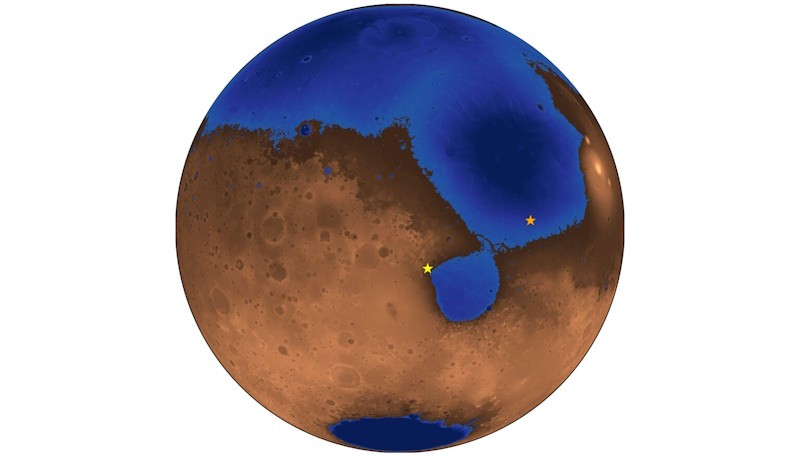
Mars today is a cold, dry, dusty planet with its only obvious water locked up in frozen polar ice caps. But billions of years ago, it appears to have had sandy beaches lapped by waves along the shoreline of a vast ocean. The latest evidence for beaches on Mars comes from a Chinese Zhurong rover that landed on the planet in 2021. During its short life it detected evidence of underground beach deposits in an area thought to have once been the site of an ancient sea, bolstering the idea that the planet long ago had large bodies of water.