
Just curious as what the lifespan is? Especially the mounts with the goto and gps. I know alot depends on the care they receive, but do optical coatings fail?
How long should a scope last?
Started by kevlvm, 07/09/2008 02:22AM
Posted 07/09/2008 02:22AM
Opening Post
Posted 07/09/2008 03:14AM
#1
Reflective coatings eventually degrade and fail, but those sealed inside a catadioptric scope like an SCT should last for many years, even decades. The motors, wiring, and electronics in that fancy goto mount will almost certainly fail first.
Antireflection coatings should last forever unless physically abused.
Antireflection coatings should last forever unless physically abused.
Joe Bergeron
Moderator, Astro-Physics Forum
Posted 07/09/2008 03:20AM
#2
Depending on the viewing conditions (humidity, salt spray in particular), the reflective coating on a mirror should last several years. Many of us have reflective coatings ten and more years old, showing no problems.
Anti-reflection coatings do not, to my knowledge, degrade with time.
As for mechanics. The basic mechanics can last a long time if cleaned and cared for. There is no reason for them to fail.... Having said that, we often let things slide, or something goofy goes wrong.
Things that can make mechanics fail are overloading (more precisely mis-balancing), which can lead to stalling and burned out motors, and simply not keeping them lubed or adjusted properly. Also dropping, etc, can cause premature failure.
As for electronic things, you may have problems with anything electronic. However, you usually have it in the first little bit (burn in time) or not for a very long time, meaning years and years. Assuming it is working after the 90 day warranty, and you watch the power supplies so that they provide the proper amount of power, the electronics can last forever. Not necessarily the wires that connect the electronics--but they are relatively easily replaced.
I would say that if you have a properly operating scope after the warranty period expires, and you take proper care of it, it could easily last dozens of years.....
However, new technology will make you want to move on long before that.
Alex
Posted 07/09/2008 10:25AM
| Edited 07/09/2008 10:27AM
#3

Kevin VerMerris said:
Just curious as what the lifespan is? Especially the mounts with the goto and gps. I know alot depends on the care they receive, but do optical coatings fail?
Telescopes, good telescopes, can be expected to last several lifetimes, essentially forever. If cared for reasonably well, there is really nothing to wear out. The coatings on reflectors do degrade with time but can last many years (30 years is possible) and recoating is relatively easy and inexpensive.
The mechanicals of a good quality mount also should last essentially forever. In general a mount is designed for stiffness and robustness in order to reduce vibrations and provide a solid platform. It is unlikely that the bearings will ever wear out as they are lightly loaded and run at very low speeds. Consider that the anti-friction bearings in a CG-5 class mount would probably do well as wheel bearings in a small car. The gear train may wear but a well made set of gears should last a long-long time.
The issues that limit the liftspan of a scope system are really in the proprietary electro-mechanical components. A mechanical problem can probably be fixed because if worse comes to worse, a new part can be machined. Simple drives such as one used 30years ago can be replaced with an entire new drive if the parts are obsolete, a telescope like the venerable RV-6 with it's simple AC drive will essentially last forever, they were last made 30 years ago and they still provide wonderous views.
The real issues in longevity is obsolescence of the electronic components. Sometimes a manufacturer just stops supporting a piece of equipment so the user is stuck in the event of a problem with the electronics. And sooner or later, the repair parts needed are no longer available, the technology is old and not supported by the chip makers. With a well made EQ mount, drives can always be retrofitted so the problem really comes down to complicated integrated systems like the ALT-AZ GOTO drives on SCTs, if/when Meade stopped supporting the LX-200s, one would be dead in the water with a failure.
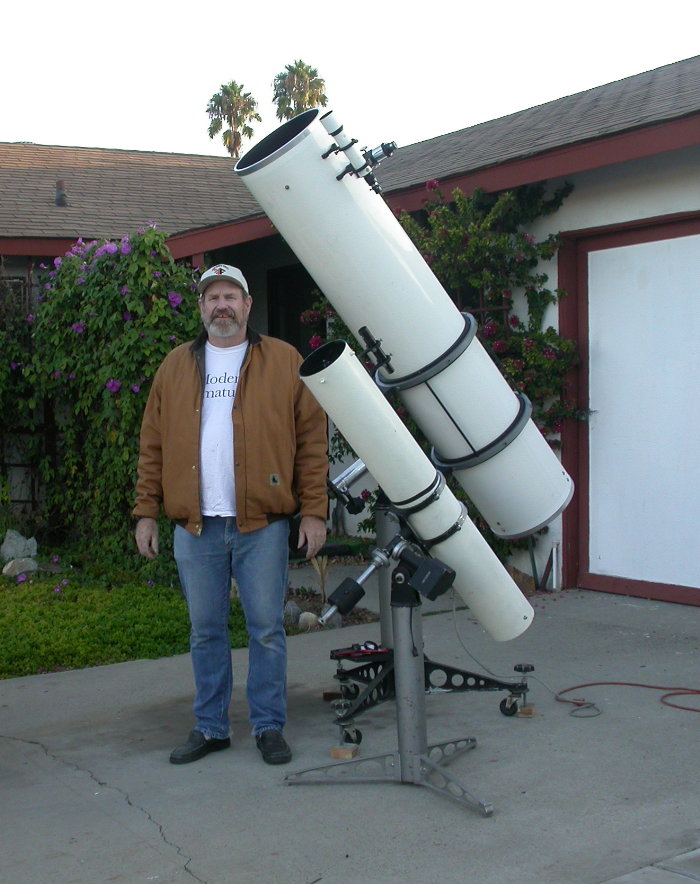
So in my view, a well made telescope and simple mount is a forever thing, assuming i care for them properly and maybe recoat the mirrors every so often, I expect them to outlive me by many years, even my scopes that are 30 or 40 years old already. The more complicated the electronics, the shorter the lifespan.
Here's a couple of scopes that are at least 30 years old and still looking at many more years of solid service...

JOn
Attached Image:
Posted 07/09/2008 11:43AM
#4

Kevin VerMerris said:
Just curious as what the lifespan is? Especially the mounts with the goto and gps. I know alot depends on the care they receive, but do optical coatings fail?
As Joe says, coatings will last a Real Long Time. At the university where I teach, I have a 1973 Celestron Orange Tube. Undoubtedly its primary and secondary have lost a little oomph over the years due to oxidation, but they still look as bright and shiney as ever and decliver good images.
Electronics. That's harder to quantify. Assuming they go the first 8 hours, and nothing bad happens (power spikes and surges, lightning, shorts) they should last a long time as well.
Chances are you will want a new scope before the old one gives up the ghost.
8)
Uncle Rod
Time on your hands?
Waste it with Uncle Rod's Astro Blog!
http://uncle-rods.blogspot.com/
Posted 07/10/2008 12:58AM
#5
Kevin
One thing that can be overlooked is the need to clean the front objective lens on a scope that has been out exposed to dew, pollen, dust and pollution for a number of nights. This is especially true for imagers, who may have their scopes pointed up for many, many hours. If not, these elements can start degrading the coatings and eventually even the glass.
Marcus Ludes recommended it be cleaned once or twice a year, depending on usage. Fred, at LSSTNR (the Takahashi main US distributor) spent about 20 minutes teaching me the safe and effective way to clean an objective with a dobbing action (no rubbing). They had a little cleaning kit for about $12 that has cleaned a number of objectives and is only half used up. I believe the TeleVue site also provides detailed instructions for this.
Hope this helps.
Steven Jindra
Funding Member
