Image of the day

Captured by
Michael Scherman

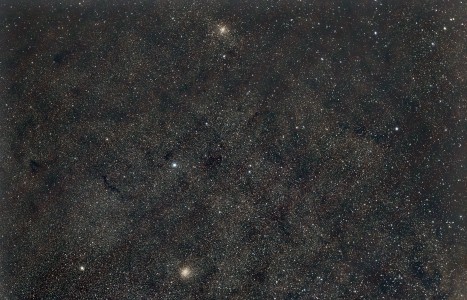
Dual Clusters near Antares

My Account

New to Astromart?

Register an account...

Need Help?

SCT or Refractor?

Started by aaronsland, 11/26/2002 01:51AM
Posted 11/26/2002 01:51AM Opening Post
If you had the choice of a SCT or Refractor, which one would you choose? Why?
I know this sounds silly but I am under the notion that aperture is everything. Bigger is better!
Believe me, I am very new to astronomy and am looking for an education I just want some educated discussion on the subject.

Nothing in education is so astonishing as the amount of ignorance it accumulates in the form of inert facts.
Posted 11/26/2002 02:10AM #1
well i chose the long focus refractor, 6", and it smokes the 8 inch reflectors, i didn't like giving up the sweet spot, you know the center, and the long focus gives great deep sky. john
Posted 11/26/2002 03:59AM #2
Reading this question takes me back several years ago when I was trying to decide on my first scope. In fact it’s a tough question to answer in a couple sentences. You really need to ask yourself some questions first. One, are you just interested in planets or deep sky? What is your budget? How easy is to get to your observing site? Meaning, are going to have to drive somewhere else to get away from light pollution?
I found through personal experience that bigger is not always better. Since you are new to astronomy I would recommend that you get a small refractor or even binoculars and learn the sky. See if you’re going to stick with this hobby. Lots of people fell out of astronomy because the scope they purchased was just too big. And took up a lot of time to set up not to mention heavy. The best telescope you could purchase is one that you are going to use! As for me, I have a SCT (12” LX200 GPS), a 80mm refractor and 12 x 60 binoculars and I loved them all. In fact I’m looking at getting an 18” Newtonian and 102mm refractor. You’ll find out if you stay in long enough, that the equipment is as much of the hobby as stargazing is.
The SCT, refractor and the reflector all have their place, their strong points and some short comings. You'll find that quiet a few people have several scopes for theses different reasons. But avoid aperture fever to start with! A 4" refractor is a good starter scope. And I'm not talking about anyting at Wal-Mart. Celestron has a model called the C102. I owned one and found it to be a very nice scope. And the price is in the comfortable range for most. Or you can pick up a nice 4" scope here on astromart. I've seen some good deals. Hope this helps :-)

Clear Skies,
David Pope
Posted 11/26/2002 05:00AM #3
Aperture is everything on Deep Sky Objects. The only draw back of SCTs is that you always see big blobby stars, and often don't get good views on planets.

I have a C8 and a 4" APO refractor. The C8 kills the refractor on DSOs. The refractor kills the C8 on the brighter double stars. The refractor is somewhat better than the C8 on planets.

I also have an old University Optics 80mm f/6.25 short refractor. I recollect elderly beginners looking through the various telescopes at a club viewing night. They were being shown all sorts of nebulas and galaxies in 8 and 10" telescopes. Toward the end of the night, they looked at a few big open clusters in Scorpius through my little telescope. They later quitely told me that the best views of the sky they'd had all night were those through my little refractor. There's certainly something aesthetically appealing about refractors.
Renato


Posted 11/26/2002 11:41AM #4
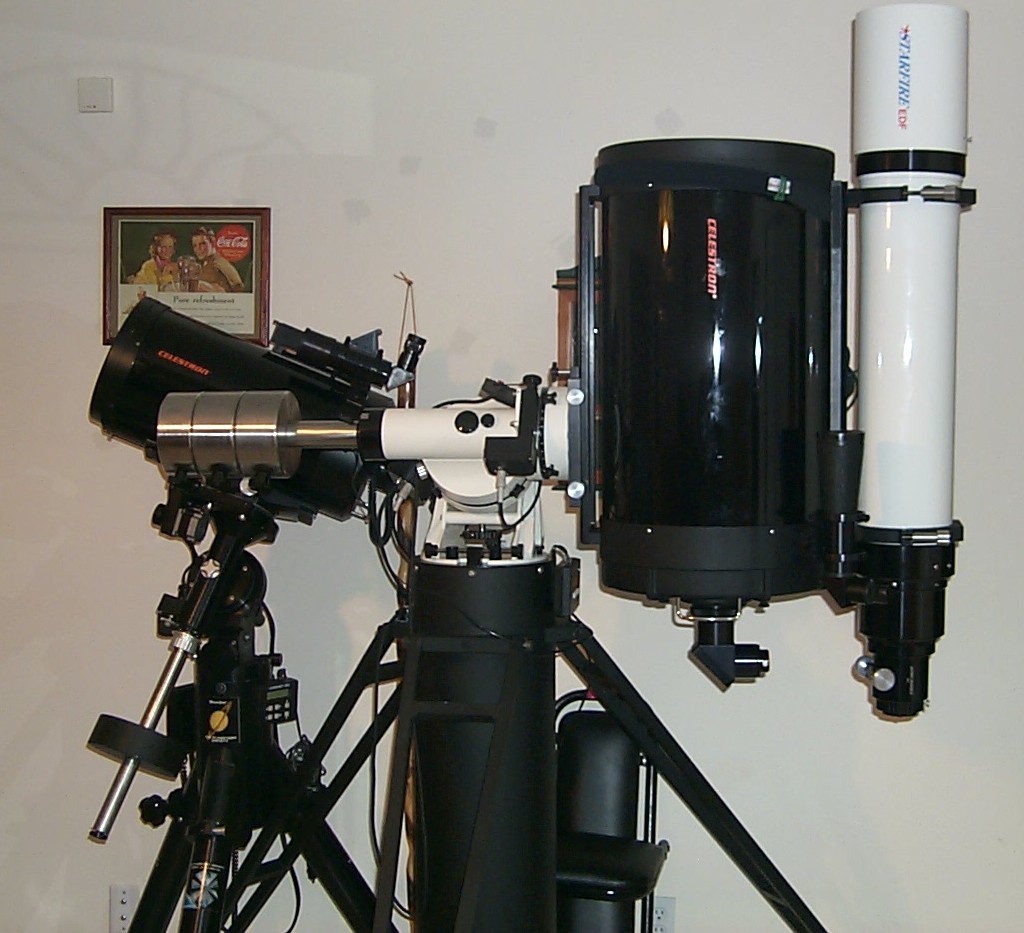
I have a TMB 100/800 which was great for lunar and planetary and acceptable for DSOs. I then got aperture fever after looking thru an AP 5" and not wanting to take a hit on my TMB and wanting to keep my GM-8 and Giro GR-2 mounts , I got a Tak Mewlon 210 (f-11.5) instead. Now I dual mount it on my Giro side by side with the TMB and have the best of both worlds. I find that for DSOs the Tak obviously wins and gives pretty sharp images.(the TMB, however, is no slouch) On lunar and planetary, during nights of steady seeing at a dark site, the Tak, if collimated correctly will show more detail at higher mags over the TMB. But in the back yard or at times of marginal or turbulant seeing the, 4" APO wins. (for EPs, I used a Nagler 9mmT1 and 12mmT2 with a 4x Powermate on the TMB and sans the Powermate on the Tak)

Posted 11/26/2002 05:10PM #5
See what you started! :-) I knew this was going to happen.

Clear Skies,
David Pope
Posted 11/26/2002 06:00PM #6
Michael,

Its tough to beat a quality, used SCT on a fork mount. Depending on the model and condition, you can get a very useful instrument between 600 and $1200. They're easy to setup, comfortable viewing position and scale nicely as observing interests grow (both recreational and scientific). If you can, try to attend a star party and look thru some. And the most important point here, make sure the optics are collimated (ask the owner!). Collimation is crucial to an SCT, and is very easy to do.
Posted 11/26/2002 06:03PM #7
Throughout the discussions like these, no one ever seems to mention the venerable 6" reflector, so I will. There is a reason that a 6" Newtonian on either a Dobsian or equatorial mount was the mainstay of amateur astronomy prior to the SCT and a reason it has stormed back on the scene. Because it is an all-purpose, portable instrument that is versatile for just about every type of observing - particularly for the beginner or intermediate.

A high-quality 6" f/8 or f/5 Newtonian is razor sharp and provides both excellent deep sky images that come close to and 8"SCT and outstanding planetary views that rival a 4" refractor (moreso with the f/8). It is very portable, cools down quickly, and best of all, is extremely affordable. A complete set up can be had for $500. You can even sell resell it quickly if you want to upgrade in the future. And, should you happen to lose interest later on (heaven forbid), no great loss.

I own a 4" refractor, 6" f/5 Newtonian with excellent optics and an 8" SCT. The 4" and 8" just collect dust because the 6" Newtonian is convenient, easy to move and use and is the best balance for general observing. It has given me some of the best deep sky and planetary views I have ever had.

That's my 2 cents worth.
Posted 11/26/2002 07:31PM #8

Of course this is nearly a religious discussion. Here's what I think : if you compare apples to apples, i.e., similar money invested, an SCT will give you much more aperture in a package of about the same portability (especially at larger apertures), good performance on planets (higher resolution, but less contrast) and hands down much better performance on DSOs. They do complement each other nicely, but since you asking about choosing one over the other, I'd go SCT no question, except if you never want to look at anything but planets and double stars.

Why? If you want a refractor to perform comparable to a much larger aperture SCT on planets, you have to get a good one. A decent 4" refractor, like a Vixen 102, will already cost you as much as or more than a decent 8" SCT and the SCT will perform better - aperture does rule. A really good 4" APO refractor, like a TV or Tak 102, costs - without a mount - as much as fully loaded 10+ inch SCT with goto and the works, and still won't outperform it especially holding it free hand . With another grand into a mount, the stars may be floating on a "velvety" background and the refractor will have better contrast, but you won't see that much more through it as the SCT will have 2-3 times the resolution.

To get decent DSO performance, you'll need at least a 6" refractor and for it to still be refractor-great on planets, you're talking say 10 grand (like a TAK FS-152) which will now easily buy you a 16 inch SCT, or a huge dob. Neither one is very potable, the dob the most still since it comes apart. There are cheaper 6" refractors, but they can't compete with a larger SCT on anything.

The bad rep SCTs sometimes get for planetary viewing is IMHO because many are not collimated right. Doesn't take much being off collimation to underwhelm on planets. It's not hard to fix, though.

That's not to say a really good APO isn't a super scope, and yes, in terms of contrast, they can't be beat. It's just that you are paying a lot of money for a relatively subjective improvement in performance (i.e.,. the "velvety sky" high-contrast thing) in a small area of observing, while giving up a lot in other areas, including DSO and money. Every scope has its niche, what you're willing to pay for it is in the eye of the beholder.


That all said, you'll enjoy any good telescope. Someone else mentioned MAK-Cass's and Schmidt- or MAK- or just plain Newtonians: All still have central obstructions, though maybe a little smaller, so a refractor will still have better contrast. MAK-Casses are pretty pricey compared to SCTs as well, Newtonians may be cheaper but much larger at a given aperture.

There is no perfect scope. I think:
Best compromise: 10”+ SCT, especially if is has a 3 or 4" relatively fast refractor buddy (widefield, so doesn’t really have to be APO).
Planetary only = long focal lenght 3 or 4" APO
DSO only = huge dob
On a budget: Newtonian
Posted 11/27/2002 02:15AM #9
Michael,

If you ever find the right answer please let all of us know. As you can see we are a bunch of confused amateurs!

I still can't make up my mind ........

Regards,

Angel


Attached Image:

astrodog's attachment for post 63511