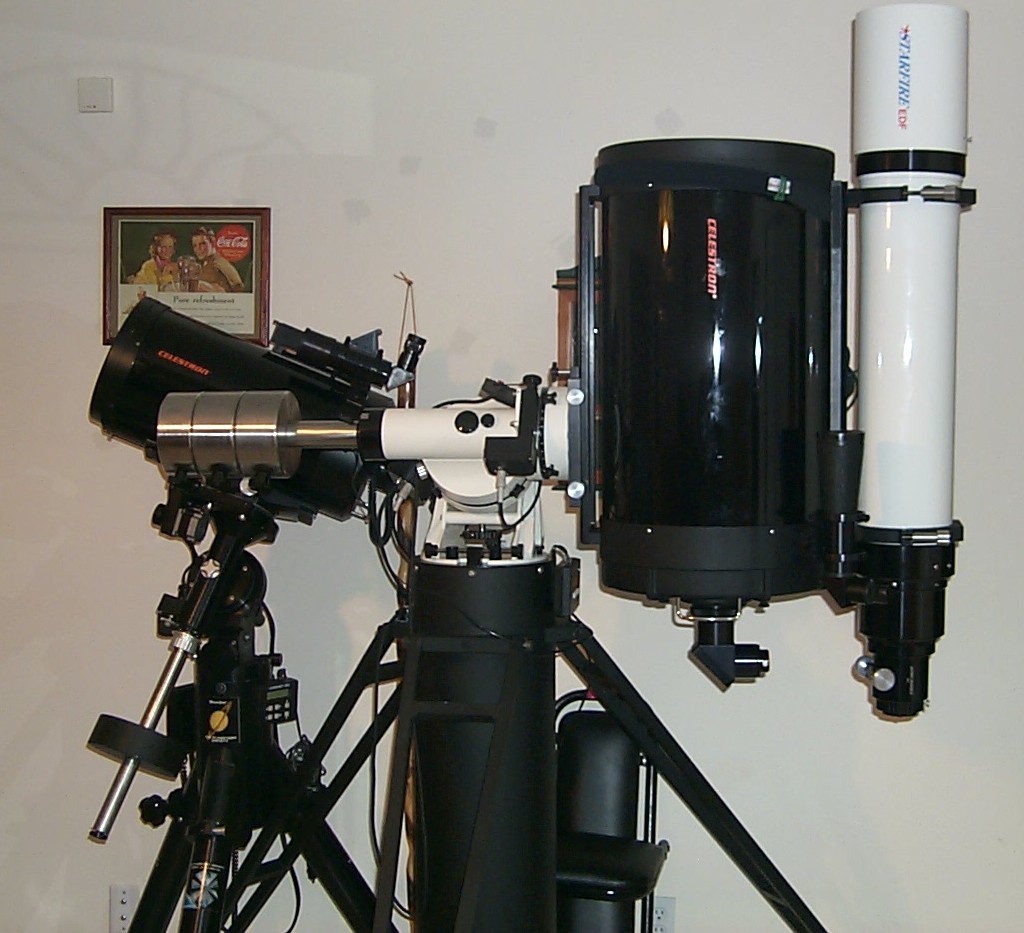
Of course this is nearly a religious discussion. Here's what I think : if you compare apples to apples, i.e., similar money invested, an SCT will give you much more aperture in a package of about the same portability (especially at larger apertures), good performance on planets (higher resolution, but less contrast) and hands down much better performance on DSOs. They do complement each other nicely, but since you asking about choosing one over the other, I'd go SCT no question, except if you never want to look at anything but planets and double stars.
Why? If you want a refractor to perform comparable to a much larger aperture SCT on planets, you have to get a good one. A decent 4" refractor, like a Vixen 102, will already cost you as much as or more than a decent 8" SCT and the SCT will perform better - aperture does rule. A really good 4" APO refractor, like a TV or Tak 102, costs - without a mount - as much as fully loaded 10+ inch SCT with goto and the works, and still won't outperform it especially holding it free hand . With another grand into a mount, the stars may be floating on a "velvety" background and the refractor will have better contrast, but you won't see that much more through it as the SCT will have 2-3 times the resolution.
To get decent DSO performance, you'll need at least a 6" refractor and for it to still be refractor-great on planets, you're talking say 10 grand (like a TAK FS-152) which will now easily buy you a 16 inch SCT, or a huge dob. Neither one is very potable, the dob the most still since it comes apart. There are cheaper 6" refractors, but they can't compete with a larger SCT on anything.
The bad rep SCTs sometimes get for planetary viewing is IMHO because many are not collimated right. Doesn't take much being off collimation to underwhelm on planets. It's not hard to fix, though.
That's not to say a really good APO isn't a super scope, and yes, in terms of contrast, they can't be beat. It's just that you are paying a lot of money for a relatively subjective improvement in performance (i.e.,. the "velvety sky" high-contrast thing) in a small area of observing, while giving up a lot in other areas, including DSO and money. Every scope has its niche, what you're willing to pay for it is in the eye of the beholder.
That all said, you'll enjoy any good telescope. Someone else mentioned MAK-Cass's and Schmidt- or MAK- or just plain Newtonians: All still have central obstructions, though maybe a little smaller, so a refractor will still have better contrast. MAK-Casses are pretty pricey compared to SCTs as well, Newtonians may be cheaper but much larger at a given aperture.
There is no perfect scope. I think:
Best compromise: 10”+ SCT, especially if is has a 3 or 4" relatively fast refractor buddy (widefield, so doesn’t really have to be APO).
Planetary only = long focal lenght 3 or 4" APO
DSO only = huge dob
On a budget: Newtonian