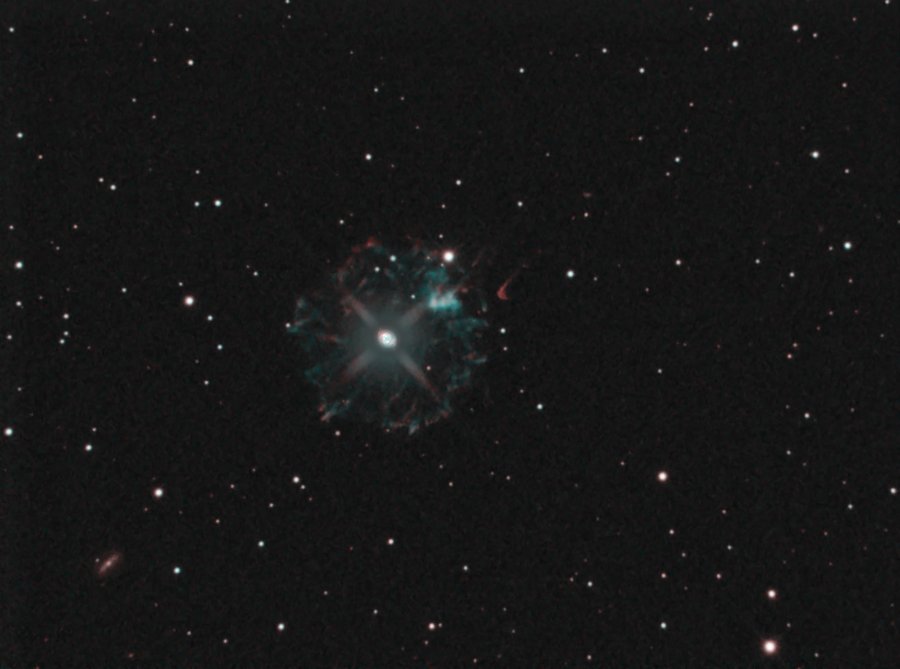
I wanted to test the limits of my new DBA Certified 10" Newt as far as resolution goes, so I gave the Cat's Eye nebula (NGC6543) a try. Since the moon was very bright, I know I wanted to try narrow band imaging. I looked around, and it seems it is dominated by Ha and OIII, so that's what I tried (Ha as R, OIII as GB)
I wanted to capture the core and the dim outer edges in the same exposure (not one set of long and one short), which drove me to take very short subexposures, particularly for narrowband. But, hey, I have an SXVH9!!! Using the CCDWare subexposure calculator and measured background levels, I figure my read noise was about 25% of Sky noise rather than the recommended 5-10%...oh well.
Being circumpolar, I could get a lot of up-time on it. Astro twilight is about 11pm (I hate daylight savings time), which is when I started imaging. I let it run for an hour and then went to bed and set my alarm for 3am...happily, everything went well!
The dim shell took a lot of processing to get it reasonable, but I was very surprised to see a good amount of detail...Ha is definitely way different than OIII. Ha seems to be at the outer fronts more.
To get as much detail as possible in the inner portion, I enlarged the images by 300% and then combined them. I had a HUGE amount of signal there, since the core was at the upper end of the histogram for each exposure and I had 136 of them!. The stacked image took deconvolution vey well, and I was left with some pretty small and subtle details. I did the traditional "paste the dimmed core into the processed shell" technique and liked the result. The large cross in the middle is the diffraction spikes for the nebula iteself.
http://www.ricksastro.com/DSOs/NGC6543wide.shtml
Rick Krejci
I wanted to capture the core and the dim outer edges in the same exposure (not one set of long and one short), which drove me to take very short subexposures, particularly for narrowband. But, hey, I have an SXVH9!!! Using the CCDWare subexposure calculator and measured background levels, I figure my read noise was about 25% of Sky noise rather than the recommended 5-10%...oh well.
Being circumpolar, I could get a lot of up-time on it. Astro twilight is about 11pm (I hate daylight savings time), which is when I started imaging. I let it run for an hour and then went to bed and set my alarm for 3am...happily, everything went well!
The dim shell took a lot of processing to get it reasonable, but I was very surprised to see a good amount of detail...Ha is definitely way different than OIII. Ha seems to be at the outer fronts more.
To get as much detail as possible in the inner portion, I enlarged the images by 300% and then combined them. I had a HUGE amount of signal there, since the core was at the upper end of the histogram for each exposure and I had 136 of them!. The stacked image took deconvolution vey well, and I was left with some pretty small and subtle details. I did the traditional "paste the dimmed core into the processed shell" technique and liked the result. The large cross in the middle is the diffraction spikes for the nebula iteself.
http://www.ricksastro.com/DSOs/NGC6543wide.shtml
Rick Krejci
Attached Image:


