Image of the day

Captured by
Lawrence Parchman

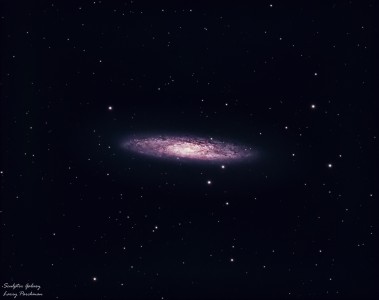
Sculptor Galaxy (NGC 253)

My Account

New to Astromart?

Register an account...

Need Help?

Horsehead and Flame

Started by vbert, 12/09/2005 07:02PM
Posted 12/09/2005 07:02PM | Edited 12/10/2005 01:53AM Opening Post
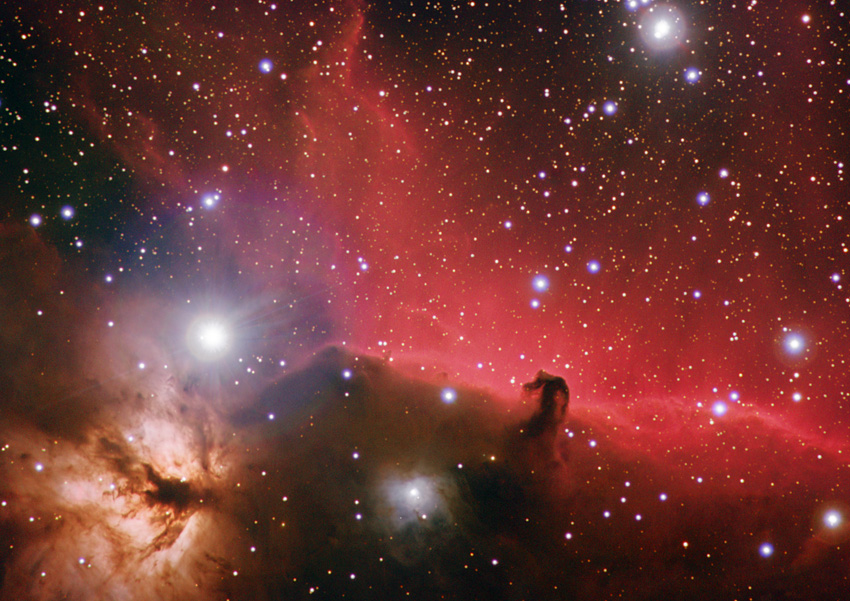
Well this is my first attempt at RGB processing so take it easy on me 8) . Although I have some fairly good data I'm getting huge reflections in the blue channel which destroys an otherwise OK image. Its not from chromatic abberation in the OTA. There is something going on between the CCD cover slip, or cover glass and the filters. Not to sure if they can be processed out or not, especially the gigantic blue cloud around Zeta which turns purple when blended with the R. Thanks for looking, Vince

Borg 77ED ST-2000XM
HaRGB 360:90:90:90
Used the Ha for Luminance at only 25% weight. To realize the full potential of the Ha without messing up the color I may have to try a blend of Ha+R for the red channel.
Attached Image:

vbert's attachment for post 28571
Posted 12/09/2005 09:19PM | Edited 12/09/2005 09:21PM #1
Hi Vincent,

Very well done! As you have found out this is a very hard region to process due to Zeta Orionis and other stars. The halos are internal reflections generally from light reflecting off the CCD chip -- back to the coverslip -- then back to the CCD chip. Here is an excellent review by Don Goldman:

http://www.astrodon.com/documentation/documentation.cfm?DocID=3

The halos can be processed out but really don't distract from a well done image. The only way to not get halos is buy a camera that doesn't have a CCD coverslip such as made by FLI or Trifid. All SBIG cameras have coverslips.

Best,

Tom

Starsearch Observatory
Lat 42N 47' 00" Long 112W 10' 47"
Elev 1752m
www.tvdavisastropics.com
Posted 12/10/2005 03:20PM #2
That is, indeed, most excellent, Vincent.
I'd show you my first RGB, but I destroyed all copies to avoid embarrassment and to avoid blackmail.
As you can see, the long RGB exposures provide rich color.
As Tom indicated, this area is a minefield for reflections and most imagers just leave them in.
Congratulations on a fine image.

dan kowall
photonhunter.com
Posted 12/10/2005 04:18PM #3
I think it is fantastic! The reflections don't detract at all.

"The expression of the beautiful is in direct ratio to the power of perception acquired by the artist." (Gustave Courbet)
Posted 12/10/2005 07:12PM | Edited 12/10/2005 07:13PM #4
Thanks for the kind comments guys. The RGB processing is alot more challenging than I expected. Its interesting that if you stare at an image with messed up color long enough, it starts to look good to your eye. Then you walk away from the screen and when you come back....WHOA! how did it get that messed up?? 8O
Posted 12/12/2005 12:19AM #5
Vince,
I like the shot a lot. Nice color, nice Horsehead. I guess the ST-200XM anti-blooming works good for you. Imagine the processing you would have gone through with an ST10.

I believe I too am struggling with some glass interface reflections. I think I'm going to go through a range of trial shots to see which glass causes the most problem - it will be interesting to see.

Jim Thommes

Mak-Newt 152 mm
C8
Megrez II APO
Zenithstar 66 mm APO
G11/Gemini
ST8300M
Artemis285 Camera
Canon 350D DSLR

http://jthommes.com/Astro/
Posted 12/12/2005 05:10AM #6
Very, very nice for a first attempt at RGB imaging. Thomas' explanation is correct--you do have a problem with refelection from the CCD back and forth with the coverslip. However, you also do have some slight CA in there, too. That Borg is not a perfect apochromat, and the halos around even the dimmer stars show that. All but the absolute best APOs will have that problem and you can just process it out. Takes a little extra work, that's all.

Great first RGB--one to be proud of.

Jeff

Jeff 8O
