Image of the day

Captured by
Michael Scherman

M17 Swan-Omega Celestron C6 Hyperstar2

My Account

New to Astromart?

Register an account...

Need Help?

M8 central region (high resolution)

Started by tvdavis, 01/21/2006 01:38AM
Posted 01/21/2006 01:38AM Opening Post
Hi Everyone,

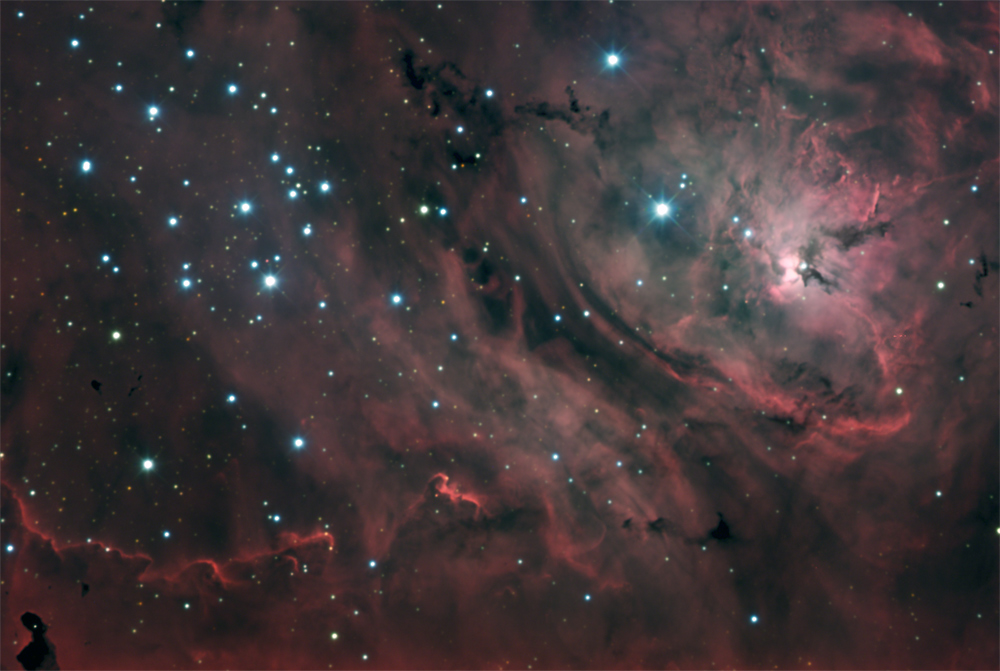
I've still been clouded out so I have been processing some of Jim Misti's data taken from Misti Mountain Observatory in Arizona with his 32" RC and STL-11k. This first image is a high resolution FOV of the central region of M8. Numerous turbulent gas clouds are present and the detail is fascinating. My little scope can't even come close to this! Anyway, I thought it looked pretty neat.

Details: http://www.tvdavisastropics.com/astroimages-1_00004a.htm

Best,

Tom Davis
Inkom, ID
Attached Image:

tvdavis's attachment for post 29274

Starsearch Observatory
Lat 42N 47' 00" Long 112W 10' 47"
Elev 1752m
www.tvdavisastropics.com
Posted 01/21/2006 01:41PM #1
Wonderful shot...very interesting detail...
Thanks for posting, Thomas! 8)

Ivan Gastaldo 8)
Coconut Creek, FL

Ivan's Observatory
Lat 26N 16' 48" Long 80W 10' 48"
[COLOR="Red"]Personal Website:[/COLOR] http://www.ivangastaldo.com

CCD Imaging and Processing/Deep Sky - Moderator
I like to complain about everything - Moderator
Posted 01/21/2006 04:33PM #2
>> My little scope can't even come close to this!>.

You would be surprised what your little scope could do with an H-alpha filter. The resolution shown in this 32" image is not all that great. Consider this image by Gleason taken with a scope just 1" larger than your 6": http://www.celestialimage.com/page213.html
If you look closely, the resolutions are similar. Just the color is missing, but you can always add that later to the H-a image.

Roland Christen
Posted 01/21/2006 11:41PM #3
hi,

very nicely done.

I agree with Roland that resolution is not limited to large
aperture scopes. Most sites in the US have an average seeing of about two
arc seconds. Assuming a ST10 camera and 3 pixels per unit of seeing this can be
achieved with a 8" scope ( a 16" scope for 1 arc sec seeing ).
Beyond that larger aperture means you get achieve a higher s/n ratio per unit
time of image accumulation, assuming sky noise limited exposures.

Larry Citro
