Image of the day

Captured by
Shane Yarnall

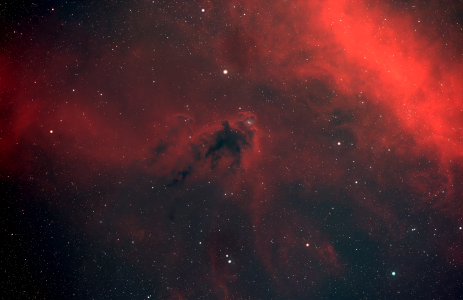
LDN 1622

My Account

New to Astromart?

Register an account...

Need Help?

NGC3621

Started by gregbradley, 02/26/2009 11:40AM
Posted 02/26/2009 11:40AM Opening Post
A beautiful spiral galaxy.

I was very happy with this one as looking at examples of this galaxy on the net I have only seen it shown as the brighter inner spiral core. The fainter outer arms are not seen.

I used a Baader clear filter for luminance. This has no UV/IR block so it lets a bit more light through.

Also the fluorite lens of the TEC180m FL is showing its strength here with less scatter than other lenses and slightly more throughput. I first noticed this feature of fluorite lenses with a Tak FS152. My dark site has virtually no light pollution and is usually very transparent. Seeing is usually pretty good although one night it wasn't when I took this image.

TEC180FL at F7, FLI ML8300 camera.

ClearRGB 160 50 60 60

http://www.pbase.com/gregbradley/image/109598263

Greg.

Posted 02/26/2009 12:17PM | Edited 02/26/2009 12:18PM #1
Lovely image Greg...the FLI 8300 is an excellent match
for your TEC small pixels & all. Did you see the new Sky & tel ? They provided a nice review of the FLI 8300
This cam is definately a winner in both price point and performance !

Broose

Broose K

Wonderful Wife wink
Posted 02/26/2009 01:23PM #2
Beautiful image Greg!

The arms on this sure do look like they would be extremely faint,great job bringing them out.


Jason
Posted 02/26/2009 05:55PM #3
Wonderful shot, Greg! Agreed, that's a beautiful galaxy!

Eric
Posted 02/26/2009 07:36PM #4
>>Also the fluorite lens of the TEC180m FL is showing its strength here with less scatter than other lenses and slightly more throughput.>.

Both those statements about scatter and throughput are not correct.

1) Your triplet lens has two other elements of ordinary optical crown, so even if the fluorite was replaced by air or vacuum, the two other glasses are still there.

2) ordinary optical glass has insignificant scatter in the scheme of things. It is almost all back scatter and very little forward scatter. The light that is scattered goes in all directions, especially back out the front of the lens (that's why you can see the faint laser trace) and almost none of the energy reaches the film plane. Unlike a mirror, where almost all scatter goes into the direction of the film plane, optical glass has almost zero focused forward scatter. That's why normal optical crown can be used in coronagraphs where no scatter can be tolerated, and mirror coatings cannot be used at all due to forward scattering.

3) the light transmission of optical crown and fluorite is almost identical over the visual wavelength range from near IR to the edge of the UV. Only in the UV does fluorite transmit more light, but that is not a useable wavelength, plus the other cover glasses of a triplet absorb light there anyway. You will not be able to measure the diffrence in transmission between a fluorite and an ED oil spaced triplet.

Lenses in general, and oil spaced triplets in particular, have very high light transmission efficiency. Refractor tubes can be ideally baffled to prevent stray light. If the figuring is good, then you can get very good focused energy into the image, which allows you to stretch it to extract ectremely faint detail. It has zero to do with the fluorite, but everything to do with the way the scope is built.

Tony Hallas discovered this himself when he was experimenting with various refractors at his deep sky site. He found that he could go far deeper with a refractor than he could with his 14.5" Cass before background light intruded into the image. Example is his latest M81/82 image, among others, which shows extensive faint extra-galactic dust around those galaxies. His scope is a 206mm F8 triplet apo, non-fluorite: http://www.astrophoto.com/M81M82.htm
I also have a preliminary Rosette which he has not published yet, but which he will show at NEAF. It has faint detail in the core that I have not seen in any amateur photo. No fluorite was needed, just a well baffled oil spaced triplet refractor.

Rolando
Posted 02/26/2009 10:37PM #5
Wow! That's a sweet image. I'm not familiar with this target, but I sure like your version.
Cheers,
Tyler

"The expression of the beautiful is in direct ratio to the power of perception acquired by the artist." (Gustave Courbet)
Posted 02/27/2009 04:58AM #6
Gorgeous galaxy shot Greg !

Regards


LouieĀ  8)

www.atalas.net
