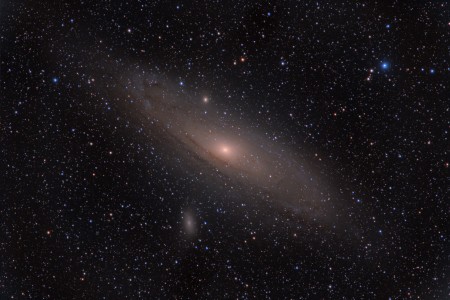
I cannot understand why folks are still using film cameras for any kind of photography. Is it some kind of masochistic tendency? With film, you first make an exposure, and wait for some period of time to see the result. If the image is satisfactory you then scan it and digitize it and probably digitally enhance it. Go digital and be instantly gratified or instantly disappointed. Will somebody please tell me how film is superior to a four to five megabyte jpeg image.
WHY FILM?
Started by streets, 09/20/2006 02:33PM
Posted 09/20/2006 02:33PM
Opening Post
Posted 09/20/2006 04:22PM
#1
Hear Hear Ed!!!
I too like film. While Digital may save a few bucks in developement costs, It isn't prone to the constant technology shifts and potential for technology failure as digital might be.
The other advantage is that for those of us who take great pleasure in astrophotography and are on a limited budget, film is a great value. it would be nice to have both film and digital, but until digital slr's reach the point of being in the same price range as film slr's, digital will not be a priority for me.
I can think of far better uses for my money than trying to keep up with the Nikon Joneses.
David Eccles
Lompoc, CA
Posted 09/20/2006 06:44PM
#3
Doing something because "everybody else does it" shouldn't be a valid reason.
Instant gratification isn't for everyone. In addition, digital cameras cannot match film for Field of View...especially in the medium and large format. Of course, you can always mosaic a set of digital images. Also, a scanned 35mm frame can provide 100+MB of lossless data which would reveal much more information than a 4-5 MB JPG.
It's also as well to ask why people still sketch what they see at the eyepiece.
Some folks, like myself, work with digital imaging on a daily, professional basis. As in the design and testing of imaging systems in an R&D type setting. I'm not saying I don't enjoy what I do for a living, but using film for astrophotography provides a break away from the routine. No computers required! I also have a heck of a lot of Technical Pan Film stored away to use up, since I wasn't able to try it when it was still being manufactured. That means I'll be developing it myself, and never having used a darkroom when it was the "in" thing means I am fascinated by the process. As far as Tech Pan is concerned, nothing digital can yet touch it for resolution. Pixels are just not that small yet.
Choosing to use chemistry rather than electricity to capture photons doesn't make the process wrong or anachronistic. I've heard that teenagers who are able to work in a darkroom at their school (ie yearbook staff or chemistry class, etc.) say that, having grown up with computers and digital equipment from the time they were born, it is actually pretty cool and refreshing to get to work with film and chemicals. I can understand completely where they are coming from.
So basically, "Because film is cool."
-Jason
Posted 09/20/2006 07:39PM
#4
In one word....KODACHROME.
For about 70 years Kodachrome has ruled in color photography. Pros still use it. A Kodachrome 35mm transparency is equivalent to a 10 Gigabyte digital image in resolution at the very least. Talking your digital mere megabytes of jpeg makes me laugh. Any digital scan of a 35mm Kodachrome slide has destroyed some information that I have seen. I couldn't even focus on grain when enlarging a 35mm slide when I was a Navy photographer as it was too fine to find with a standard B&W film grain focuser. 35mm Kodachrome slides are virtually grainless, if you ever saw a slide show by a photograper that knew how to use Kodachrome. It's about the only film where nonphotograpers have asked me what kind of film and camera I was using. You KNOW when a 35mm Kodachrome slide pops into view if they are mixed in with any other type of transparency film. Nothing has closely duplicated it.
Remember, few camera lenses will be up to the task of getting the most out of Kodachrome. They have to be high end Nikkor, Zeiss, Leitz, Zuiko, Pentax, Canon, etc. We used Kodachrome to test camera lenses. With lesser films, you can use lenses to test the film. Kodachrome could show defects in the best camera lenses. In astrophotography, you probably can't use its superior resolution limits due to mount movement. Kodachrome 25 had the lowest reciprocity failure and color shift of any film I used at low light levels.
I do important travel photos in Kodachrome if I can. The slow speed survives airport x-ray machines better than other faster films if you keep it in a lead lined bag. Of course, a strong argument can be made for digital for travel. I hate packing all that 35mm camera gear. Nothing beats the Kodachrome slide show, however. The downside is the few labs that still do Kodachrome processing and the process is quite toxic and far beyond the limits of an amateur film developer in the knowledge of organic chemistry and the precision of developing steps that is mandatory. It is only cost effective in a large continuous processing scenario. Mini labs cannot do it, and you wait two weeks for the slides.
Maybe digital will catch up to it some day. It would be nice, because I don't like the Kodachrome development toxicity and need to send to Kodak for developing.
In getting the most amount of resolution in the shortest exposure time, film still wins. It will be used for high speed, high resolution scientific work and such until digital catches up. It's sort of like vacuum tubes in that solid state devices simply can't surpass vacuum tubes in some areas such as high frequency, high power radio transmission or x-ray production. The needed use of film is limited, but it's still there.
Those of the instant gratification generation will have to be satisfied with digital images, or shoot very expensive Polaroid instant films.
Posted 09/21/2006 01:09AM
#5
Ron,
I think there is still some appeal to film for astrophotography as you can get a GREAT result with limited funds and limited trouble, as long as you insure you have the basics down in getting the image such as focus, tracking, but then again, this is needed regardless of whether you are digital or not.
Yes there are some stunning dslr images out there, but they are from a $700+ camera, a gazillion short images stacked, aligned and processed up the wazooo, to get that result. If you look at your basic entry level image, it is pretty crude, little depth, not much color.
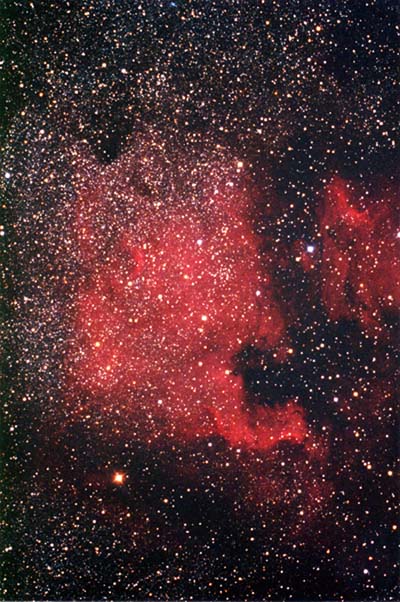
Now I don't profess to be any kind of expert, but as an example, the following image is a single 20 minute image with basically no processing scanned on my flatbed scanner from a print with a minor contrast stretch. The camera is a OM1, that is worth what, 50 bucks? This was first "guided" deep sky image.
By the way, I have a DSLR and I rarely use it for imaging other than moon shots as it is kind of a pain.
Kevin
I think there is still some appeal to film for astrophotography as you can get a GREAT result with limited funds and limited trouble, as long as you insure you have the basics down in getting the image such as focus, tracking, but then again, this is needed regardless of whether you are digital or not.
Yes there are some stunning dslr images out there, but they are from a $700+ camera, a gazillion short images stacked, aligned and processed up the wazooo, to get that result. If you look at your basic entry level image, it is pretty crude, little depth, not much color.
Now I don't profess to be any kind of expert, but as an example, the following image is a single 20 minute image with basically no processing scanned on my flatbed scanner from a print with a minor contrast stretch. The camera is a OM1, that is worth what, 50 bucks? This was first "guided" deep sky image.
By the way, I have a DSLR and I rarely use it for imaging other than moon shots as it is kind of a pain.
Kevin
Attached Image:
Posted 09/21/2006 05:08PM
#7
Interesting discussion all the way through.
However, when you go to see what people are producing nowadays, I think you will see that astrophotography is better today than it was ten years ago. The pictures we see on our screens, and the pictures we see on paper at exhibitions are better than they were a while ago. Why?
I think part of it has to do with the ST-4 and later autoguiders. In the olden days, when one had to guide by eyeball and hand, people gave up on astrophotography before they got really good at it. Now, they can keep at it because the at-the-telescope drudgery is no longer a problem. So, while somebody may have been an astrophotographer for four or five years a long time ago before giving it up, people today stay at it for a lot longer, and develop better techniques.
A second observation. Any photographer will tell you that how you are viewing the photograph has a lot to do with your imaging medium. And nowadays, we are viewing most of our images over a computer screen that is approximately 1280 pixels wide. SO, how many megapixels does that take? The argument that a 35 mm film image has Billions of pixels is largely immaterial if we are viewing over a screen that is only using a Megapixel and a half. (And counting grain and other film gremlins, just how many pixels does a 35mm piece of film have?) Furthermore, how many of us really understand how to print a color film photograph? Fact is that nearly all photographs today are processed in a computer, printed on a digital printer, and/or viewed on a digital screen--so the argument that film is inherently superior to digital just does not apply.
As to the argument that the cameras are changing so much that the digital medium is not "stable..." well.... How many of us are still riding horses just because the automakers have not yet decided between conventional internal combustion, diesel, hybrid, and hydrogen?
Fact is--images are better today than they were ten years ago. And more people are doing them in a hobby (astronomy in general) that has remained at best static in overall numbers. And I think the reason is largely because digital images are better and easier to do than are film images.
Alex
Posted 09/24/2006 07:00AM
| Edited 09/24/2006 07:07AM
#8
Easy.. Film still is the BEST tool for SOME aspects of astrophotography. Unless you have TENS of thosands of dollars to invest in equipment, there is no digital setup that can compete with medium format film.
Check out this site to see what I mean:
-- http://www.ifa.hawaii.edu/ifa/astrophotography.htm
For the person on a very limited budget, you can do a lot more with film than with digital.
Film is MUCH more forgiving than CCD imaging, precisly because it is less sensitive. Also, field of view is unmatched with film. Do you have any idea what a CCD system would cost that has the same resolution AND field of view of a 35mm frame? What about a 60x70mm medium format negative?
Here is a shot I did with film. It was taken with a stock Meade LXD75 8" Schmidt Newtonian.
- http://www.petesastrophotography.com/M20-full.jpg
This is a SINGLE, unfiltered 30 minute exposure. To show what film can record, this is a COMPLETELY untouched slide. No computer processing of any kind. It is also the ONLY time I have ever photographed this subject. One shot. Fist attempt.
And here is another example of why I shoot with film:
http://www.petesastrophotography.com/M31.jpg
There is no digital camera that can do this for $50. That's what my OM-1 cost today.
Also.. no CCD imager could capture this FOV with the Meade SN8... unless you spend more than my car cost.
As far as quality.. while these should have demonstrated that film works well for astrophotography, here is one that really shows a side-by-side comparison. It's between a $7,000 CCD setup on the LEFT and my $1500 film setup on the RIGHT. You be the judge.
http://www.petesastrophotography.com/tuorial-images/M42-compare.jpg
Peter
Posted 09/26/2006 01:07AM
#9
Folks, we've pretty much been through this over the last five days........I don't think I'm going to convince anybody that digital imaging is generally the way to go, and that Film is gradually being phased out.
I do respect your arguments that Film photography is still alive and capable of taking wonderful images. (And I especially want to say that I appreciate that everybody has been respectful of each other during this discussion.)
But everything I've heard from folks (Film is cheaper, has more resolution, can be easily upgraded by improving the film,has a better "feel") sounds more and more like people recalling the good old days, rather than independently looking at the situation. Vinyl is better than CD. A 56 Chevy is better than the new Camaro.
Now, I am not one to say that the way the people are doing things is necessarily the right way, or that the crowd always knows best. (I, for instance prefer backpacking to NASCAR, and staying in a hostel to a Five Star Hotel.) However, I have to note: in the five days this discussion has been going on down here in the film astrophotography forum, we have had about three postings of film photos. In the Digital imaging Forums (Deep Sky and Solar System), we have had about 30 or so. Granted at least half a dozen of those were from the same guy. But most of their photos were at least as good as what I saw in these Film photos--some better, some not so good. If film is so great, why are so many of the good photographers using digital? If film is so superior, why aren't the pictures we see from it superior?
By the way, don't answer those questions, at least for me......For my money, I think it is time to let the whole discussion lie. I'll still look in here in Film, because I like the pictures and the discussion. But, I don't think we are getting anywhere.
Alex
Funding Member
