Reviews & Articles
Image of the day
About Astromart
My Account
New to Astromart?
Register an account...Need Help?
News
NASA's Cassini images reveal spectacular evidence of an active moon.

Jets of fine, icy particles streaming from Saturn's moon Enceladus were captured in recent images from NASA's Cassini spacecraft. The images provide unambiguous visual evidence the moon is geologically active. <b>NOTE: French, German, Italian, and Spanish translations follow...</b>
A Giant Hubble Mosaic of the Crab Nebula.
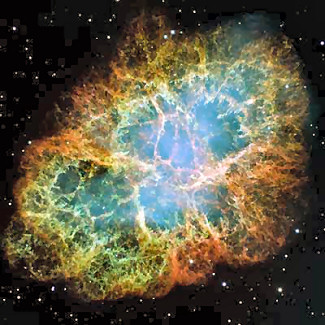
The Hubble pulls another fuzzy rabbit out of it's amazing hat...
The 80mm WO ED Triplet grabs another review and this week's prize.

This little scope get a little more scrutiny from this week's review contest winner.
Chandra Proves Black Hole Influence Is Far Reaching.

Scientists using NASA's Chandra X-ray Observatory have discovered evidence of energetic plumes -- particles that extend 300,000 light years into a massive cluster of galaxies. The plumes are due to explosive venting from the vicinity of a supermassive black hole, and they provide dramatic new evidence of the influence a black hole can have over intergalactic distances. <b>NOTE: French, German, Italian, and Spanish translations follow...</b>
Planet-Sized Brown Dwarf May Yield Smallest Known Solar System.
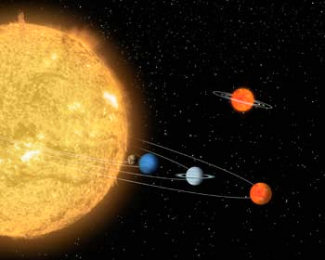
Astronomers using NASA's Spitzer and Hubble Space Telescopes and other ground-based observatories have discovered a failed star, less than one-hundredth the mass of the Sun, possibly in the process of forming a solar system. <b>NOTE: French, German, Italian, and Spanish translations follow...</b>
A scope so big, it broke the review in two parts!

This week's review winner is all about Meade's Big Bubba - the LX200 16" SCT...
Radio Astronomers Find a "Dark Matter Galaxy" in Virgo that Contains no Stars

Radio Astronomers have discovered an object that appears to be an invisible galaxy made almost entirely of dark matter - the first ever detected. A dark matter galaxy contains a large amount of mass that rotates like a galaxy, but has no stars. Dark matter galaxies are thought to form when the density of matter in a galaxy is too low to create the conditions for star ignition and star formation. Finding a dark matter galaxy is an important breakthrough because, according to cosmological models, dark matter is five times more abundant than ordinary matter. If this dark matter galaxy was an ordinary galaxy with stars, it would be a bright spiral galaxy in the Virgo Cluster of galaxies that would be visible with a good amateur telescope.
SWIFT Captures an Expolding Star at the Edge of the Visible Universe

A powerful Gamma-Ray Burst (marking the death of a massive star and the birth of a black hole) at a distance of 13 billion light years from Earth been detected by NASA's space-based SWIFT Observatory. The universe is thought to be 13.7 billion years old, making this the most distant explosion ever recorded.
A New Study of Supernovae May Show that Einstein's "Biggest Blunder" may Prove to be Right After All

An international team of astrophysicists using a variety of instruments, including some of the largest telescopes on earth, are studying distant supernovae to better understand the effects of the mysterious "dark energy" that is speeding up the expansion of the universe.
Something out of the ordinary.... A wooden refractor.

The 8” f/6 ED Travel Star Refractor gets taken for a little trip by this week's review winner.
Feeding the Monster - ESO Gets a Close-up Look at a Super-Massive Black Hole
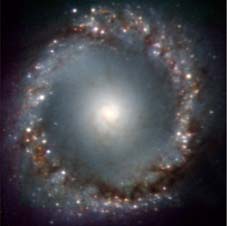
New Images from the European Southern Observatory's (ESO) Very Large Telescope (VLT) in Chile Depict the Violent Surroundings of a Super-massive Black Hole at the center of NGC 1097.
Chandra Reveals Cat-shaped Image of Exploded Stars
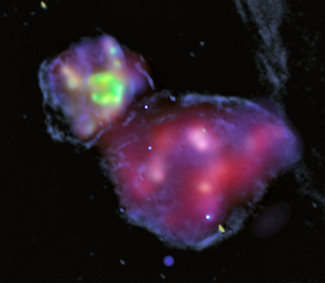
Object DEM L316: Supernova Remnants Deconstructed <b>NOTE: French, German, Italian, and Spanish translations follow...</b>
Eight New Einstein Rings and Eleven New "Gravitationally Lensed" Galaxies Discovered
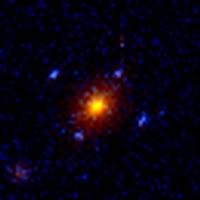
Astronomers have used the Hubble Space Telescope and the Sloan Digital Sky Survey (SDSS) to identify 19 new "Gravitationally Lensed" galaxies. Among these 19, they have found eight new "Einstein rings" -- the most elegant manifestation of the lensing phenomenon.
New Class of ‘Supergiant’ X-ray Binary Stars Discovered by INTEGRAL
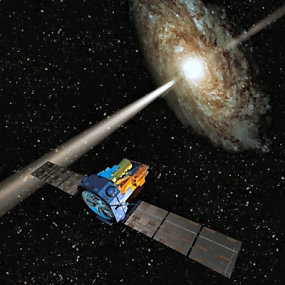
The European Space Agency's INTEGRAL(International Gamma-Ray Astrophysics Laboratory) has discovered a new class of X-ray Fast ‘Transient’ binary stars, undetected in previous observations.
Scientists Look for the Source of Jupiter’s 340 mph Winds
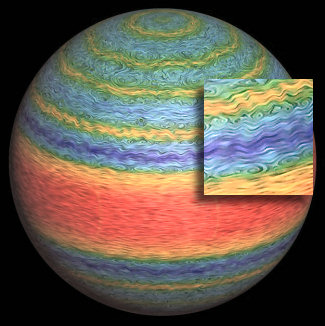
Jupiter's powerful winds continually circle the planet, and have changed very little in the 300 years that scientists have studied them. Massive east-west winds in Jupiter's equatorial region reach approximately 340 miles per hour — twice as fast as winds generated by strong hurricanes on Earth.