Reviews & Articles
Image of the day
About Astromart
My Account
New to Astromart?
Register an account...Need Help?
News
Sometimes, its the little things...

This week's review winner explores the virtues of a little add-on helical fine focuser that clearly improved the observing life of the winning reviewer...
NASA's Hubble discovers new rings and moons around Uranus

NASA's Hubble Space Telescope photographed a new pair of rings around Uranus and two new, small moons orbiting the planet. <b>NOTE: French, German, Italian, and Spanish translations follow...</b>
CONDOR Looks at the Universe in the 1.5 TeraHertz Range for the First Time

CONDOR pointed its eye to the universe for the first time, opening up the nearly unknown TeraHertz universe for exploration.
Astronomers Use Laser to Take Clearest Images of the Center of the Milky Way
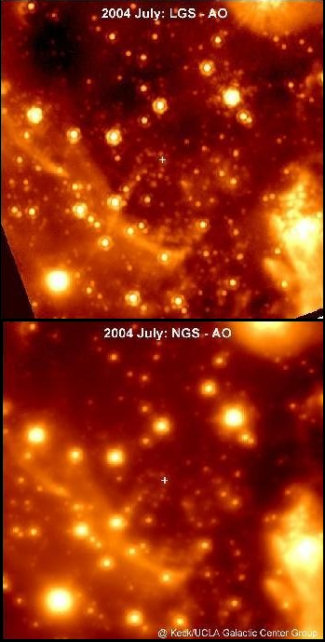
UCLA astronomers have taken the first clear picture of the center of our Milky Way galaxy, including the area surrounding the supermassive black hole, using a new laser virtual star at the W.M. Keck observatory in Hawaii.
Wanted: Amateur Astronomers to Help in Supernova-Neutrino Research

Ohio State University scientists have thought of a new way to help establish an astronomical linkage between the detection of subatomic particles known as Neutrinos and Supernovae... and their plan relies on the well-connected network of amateur astronomers. Since 2002, there have been at least nine supernovae identified in galaxies within about 30 million light years of our Milky Way, and more than half of those were discovered by amateur astronomers. Today's so-called amateur astronomers aren't really so amateur. With the quality of equipment in their hands, they can be though of as "professional amateurs." When a major discovery is made, they know as soon as the professionals do.
A little maroon Mak anyone?

This week's review contest winner takes Orion's 90mm Mak and basic EQ mount out under the stars...
Neutron Star Collisions Linked to to Mysterious Cosmic Gamma Ray Bursts

Cosmic Gamma Ray Bursts (GRBs), the most powerful explosions in the universe, have the extreme brilliance of a billion billion Suns and occur several times a day -- But very little is known about them. Two types of Gamma Ray Bursts have been observed 1) Long ones that last for tens or hundreds of seconds, and 2) Short bursts, which last a few milliseconds to a second. Long bursts are believed to result from the death of massive stars only a few million years old in young and vigorously star forming galaxies. Short Gamma Ray Bursts, until now shrouded in mystery, are being linked through recent research to the collision of two neutron stars, or a neutron star and a black hole. The objects slowly approach each other as their orbits shrink over hundreds of millions of years. Eventually, the two objects get so close together that they simply shred each other apart in a cataclysmic explosion.
Buffy Stands Out from the Crowd.

A team of astronomers working in Canada, France and the United States have discovered an unusual small body orbiting the Sun beyond Neptune, in the region astronomers call the Kuiper belt. This new object is twice as far from the Sun as Neptune and is roughly half the size of Pluto. The body's highly unusual orbit is difficult to explain using previous theories of the formation of the outer Solar System. <b>NOTE: French and German translations follow (character count too large for subsequent translations - Ed.)</b>
A bigger Vixen Cat

This week's review winner uncovers the 10.25" Vixen Klevtsov Astrograph...
Astronomers Use Hubble to 'Weigh' Dog Star's Companion

For astronomers, it's always been a source of frustration that the nearest white-dwarf star is buried in the glow of the brightest star in the nighttime sky. <b>NOTE: French, German, Italian, and Spanish translations follow...</b>
Is Earth in a Vortex of Space-Time? NASA's Gravity Probe B may soon provide the answer
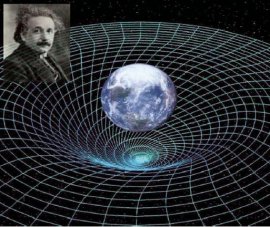
Almost 90 years after Albert Einstein first postulated his general theory of relativity, Physisists have finished collecting data that will put his theory to a new and different kind of experimental test. NASA's Gravity Probe B, orbiting at an altitude of 400-miles directly over the poles, will measure two important effects: 1)how space and time are warped by the presence of the Earth and 2) how the Earth's rotation drags space-time around with it. These effects, if indeed they can be measured, have far-reaching implications for the nature of matter and the structure of the Universe.
Movement of Earth's North Magnetic Pole Accelerating Rapidly
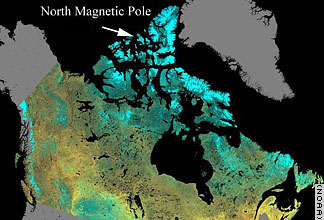
After some 400 years of relative stability, the Earth's North Magnetic Pole has moved nearly 1,100 kilometers out into the Arctic Ocean during the last century and at its present rate could move from northern Canada to Siberia within the next 50 years. Is it time to upgrade your telescope's directional firmware?
Looking for Near Earth Objects (NEOs) - Natural Hazards of Global Proportions

Telescopes around the world are watching the skies for rocky remnants from outer space to determine if they are on a collision course with Earth. The presence of large impact craters on Earth provides dramatic evidence of past collisions. A NEO larger than 1 km will collide with Earth every few hundred thousand years, causing significant global disaster. A NEO larger than 6 km, a true "Planet Killer" that could cause mass extinction, can be expected to collide with Earth every hundred million years or so.
Galaxy Collisions Dominate the Local Universe.
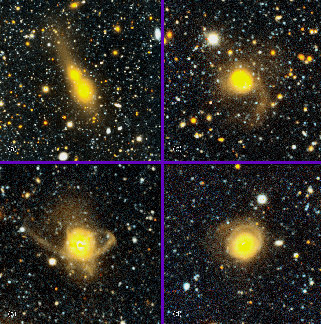
More than half of the largest galaxies in the nearby universe have collided and merged with another galaxy in the past two billion years, according to a new study using hundreds of images from two of the deepest sky surveys ever conducted. <b>NOTE: French, German, and Italian translations follow...</b>
Astronomers Find the Most Stable Optical Clock in the Heavens
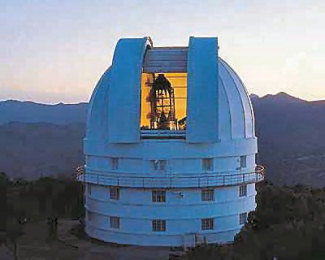
A 400 million-year-old white dwarf located in Leo Minor has been found to generate pulses of light that are so regular that it loses only one second in 8.9 million years. The pulses of this star are more accurate than the even the ticks of an atomic clock, making this white dwarf the most precise chronometer known in the heavens.