Image of the day

Captured by
Byron Davies

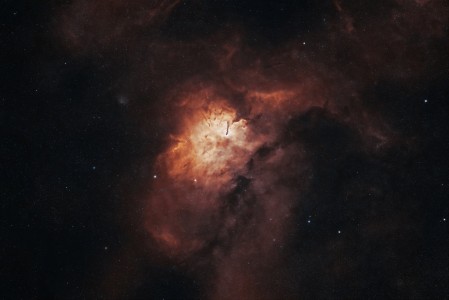
Sh2-86 (NGC-6820)

My Account

New to Astromart?

Register an account...

Need Help?

What do you observe?

Started by kulginov, 05/03/2007 08:38PM
Posted 05/03/2007 08:38PM Opening Post
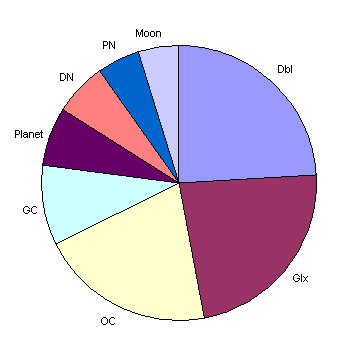
Here are my observation statistics.

My Northern location accounts for the large share of double stars (due to the lack of darkness on summer nights), almost a quarter, and the small share of planets. My real observing passions, galaxies and open clusters, came second and third, respectively. The relatively large amount of global clusters is due to my regular astro-travel. I definitely need to improve the share of Moon observations. As to diffuse and planetary nebulae, I've never really cared for them...

Dmitri
Attached Image:

kulginov's attachment for post 36963
Posted 05/04/2007 01:23AM #1
Mostly galaxies, globulars, planetaries, and open clusters in that order. Doubles and variables rarely if ever. Could not even begin to contemplate a pie chart.

I Yam What I Yam!
Posted 05/04/2007 02:17AM | Edited 05/04/2007 02:19AM #2
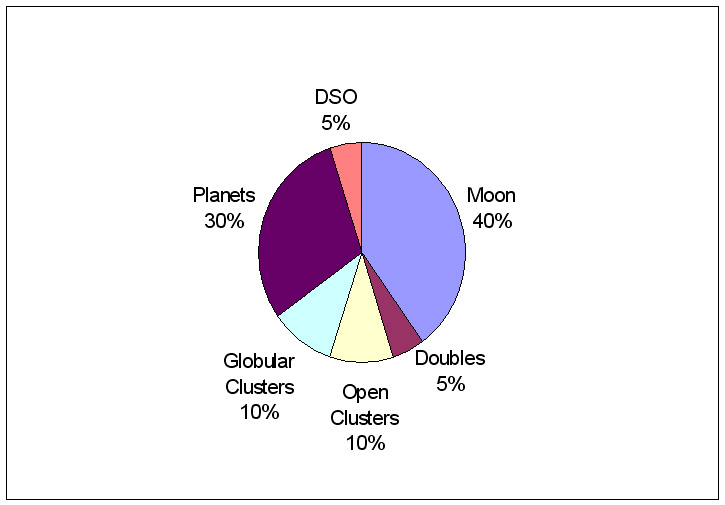
I live in suburb of city. My typical limiting magnitude is 3.0-3.5, with 4.5 being super exceptional evening (handful of times a year). I can't really practically seperate between PN,DN,Glx given the light pollution so they are all just faint fuzzies so I lump them into DSO. Chart attached.

Attached Image:

wpaolini's attachment for post 113766
Posted 05/04/2007 06:09AM #3
My statistics are not too different from Dmitri's. However, I spend more time observing planetary and diffuse nebulae. I have also included supernova remanents as a separate group even if I only observe three of them (M1, the Veil and IC443 in Gemini). I very often return to the Veil, and observe it more often than the moon.

I didn't make a pie chart, but give just the figures here (based on the number of records in my log, not the time spent).

Planets: 5%
Moon: 2%
Doubles: 36%
Galaxies: 27%
Open clusters: 6%
Globulars: 4%
Diffuse nebulae: 7%
Planetary nebulae: 10%
SNR: 3%

The sun and comets are not included even though I occasionally observe such objects. In periods with Jupiter present I spend more time on planets.

Inge S
Posted 05/05/2007 05:43PM | Edited 05/05/2007 05:45PM #4
Great topic, Dmitri!
My percentages change with the seasons.
Obviously, there's a plethora of galaxies this time of year. But I really do enjoy most everything.
Planets are always fun, but of course they have their seasons too.
When I first got started I tired of open clusters after a short time, but I have come to appreciate them again.
Lately, I am trying to learn more double stars. They can be quite lovely.
I need to observe the moon more often, too. I always enjoy it when I do, but I have traditionally
thought of it as a hinderance to my deep sky observing.
It's nice to see the big, bright globular clusters coming back into the picture.
I guess they are some of my favorite objects. Along with galaxies and nebulae.
I probably enjoy the nebulae more than anything, if I had to pick one type of object.
But fortunately I don't...I want to see it all! grin
Linton
Posted 05/05/2007 05:49PM #5
Interesting how different our tastes all are! For my part, I've spent a lot of my time getting to know the Messier's, and also have enjoyed Mars, Saturn, Jupiter, and the moon. Pretty standard fare, I guess. Currently working my way through the Herschel 400, hoping to put together my own list of the top 100 or so M and H objects for future reference. Never much cared for double stars, but I'm investigating some of the best based on recent articles in S&T, and Astronomy. We'll see what develops!
Larry
Posted 05/05/2007 10:56PM #6
I confess to keeping almost no track of what I'm observing anymore. The non-astro parts of life, and the weather, leave me scope time in no predictable schedule. So I steal it where I can. Therefore I observe what ever is near the meridian at the hour available on any dark night.

Having a deep field atlas at hand, rather than an list of intended targets, has been one of the best methods to do this. All objects on the page in a given part of the sky are on the menu.

The down side is that you miss some of the seasonal wonders. But I was missing them anyway. The method of non-planning and just going to rural sky with the MSA or Uranometria really opens up the deep sky options. If it's faint and fuzzy and crossing the meridian, then it's in season.


Posted 05/06/2007 09:07PM #7
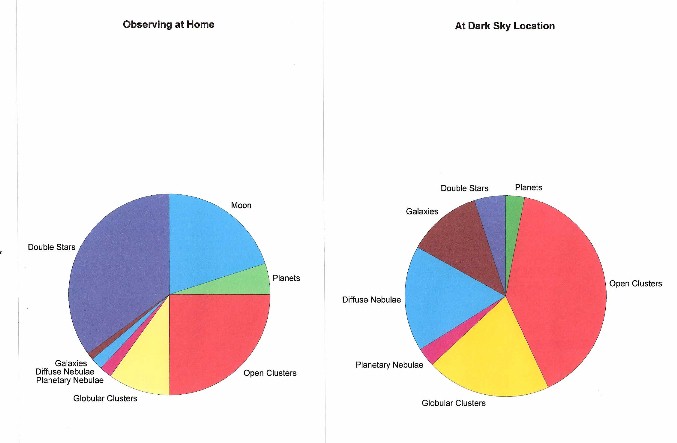
You also provoked me into making pie charts to show my observing preferences! As for many others, these preferences depend on whether I'm trying to star-gaze at my light-polluted suburban home or at one of the more-or-less dark sky sites accessible to me. Here are two charts illustrating the differences.

Attached Image:

Herbert Kraus's attachment for post 113810

NexStar 8i SCT, Orion 80ED APO refractor, Orion 120 mm EQ refractor, 3.5-inch Questar
Posted 05/07/2007 07:16AM #8
There have been many responses 'I do this and my preferences are that', but I have to remark that my pie chart has come out much against my expectations. I expected much less double stars and much more open clusters. So maybe someone will want to sit down and actually count the observations.

Dmitri