
News
Have the Imaginary Concepts of Dark Matter and Dark Energy Finally Run Their Course?
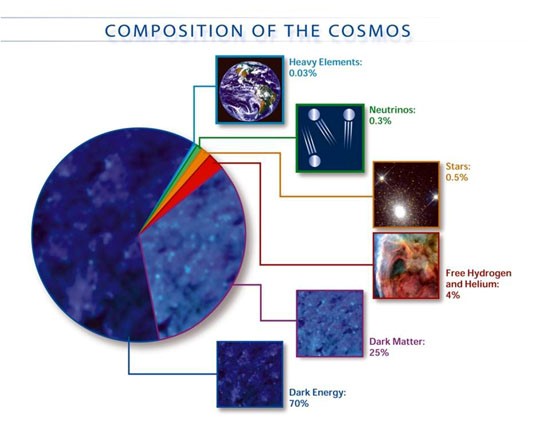
A University of Geneva researcher has shown that the accelerating expansion of the Universe and the movement of the stars in galaxies can be explained without drawing on the concepts of Dark Matter and Dark Energy... And the work is pointing to a very inconvenient conclusion -- These two entities may not actually exist. History provides us with many examples where scientists have simply invented ideas out of thin air to help explain away things that are just not understood. In some ways, Dark Matter and Dark Energy bring to mind another imaginary concept -- the so called "Aether Wind." In 1887, Albert Michelson and Edward Morley proved that there was no such thing, even though everybody just "knew" that space was filled with it. Will this new work lead to the development of a Michelson-Morley-like experiment for the 21st century that does away with the concepts of Dark Matter and Dark Energy? Time will tell.
Thanksgiving

From all of us here at Anacortes Telescope and Wild Bird: Have a great Thanksgiving with your family and friends.
Physicists Describe New Dark Matter Detection Strategy

Though it has not yet been detected directly, physicists are fairly certain that dark matter must exist in some form. The way in which galaxies rotate and the degree to which light bends as it travels through the universe suggest that there's some kind of unseen stuff throwing its gravity around. The leading idea for the nature of dark matter is that it's some kind of particle, albeit one that interacts very rarely with ordinary matter. But nobody is quite sure what a dark matter particle's properties might be because nobody has yet recorded one of those rare interactions. Physicists from Brown University have now devised a new strategy for directly detecting dark matter.
Space Launch System (Saturn V on Steroids) to Fly December 2019

NASA has provided an update on the first integrated launch of the Space Launch System (SLS) rocket and Orion spacecraft after completing a comprehensive review of the launch schedule. This first un-crewed mission, known as Exploration Mission-1 (EM-1) is a critical flight test for NASA's human deep space exploration goals. EM-1 lays the foundation for the first crewed flight of SLS and Orion, as well as a regular cadence of missions thereafter near the Moon and eventually to the asteroids and Mars. NASA is currently managing the program to a scheduled December 2019 launch.
Kiss the Sky Tonight -- Month of November 2017

Welcome to the night sky report for November 2017 -- Your guide to the constellations, deep sky objects, planets, and celestial events that are observable during the month. The night sky is truly a celestial showcase, so get outside and explore its wonders from your own backyard.
WorldWide Telescope Application Now Universally Accessible Via Web Browser

Have you missed out on WorldWide Telescope (WWT) because you're not using a Windows computer? Good news -- WWT can now be accessed via a web interface, with no dependence on your Operating System. WWT is a powerful application that allows users to interactively browse the multi-wavelength sky. Based on feedback from the astronomy community, WWT has now expanded its support so that anyone can use the full features of this application from their web browser.
First Time That a Cosmic Event is Observed Optically and With Gravitational Waves

For the first time, scientists have directly detected gravitational waves (ripples in space-time) together with the light from a spectacular collision of two neutron stars. This marks the first time that a cosmic event has been observed with both gravitational waves and light. The discovery was made using the Laser Interferometer Gravitational-Wave Observatory (LIGO) in the US, the Virgo detector in Italy, and some 70 ground and space-based observatories. As two neutron stars spiraled together about 130 million years ago, they emitted gravitational waves that were detected for about 100 seconds on August 17, 2017. In the days and weeks following the initial discovery, a full spectrum of light and electromagnetic radiation from the event (including X-ray, ultraviolet (UV), optical, infrared (IR) and radio waves) were detected and analyzed -- A treasure trove of material that will keep scientist busy for years to come.
US Geological Survey Speculates -- What's in the Yellowstone Super Volcano's Future?

Yellowstone, one of the world's largest active volcanic systems, has produced several giant volcanic eruptions in the past few million years, as well as many smaller eruptions and steam explosions. Although no eruptions of lava or volcanic ash have occurred for many thousands of years, future eruptions are likely. In the next few hundred years, hazards will most probably be limited to ongoing geyser and hot spring activity, with occasional steam explosions and moderate to large earthquakes. To better understand Yellowstone's volcano and earthquake hazards and to help protect the public, the US Geological Survey, the University of Utah, and Yellowstone National Park formed the Yellowstone Volcano Observatory, which continuously monitors activity in the region.
Kiss the Sky Tonight -- Month of October 2017

Welcome to the night sky report for October 2017 -- Your guide to the constellations, deep-sky objects, planets, and celestial events that are observable during the month. The night sky is truly a celestial showcase, so get outside and explore its wonders from your own backyard. In the now famous words of James Marshall Hendrix (apparently a fellow admirer of the heavens), "Excuse me while I kiss the sky."
Sputnik 1 -- 60 Years Ago Today

History changed 60 years ago today, on October 4, 1957, when the Soviet Union successfully launched Sputnik 1. The world's first artificial satellite was about the size of a beach ball -- about 23 inches diameter -- and weighed less than 190 pounds. It took about 98 minutes to orbit the Earth on its elliptical path. That single launch ushered in a whole array of new political, military, technological, and scientific developments in the years that followed. While the Sputnik launch was a single event, it marked the start of the Space Age and the US - USSR space race.
Scientists Find Elusive Giant Black Hole Pairs

Astronomers have identified a bumper crop of dual supermassive black holes in the centers of galaxies. This discovery could help astronomers better understand how giant black holes grow and how they may produce the strongest gravitational wave signals in the Universe. The new evidence reveals five pairs of supermassive black holes, each containing millions of times the mass of the Sun. These black hole couples formed when two galaxies collided and merged with each other, forcing their supermassive black holes close together.
Mercury's Poles Contain Ice -- And There's More of It Than Originally Thought

The scorching hot surface of Mercury seems like an unlikely place to look for ice, but research over the past three decades has suggested that surface water is frozen at the two poles of the planet, hidden away on crater floors that are permanently shadowed from the Sun's blistering rays. Now, a new study led by Brown University researchers suggests that there could be much more ice on Mercury's surface than originally thought.
Smallest-Ever Star Discovered by Astronomers in the UK

The smallest star yet measured has been discovered by a team of astronomers led by the University of Cambridge in the UK. With a size just a sliver larger than that of Saturn, the gravitational pull at its stellar surface is about 300 times stronger than what humans feel on Earth. The star is likely as small as stars can possibly become, as it has just enough mass to enable the fusion of hydrogen nuclei into helium. If it were any smaller, the pressure at the center of the star would no longer be sufficient to enable this process to take place.
Cassini Prepares for its September 15th Death Dive into Saturn

After two decades in space, NASA's Cassini spacecraft is nearing the end of its remarkable journey of exploration. Having expended almost every bit of its rocket propellant, operators are deliberately plunging Cassini into the giant planet to ensure that Saturn's moons will remain pristine and uncontaminated for future exploration -- in particular, the ice covered, ocean-bearing moon Enceladus, and Titan, with its intriguing pre-biotic chemistry. From its launch in 1997 to its upcoming Grand Finale, the Cassini-Huygens mission has racked up a remarkable list of achievements, and in the process has paved the way for the next generation of probes that will explore the four outer gaseous planets.
Distant Galaxy Sends Out 15 High Energy Radio Bursts -- Can You Hear Me Now?

The Breakthrough Listen Program, an initiative to find signs of intelligent life in the universe, has detected 15 brief but powerful radio pulses emanating from a mysterious and repeating source far across the universe.
Funding Member
