News
Why is Yawning So Contagious?

Do you yawn when you read an Astromart News posting? I hope not. But if you do, does your spouse or significant other also yawn even though he or she is across the room? Why is that so? Is this what Albert Einstein would label "Spooky action at a distance?" Nah. But still, why do we yawn if someone else does? Researchers at the University of Nottingham suggest that the human propensity for contagious yawning is triggered automatically by primitive reflexes in the primary motor cortex -- an area of the brain responsible for motor function. Their latest findings show that our ability to resist yawning when someone else near us yawns is limited... And our urge to yawn is increased if we are instructed to resist yawning.
Astronomers Image the Surface and Atmosphere of the Red Supergiant Star Antares

To the unaided eye the famous bright star Antares shines with a strong red tint in the heart of the constellation Scorpius. It is a huge and comparatively cool red supergiant in the late stages of its life, on the way to becoming a supernova. A team of astronomers, led by Keiichi Ohnaka, of the Universidad Catolica del Norte in Chile, used ESO's Very Large Telescope Interferometer (VLTI) at the Paranal Observatory in Chile to map Antares' surface and to measure the motions of the surface material. This is the best image of the surface and atmosphere of any star other than the Sun.
National Solar Observatory to Create 90 Minutes of Totality Using 68 Telescopes

For the average observer, the Solar Eclipse on Monday, August 21, 2017, will last about 2 minutes and 40 seconds of totality. The National Solar Observatory (NSO), in a unique experiment, plans to create 90 minutes of continuous totality using a chain of 68 telescopes strategically placed across the country. The Citizen CATE (Continental America Telescopic Eclipse) Experiment aims to capture images of the inner solar corona using a network of telescopes operated by volunteer citizen scientists, high school groups, and universities. The goal of CATE is to produce a scientifically unique data set -- A series of high resolution, rapid cadence white light images of the inner corona for 90 straight minutes.
NASA to Chase Eclipse with a Pair of WB-57s at 50,000 Feet

Total solar eclipses are unique opportunities for scientists to study the hot atmosphere above the Sun's visible surface. The faint light from the Corona is usually overpowered by intense emissions from the Sun itself. During a total eclipse, however, the Moon blocks the glare from the bright solar disk and darkens the sky, allowing the weaker coronal emissions to be observed. A team led by Southwest Research Institute will use airborne telescopes aboard NASA WB-57 research aircraft to study the solar corona and Mercury's surface during next week's total solar eclipse. The August 21 observations will provide the clearest images to date of the Sun's outer atmosphere. In addition, the scientists will attempt to take the first-ever thermal images of surface temperature variations of the planet Mercury.
New Clues to the Universe's Structure Revealed

Imagine planting a single seed and with great precision being able to predict the exact height of the tree that grows from it. Now imagine traveling to the future and snapping photographic proof that you were right. If you think of the seed as the early universe and the tree as the universe the way it looks now, you have an idea of what the Dark Energy Survey (DES) collaboration has just done. DES scientists have just unveiled the most accurate measurement ever made of the present large scale structure of the universe, and have been able to map it back to the first 400,000 years following the Big Bang.
Sun's Core is Spinning Four Times Faster Than its Surface

The Sun's core spins nearly four times faster than the Sun's surface according to new findings by an international team of astronomers. Scientists had originally assumed that the Sun was spinning like a merry-go-round with the core rotating at about the same speed as the surface. The researchers studied surface acoustic waves in the Sun's atmosphere, some of which penetrate to the Sun's core, where they interact with gravity waves that have a sloshing motion similar to how water would move in a half-filled tanker truck driving on a curvy mountain road. After the Sun formed, the Solar wind likely slowed the rotation of the outer part of the Sun. It is hoped that eventually, a better understanding of the rotation of the Solar core may give a clue to how the Sun formed.
Countdown to the Great American Solar Eclipse -- One Month from Today

So, what will you be doing during the Great American Solar Eclipse of 2017? Observing? Photographing? Throwing a Great American Eclipse party in your backyard? In past total solar eclipses, people have spent thousands of dollars on extravagant trips and cruises to remote parts of the world to cross this experience off of their "bucket lists." This year, you will be able to walk outside and see one for yourself from the comfort of your home (weather permitting). On August 21, 2017, most of the nation will only see a partial eclipse, but if you are one of the lucky millions along the path of totality, you will experience about two minutes of mid-day darkness as the black shadow of the Moon races across the nation at about 2000 mph.
NASA's Juno Completes Close Flyby of Jupiter's Great Red Spot

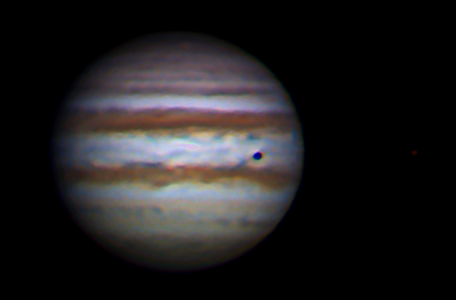
NASA's Juno mission completed a close flyby of Jupiter and its Great Red Spot on July 10, 2017, during its sixth science orbit. Just days after celebrating its first anniversary in Jupiter orbit, the Juno spacecraft flew directly over the planet's Great Red Spot, the gas giant's iconic, 10,000 mile wide (16,000 kilometer wide) storm. This was humanity's first up-close view of the gigantic feature -- a storm monitored by astronomers since 1830, and possibly existing for centuries before that.
Quantum Teleportation -- Not Quite Star Trek... But It is a Start

Quantum teleportation has become a standard operation in quantum optics labs around the world. The technique relies on the strange phenomenon of quantum entanglement. This occurs when two quantum objects, such as photons, form at the same instant in time and the in same location in space, and so share the same existence. In technical terms, they are described by the same wave function. According to a report in MIT Technology Review, researchers in China have teleported a photon from the ground to a satellite orbiting more than 500 kilometers above. It may not yet be the same as Star Trek, but it is a start.
In the Beginning, Nothing... Then God Said "Let There Be Noise" -- An Introduction to Acoustic Cosmology

Is there a musical equivalent to the curvature of space-time? Gavin Starks thinks so. Yesterday he presented his findings at the Royal Astronomical Society's National Astronomy Meeting held at the University of Hull in the UK. Starks, who has a background in radio astronomy and electronic music, has been working on "Acoustic Cosmology" for more than 20 years in collaboration with Professor Andy Newsam of Liverpool John Moores University in the UK. Their aim is to test whether mathematical relationships that describe cosmology and quantum mechanics can be applied to a Sonic Universe, or "Soniverse."
Strange Bacterial Life Forms Emerged Less Than 800 Million Years After Earth's Formation

Remains of microorganisms at least 3.77 billion years old have been discovered by an international team led by University College London scientists, providing direct evidence of one of the oldest life forms on Earth. Tiny filaments and tubes formed by bacteria that lived on iron were found encased in quartz layers in Quebec, Canada, where some of the oldest sedimentary rocks known on Earth exist. These rocks likely formed part of an iron-rich deep sea hydro-thermal vent system that provided a habitat for Earth's first life forms between 3.77 and 4.30 billion years ago. Earth was formed 4.54 billion years ago, so it appears that life on Earth emerged rather early in its history.
Scientists Solve the Mystery of Unexplained "Bright Nights"

Dating back to the first century AD, scientists, philosophers, and other observers have noted the occasional occurrence of "Bright Nights," when an unexplained glow in the night sky lets observers see distant mountains, read newspapers, or check their watches. Few, if any, people observe Bright Nights anymore due to widespread light pollution, but new findings show that they can be detected by scientists and may still be noticeable in remote areas. The new study suggests that waves in the upper atmosphere converge over specific locations on Earth and amplify naturally occurring airglow -- a faint light in the night sky that often appears green due to the activities of atoms of oxygen in the high atmosphere. Normally, people don't notice airglow, but on Bright Nights it can become visible to the naked eye, producing the unexplained glow detailed in historical observations.
New Evidence Suggests that ALL Sun-like Stars are Born as Binaries

Did our Sun have a twin when it was born 4.5 billion years ago? Almost certainly yes -- though not an identical twin... And so did every other Sun-like star in the Universe, according to a new study. Many stars have gravitationally bound companions, including our nearest neighbor, Alpha Centauri, a triplet system. Astronomers have long sought an explanation -- Are binary and triplet star systems born that way? Did one star capture the other? Do binary stars sometimes split up and become single stars? The new study, based on a radio survey of a giant molecular cloud in the constellation Perseus and a mathematical model that can explain the Perseus observations only if all Sun-like stars are born with a companion, suggest that Yes -- all Sun-like stars in the Universe start life as binaries.
If the Universe is Structured Like a Block of Swiss Cheese, Then We Live Inside One of the Holes

A University of Wisconsin analysis has shown that our galaxy resides in an enormous void -- a region of space containing far fewer galaxies, stars, and planets than expected. This idea that we exist in one of the holes of the Swiss cheese structure of the cosmos helps explain inconsistencies in the measurement of the Hubble Constant, the unit that cosmologists use to describe the rate at which the universe is expanding. No matter what technique one uses, we should get the same value for the expansion rate of the universe, but we don't. The reason is that the void has far more matter outside, which exerts a larger gravitational pull towards the inside "wall" of the void. This affects the Hubble Constant value as measured from a technique that uses supernovae, while it has no effect on the value derived from a technique that uses the Cosmic Microwave Background.
Homo Sapiens Emerged 100,000 Years Earlier Than Previously Thought

Researchers have uncovered 300,000 year old fossil bones of Homo Sapiens in Jebel Irhoud, Morocco -- a find that represents the oldest reliably dated fossil evidence of our species. The find is 100,000 years older than any other previously discovered Homo Sapiens fossils. Amazingly, the facial shape of the skulls is almost indistinguishable from that of modern humans living today. Previously, the oldest Homo Sapiens fossils were discovered at two sites in Ethiopia, dating 195,000 and 160,000 years old. Consequently, many researchers believed that all humans living today descended from the population that lived in East Africa around 200,000 years ago. But this new find suggests that early Homo Sapiens spread across the entire African continent and long before the out-of-Africa dispersal of Homo Sapiens began, there was dispersal within the African continent.
Funding Member
