Search Stories
Space Shuttle Should Conduct Final Servicing Mission To Hubble Space Telescope.
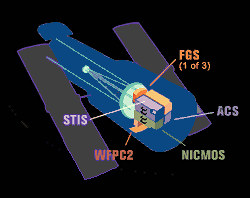
WASHINGTON -- To ensure continuation of the extraordinary scientific output of the Hubble Space Telescope and to prepare for its eventual de-orbiting, NASA should send a space shuttle mission, not a robotic one, says a new congressionally requested report from the National Academies' National Research Council. <b>NOTE: French, German, and Italian translations follow...</b>
Hubble Weighs in on the Heaviest Stars in the Galaxy.

Unlike humans, stars are born with all the weight they will ever have. A human's birth weight varies by just a few pounds, but a star's weight ranges from less than a tenth to more than 100 times the mass of our Sun. Although astronomers know that stars come in a variety of masses, they are still stumped when it comes to figuring out if stars have a weight limit at birth. <b>NOTE: French, German, and Italian translations follow...</b>
Simulations Reveal Surprising News about Black Holes
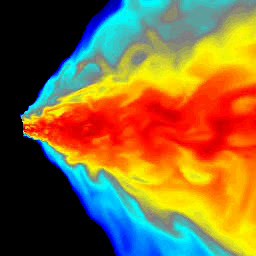
Computer simulations of how black holes accrete matter show surprising violence and turbulence, challenging many commonly held assumptions about the nature of this phenomenon. <b>NOTE: French, German, and Italian translations follow...</b>
Super-Sharp Radio "Vision" Measures Galaxy's Motion in Space

Astronomers using the National Science Foundation's Very Long Baseline Array (VLBA) have measured the motion across the sky of a galaxy nearly 2.4 million light-years from Earth. <b>NOTE: French, German, and Italian translations follow...</b>
Spitzer Space Telescope Exposes Dusty Galactic Hideouts

How do you hide something as big and bright as a galaxy? You smother it in cosmic dust. NASA's Spitzer Space Telescope saw through such dust to uncover a hidden population of monstrously bright galaxies approximately 11 billion light-years away. <b>NOTE: French, German, and Italian translations follow...</b>
The Impending Destruction of NGC 1427A
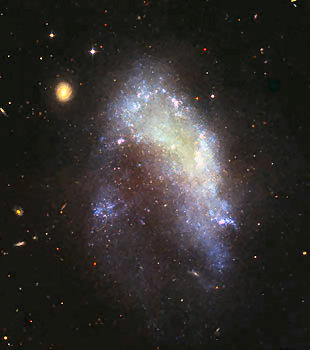
What happens when a galaxy falls in with the wrong crowd? The irregular galaxy NGC 1427A is a spectacular example of the resulting stellar rumble. Under the gravitational grasp of a large gang of galaxies, called the Fornax cluster, the small bluish galaxy is plunging headlong into the group at 600 kilometers per second or nearly 400 miles per second. <b>NOTE: French, German, and Italian translations follow...</b>
Jupiter: Chandra Probes High-Voltage Auroras on Jupiter

Jupiter shows intense X-ray emission associated with auroras in its polar regions. Extended monitoring by Chandra showed that the auroral X-rays are caused by highly charged particles crashing into the atmosphere above Jupiter's poles. <b>NOTE: French, German, and Italian translations follow...</b>
New theory of how planets form finds havens of stability amid turbulence

BLOOMINGTON, Ind. -- A new theory of how planets form finds havens of stability amid violent turbulence in the swirling gas that surrounds a young star. These protected areas are where planets can begin to form without being destroyed. The theory will be published in the February issue of the journal Icarus. <b>NOTE: French, German, and Italian translations follow...</b>
Cassini Captures First-Ever Photographs of Saturn's Radiation Belts

Using an innovative camera on NASA’s Cassini spacecraft, scientists have captured images of a radiation belt inside the rings of Saturn and have the clearest picture yet of the planet’s giant magnetosphere, according to a mid-year report of the spacecraft published today in the journal Science. <b>NOTE: French, German, and Italian translations follow...</b>
NASA Observes One of Brightest Cosmic Explosions
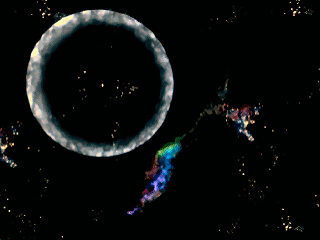
Scientists detected a flash of light from across the Galaxy so powerful; it bounced off the moon and lit up the Earth's upper atmosphere. The flash was brighter than anything ever detected from beyond our Solar System, and it lasted over a tenth of a second. <b>NOTE: French, German, and Italian translations follow...</b>
NASA's Cassini Spacecraft Continues Making New Discoveries
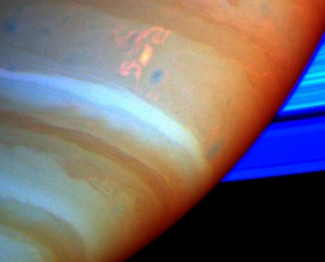
New findings include wandering and rubble-pile moons; new and clumpy Saturn rings; splintering storms and a dynamic magnetosphere. <b>NOTE: French, German, and Italian translations follow...</b>
Swift Sees Pinwheel Galaxy, Satellite Fully Operational

The Swift satellite's Ultraviolet/Optical Telescope (UVOT) has seen first light, capturing an image of the Pinwheel Galaxy, long loved by amateur astronomers as the "perfect" face-on spiral galaxy. The UVOT now remains poised to observe its first gamma-ray burst and the Swift observatory, launched into Earth orbit in November 2004, is now fully operational.<b> NOTE: French, German, and Italian translations follow...</b>
CCD Imager's Tool Review Nabs Prize

The Optec Pyxis Rotator gets graded, rated, and rotated by Bob Benamati...
Titan's Atmosphere Comes from Ammonia, Huygens Data Says...
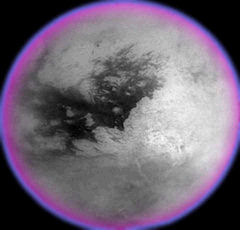
Cassini-Huygens supplied new evidence about why Titan has an atmosphere, making it unique among all solar system moons, a University of Arizona planetary scientist says. (Article by Lori Stiles. University of Arizona)
Mysterious Magnetar Yielding Secrets to VLA
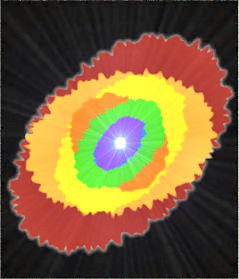
A giant flash of energy from a supermagnetic neutron star thousands of light-years from Earth may shed a whole new light on scientists' understanding of such mysterious "magnetars" and of gamma-ray bursts.