News
Museum of Astronomical Telescopes, Japan
The Asahi Shimbun's story on the newly opened Museum of Astronomical Telescopes in Sanuki, Kagawa Prefecture
Hubble Breaks the Cosmic Distance Record with a Redshift of 11.1

NASA's Hubble Space Telescope is an amazing time machine. By looking back through space, astronomers actually look back through time. Now, by pushing Hubble to its limits, a team of astronomers has shattered the cosmic distance record by viewing the farthest galaxy ever seen. Named GN-z11, this surprisingly bright, infant galaxy is seen as it was 13.4 billion years in the past. GN-z11 is located in the direction of the constellation of Ursa Major. The astronomers saw it as it existed just 400 million years after the Big Bang, when the universe was only three percent of its current age. At a spectroscopically confirmed redshift of 11.1, the galaxy is even farther away than originally thought. At a billion solar masses, it is producing stars surprisingly quickly for such an early time. This new record will most likely stand until the launch of Hubble's successor, the James Webb Space Telescope, which will look even deeper into the universe for early galaxies.
FRB Helps Reveal Missing Matter in the Universe

An international research team used a combination of radio and optical telescopes to identify the precise location of a Fast Radio Burst (FRB) in a distant galaxy, allowing them to conduct a unique census of missing matter in the Universe. FRBs are mysterious bright milliseconds-duration bursts of radio emissions originating billions of light years away. The bursts arrive first at high frequencies and then progressively sweep down to lower frequencies before disappearing completely and not recurring. FRBs are likely caused by extreme catastrophic events in the distant Universe, but their origin is still unknown. FRBs are similar in many ways to Gamma Ray Bursts (GRBs), but their association (if any) has not yet been established. Whereas GRBs are associated with supernova explosions, FRBs may result from Magnetars (extreme Magnetic Stars). FRBs are very difficult to detect and before this discovery only 16 had been detected.
Five Dimensional Black Hole Could Break General Relativity

General relativity underpins our current understanding of gravity. In part, the theory tells us that matter warps its surrounding spacetime and what we call gravity is the effect of that warp. In the 100 years since it was published, general relativity has passed every test that has been thrown at it, but one of its limitations is the existence of singularities, as found at the center of black holes. Researchers in the UK have now shown that a bizarrely ring shaped black hole, first discovered by theoretical physicists in 2002, could cause Einstein's general theory of relativity to break down. However, such an object could only exist in a universe with five or more dimensions.
Finally! Gravitational Waves Detected 100 Years After Einstein's Prediction

For the first time, scientists have observed ripples in the fabric of spacetime called gravitational waves, arriving at Earth from a cataclysmic event in the distant universe. This confirms a major prediction of Albert Einstein's 1915 General Theory of Relativity and opens an unprecedented new window to the cosmos. Physicists have concluded that the detected gravitational waves were produced during the final fraction of a second from the merger of two black holes to produce a single, more massive spinning black hole. The gravitational wave-producing collision of two black holes had been predicted but never observed.
Radio Astronomers Reveal New Clues About the "Great Attractor"

The Milky Way is moving toward the constellation Centaurus at a velocity of two million kilometers per hour. The motion appears to be due to the gravitational pull of a large, but unobservable, concentration of matter dubbed the "Great Attractor," a supercluster (or group of galaxy clusters) estimated to contain mass equivalent to more than a Million Billion Suns. Until now, efforts to find the Great Attractor have been hampered by its location in an area behind the plane of the Milky Way where gas and dust within our galaxy block much of the visible light. Now, utilizing new techniques available to Radio Astronomers, a multitude of hidden galaxies have been studied for the first time, shedding light on this mysterious gravitational anomaly dubbed the Great Attractor.
Astronomers Create First Large Scale Map of Stellar Ages in the Milky Way

Using completely new ways of deducing the ages of red giant stars, astronomers have created the first large scale map that shows stellar ages in the Milky Way. Determining the ages of nearly 100,000 red giant stars, at distances of up to 50,000 light years from the galactic center, astronomers from the Max Planck Institute for Astronomy in Germany were able to test key ideas about the growth of the Milky Way. Notably, the map confirms that our home galaxy has grown from the inside out -- Today, most old stars can be found in the middle and more recently formed ones in the outskirts.
Planet 9 From Outer Space

Researchers at the California Institute of Technology have found evidence of a giant planet tracing a bizarre, highly elongated orbit in the outer solar system. The object, which the researchers have nicknamed "Planet Nine," has a mass about 10 times that of Earth and orbits about 20 times farther from the sun on average than does Neptune (which orbits the sun at an average distance of 2.8 billion miles). In fact, it would take this new planet between 10,000 and 20,000 years to make just one full orbit around the sun. The researchers, Konstantin Batygin and Mike Brown, discovered the planet's existence through mathematical modeling and computer simulations but have not yet observed the object directly.
"Back in My Day, We Had Nine Planets" and Other Favorite Quotations

This week is a bit slow on news, so I'll post some of my favorite quotations. Some are deep. Others not so much...
US Postal Service Honors NASA Planetary Achievements With 2016 Stamps

The Postal Service has released a preview of its new 2016 stamps, which include eight new colorful Forever stamps of NASA images of solar system planets. Separately, Forever stamps of Pluto and the New Horizons spacecraft, Global Forever stamps dedicated to Earth's moon, and Forever stamps providing a tribute to 50 years of Star Trek will be issued.
Cosmic Deja Vu -- Refsdal Supernova Reappears Exactly as Predicted

Due to the effects of gravitational lensing, as predicted by Einstein's general theory of relativity, a distant and massive cluster of galaxies is acting like a time machine, replaying for the second time in 13 months the explosion of a massive star 9.3 billion years ago located near the edge of the observable universe.
Have a Merry Christmas!

And to all, a clear and cloudless night!
What Powers Gamma Ray Bursts? Researchers Think They Found the Source

A supercomputer simulation of a mere 10 milliseconds during the collapse of a massive star into a neutron star proves that these catastrophic events, often called Hypernovae, can generate the enormous magnetic fields needed to explode the star and fire off bursts of gamma rays that are visible halfway across the universe. The simulation and visualization of the toroidal magnetic field that is formed from a collapsed massive star, required 130,000 computer cores operating in parallel over a span of two weeks on "Blue Waters" -- one of the most powerful supercomputers in the world.
Mars Expected to Lose a Moon... But Gain a Ring
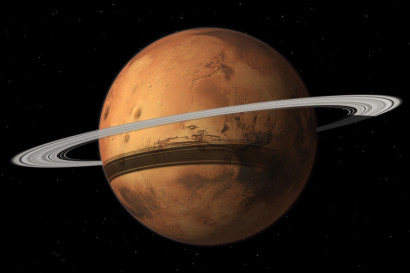
Mars' largest moon, Phobos, is slowly falling toward the planet. But rather than smash into the surface, it will likely be shredded and the pieces strewn about the planet in a ring much like the one encircling Saturn, according to two scientists at the University of California - Berkeley. As Phobos gets closer to the planet, the force of gravity will be enough to actually pull the moon apart. This is because Phobos is highly fractured, with lots of pores and rubble. Dismembering it will be analogous to pulling apart a granola bar, scattering crumbs and chunks everywhere. Though inevitable, the demise of Phobos is not imminent. It will probably happen in 20 to 40 million years, leaving a ring that may persist for up to 100 million years.
Thanks

A big Thank You to all of our Astromart Members.
Funding Member
