News
A Simple, Elegant Solution for Determining the Distances to Planetary Nebulae
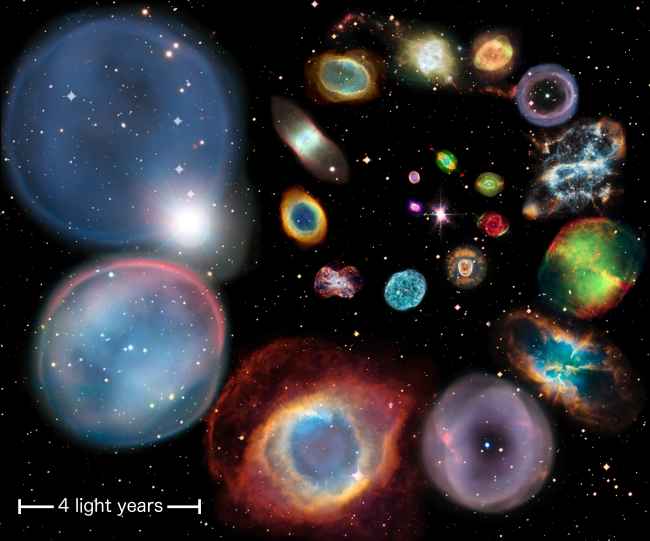
There are thousands of planetary nebulae in our galaxy and they provide targets for professional and amateur astronomers alike, with the latter often taking spectacular images of these beautiful jewels. But despite intense study, scientists have struggled to measure one of their key properties -- their distance. Now, a new way of estimating more accurate distances to the planetary nebulae dispersed across our galaxy has been announced by a team of three astronomers at the University of Hong Kong. The new approach, which is both simple and elegant, allows astronomers to measure distances up to 5 times more accurately than previous methods.
Ancient Stars Older Than the Milky Way Found at the Center of Our Galaxy

An international team of astronomers, led by researchers from the University of Cambridge and the Australian National University, have discovered some of the oldest stars in our galaxy, whose chemical composition and movements could tell us what the Universe was like soon after the Big Bang. These stars, which have been at the very center of the Milky Way for billions of years, contain extremely low amounts of metal and are made up almost entirely of hydrogen, helium, and small amounts of lithium.
Flirting With Disaster -- Two Stars in a Final Kiss
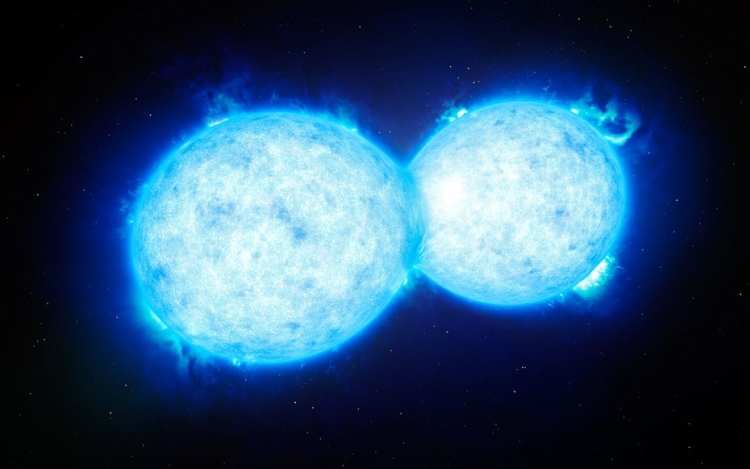
Using ESO's Very Large Telescope, an international team of astronomers have found the hottest and most massive double star with components so close that they touch each other. The two stars in the extreme system VFTS 352 could be heading for a dramatic end, during which the two stars either coalesce to create a single giant star, or form a binary black hole.
Notre Dame Astrophysicists Produce the First Age Map of the Milky Way Halo

University of Notre Dame astronomer Timothy Beers and his Galactic Archaeology team have produced the first chronographic (age) map of the halo of the Milky Way galaxy. The halo, along with the disk and bulge, are the primary components of the galaxy. Using a sample of 4700 Blue Horizontal-Branch (BHB) stars from the Sloan Digital Sky Survey (SDSS), the research team showed that the oldest stars are concentrated in the central region of the galaxy. In addition, the researchers also resolved the ages of dwarf galaxies and the stellar debris that was stripped from them due to their gravitational interaction with the Milky Way.
Largest Astronomical Image of All Time -- The Milky Way in 46 Billion Pixels

Astronomers at the Ruhr-Universitat Bochum in Germany have compiled the largest astronomical image of the night sky to date -- A picture of the Milky Way containing 46 billion pixels. In order to view it, Dr. Rolf Chini, Professor of Astrophysics, and his team of researchers have developed an online tool. The image contains data gathered in astronomical observations over a period of five years.
Geochronological Analysis of Shocked Zircon Puts Age of Moon Into Question

Phenomenally durable crystals called zircons are used to date some of the earliest and most dramatic cataclysms of the solar system. The super collision that ejected material from Earth to form the moon roughly 50 million years after Earth formed is one of these events. Another is the late heavy bombardment -- a wave of violent impacts that created the hellish surface conditions on the young Earth -- about 4 billion years ago. Both events are widely accepted but unproven, so geoscientists are eager for more details and better dates. Many of the currently accepted dates come from zircons retrieved from the moon during NASA's Apollo voyages in the 1970s. However, a new study of zircons from a gigantic meteorite impact in South Africa casts doubt on the methods used to date lunar impacts.
Imagine That... Pluto Has Blue Skies and Water Ice
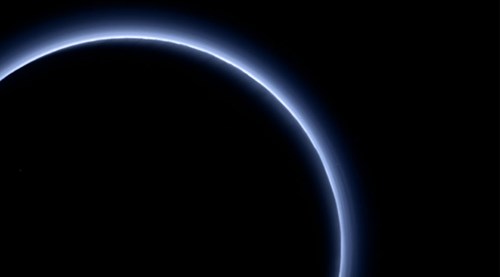
The first color images of Pluto's atmospheric haze, returned by NASA's New Horizons spacecraft last week, reveal an unexpected rich blue color. The way the haze particles scatter the blue light has gotten the attention of the New Horizons science team. On Earth, particles in the atmosphere are very tiny nitrogen molecules. On Pluto they appear to be larger, but still relatively small, soot-like particles called tholins.
New "Stealth Dark Matter" Theory May Explain Universe's Missing Mass

Dark matter makes up 83 percent of all matter in the universe and does not interact directly with electromagnetic or strong and weak nuclear forces. Light does not bounce off of it and ordinary matter goes through it with only the feeblest of interactions. Lawrence Livermore National Laboratory (LLNL) scientists have now come up with a new theory that may identify why dark matter has evaded direct detection in Earth-based experiments. They believe that even though dark matter is naturally "stealthy" today, it would have been easy to see via interactions with ordinary matter in the extremely high temperature plasma conditions that pervaded the early universe.
Percival Lowell Was Right After All -- There Is Flowing Water on Mars
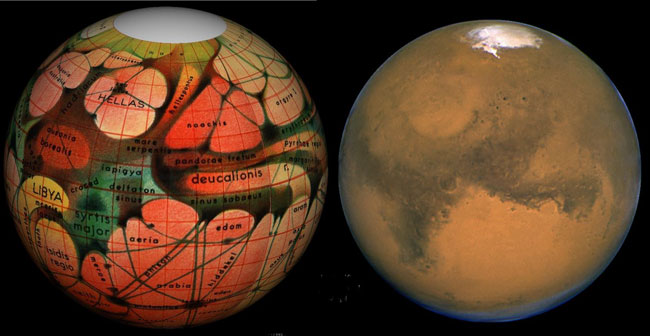
New findings from NASA's Mars Reconnaissance Orbiter (MRO) provide the strongest evidence yet that liquid water flows intermittently on present day Mars. Using an imaging spectrometer on MRO, researchers detected signatures of hydrated minerals on slopes where mysterious streaks have been seen on the Red Planet. These darkish streaks appear to ebb and flow over time. They darken and appear to flow down steep slopes during warm seasons and then fade in cooler seasons, indicating the presence of flowing water.
"Supermoon" Total Lunar Eclipse to be Visible on Sunday Night
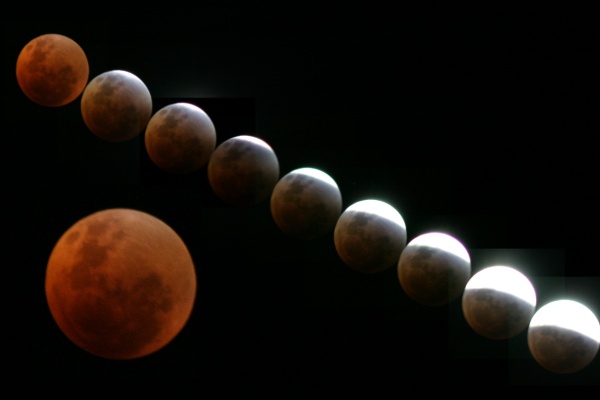
For the first time in more than 30 years, we'll be able to witness a "Supermoon" in combination with a total lunar eclipse. Late on Sunday, September 27, 2015, in the USA and in much of the world, a total lunar eclipse will mask the moon's face for more than an hour. So, what makes this a "Supermoon" total eclipse? On September 27th, we're going to have a perigee full moon -- That is the moon will be at its closest point to the Earth for the year. The timing of the total eclipse will coincide with the perigee full moon and the moon will appear 14 percent larger and 30 percent brighter in the night sky than during an apogee full moon. The total eclipse will last one hour and 12 minutes and will be visible in North and South America, Europe, Africa, parts of West Asia, and the eastern Pacific.
One Decade After Launch, Mars Reconnaissance Orbiter Still Going Strong

Although designed originally for a two year mission, ten years after launch, NASA's Mars Reconnaissance Orbiter (MRO) continues to reveal the Red Planet's diversity and activity, returning more data about Mars every week than the weekly total from all six other active Mars missions... Yet its work is far from over. The spacecraft has been orbiting Mars at an altitude of about 186 miles (300 kilometers), passing near the north and south poles about 12 times a day. The workhorse orbiter is now playing a key role in NASA's Journey to Mars planning as it searches for candidate sites where humans will first explore the Martian surface in the 2030s.
Farthest Galaxy Detected by CalTech Researchers
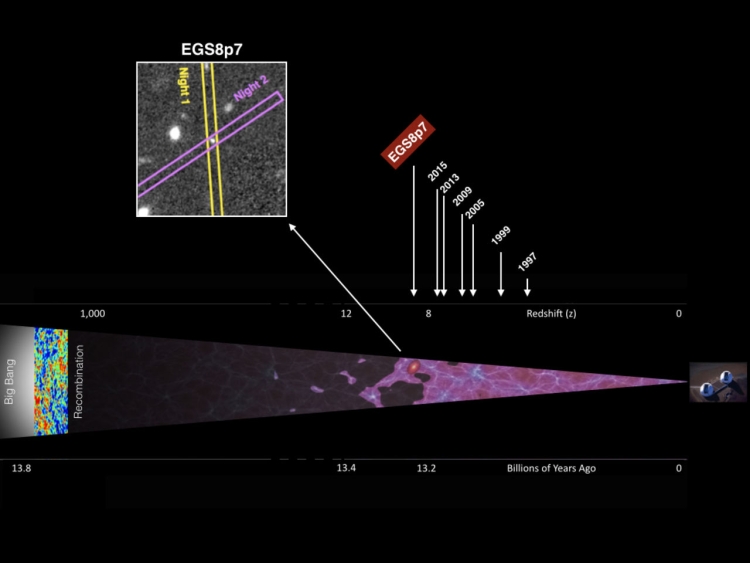
CalTech Researchers have reported the detection of the farthest object yet, a galaxy called EGS8p7. At more than 13.2 billion years old, it provides a fascinating glimpse of the very early universe, just 600,000 years after the Big Bang.
New Horizons Team Selects Next Kuiper Belt Flyby Target

NASA has selected the potential next destination for the New Horizons mission to visit after its historic July 14, 2015 flyby of the Pluto system. The destination is a small Kuiper Belt Object (KBO) known as 2014 MU69 that orbits nearly a billion miles beyond Pluto. Scientists estimate that PT1 is just under 30 miles (about 45 kilometers) across. Early target selection was important, as the team needs to direct New Horizons toward the object this year in order to perform any extended mission with healthy fuel margins.
Historic 24 Inch Clark Telescope at Lowell Observatory to Reopen

Lowell Observatory's historic Clark Telescope in Flagstaff, Arizona will return to tour operations on September 5, 2015 after a 20 month long renovation project. The 24 Inch Clark refractor had been a mainstay for visitor to Lowell for decades, but the constant heavy use resulted in parts wearing out. By 2013, the instrument was in danger of permanent damage if corrective measures weren't taken, so the Observatory undertook a fundraising campaign to support a complete renovation of the telescope and the dome that houses it.
Supernovae in the Wrong Place, But it Must Have Been the Wrong Time
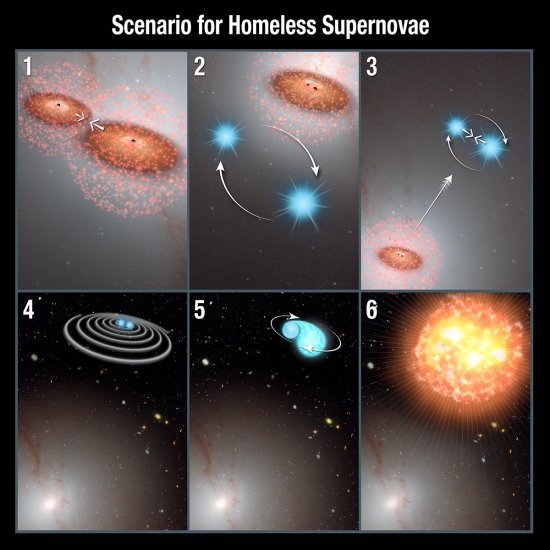
What happens when you find something in the wrong place at the wrong time? That's a question astronomers have been trying to answer after finding several exploding stars outside the cozy confines of galaxies, where most stars reside. These wayward supernovae also have puzzled astronomers because they exploded billions of years before their predicted detonations. Astronomers using archived observations from several telescopes, including the Hubble Space Telescope, Lick Observatory, W. M. Keck Observatory, and the Subaru Telescope, have developed a theory for where these doomed stars come from and how they arrived at their current homes.
Funding Member
