News
Surprising New Class of Hyper-velocity Stars Discovered Escaping the Galaxy
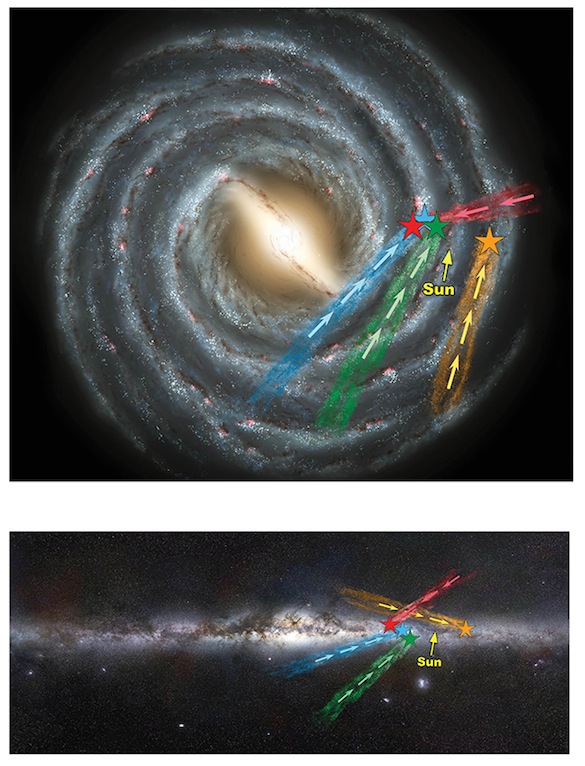
An team of astronomers at Vanderbilt University has discovered a surprising new class of Hyper-velocity Stars -- solitary stars moving fast enough to escape the gravitational grasp of the Milky Way galaxy. The most commonly accepted mechanism for kicking a star out of the galaxy involves an interaction with the supermassive black hole at the galactic core. None of these Hyper-velocity stars come from the center, which implies that these may belong to a new class of Hyper-velocity Stars that use a different ejection mechanism.
Orbital Successfully Launches Its First Resupply Mission to the ISS

Orbital Sciences Corporation, a leading space technology company, has successfully launched its Antares medium-class rocket carrying the first of eight regularly scheduled Cygnus cargo logistics spacecraft missions to the International Space Station (ISS). This first mission will culminate in rendezvous and berthing with the ISS on Sunday, January 12, 2014. Cygnus will deliver approximately 2780 lbs. (1260 kg.) of cargo to the Expedition 38 astronauts and remain attached to the space station until February 18th before departing with approximately 2800 lbs. (1300 kg.) of disposable cargo for a safe, destructive reentry over the Pacific Ocean.
Gemini Planet Imager First Light!
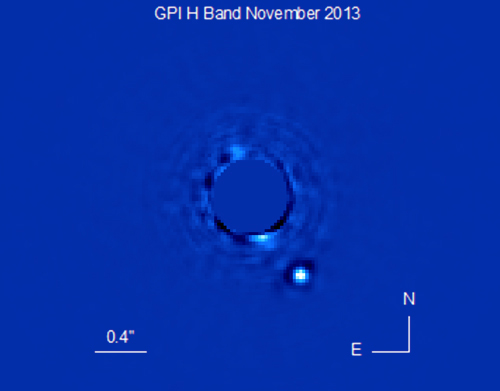
After nearly a decade of development, construction, and testing, the world’s most advanced instrument for directly imaging and analyzing planets around other stars is pointing skyward and collecting light from distant worlds. The instrument, called the Gemini Planet Imager (GPI), was designed, built, and optimized for imaging faint planets next to bright stars and probing their atmospheres. It will also be a powerful tool for studying dusty, planet-forming disks around young stars. It is the most advanced such instrument to be deployed on one of the world’s biggest telescopes – the 8-meter Gemini South telescope in Chile.
Reverse Shock Waves Light-up Supernova Remnants

When a star explodes as a supernova, it shines brightly for a few weeks or months before fading away. Yet the material blasted outward from the explosion still glows hundreds or thousands of years later. What powers such long-lived brilliance? In the case of Tycho's supernova (initially observed by astronomer Tycho Brahe in 1572), astronomers have discovered that a reverse shock wave races inward at Mach 1000 (1000 times the speed of sound) and heats the remnant, causing it to emit X-ray light. Without these reverse shock waves, we wouldn't be able to study ancient supernova remnants today.
Goodbye 2013!
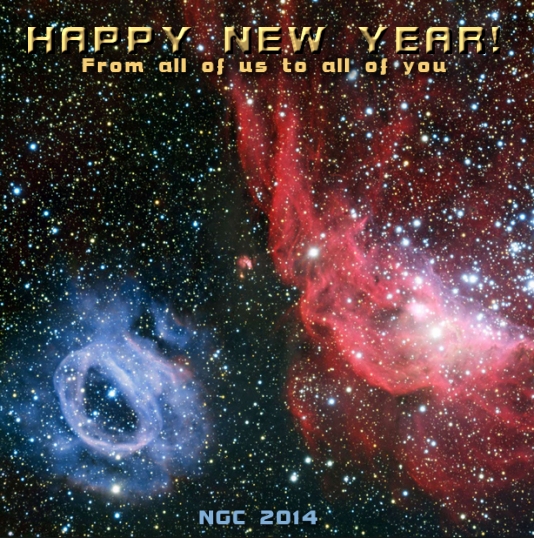
And hello 2014!!!
Merry Christmas!

From the entire Anacortes Team..
Newly Found Pulsar Helps Astronomers Explore Milky Way's Mysterious Core

Astronomers have made an important measurement of the magnetic field emanating from a swirling disk of material surrounding the black hole at the center of our Milky Way Galaxy. The measurement, made by observing a recently discovered pulsar, is providing them with a powerful new tool for studying the mysterious region at the core of our home galaxy.
Baffling Triple-Star System Reveals an Exoplanet and a Spectacular Ring of Comets
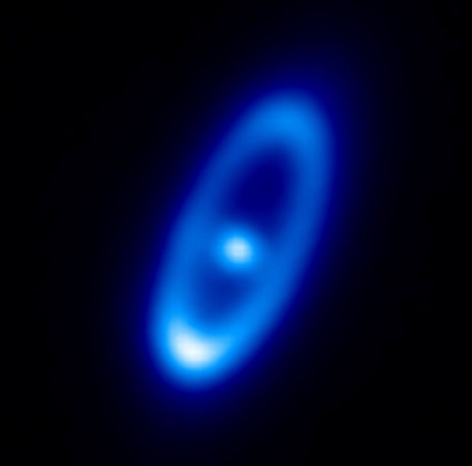
The nearby star Fomalhaut A hosts the most famous planetary system outside our own Solar System, containing both an exoplanet and a spectacular ring of comets. An international team of astronomers have announced a new discovery with the Herschel Space Observatory that has made this system even more intriguing; the least massive star of the three in the Fomalhaut system, Fomalhaut C, has now been found to host its own comet belt.
Gamma Ray Burst Tops the Charts as the Brightest Ever Seen

Gamma-ray bursts (GRBs) are the most luminous explosions in the cosmos, thought to be triggered when the core of a massive star runs out of nuclear fuel, collapses under its own weight, and forms a black hole. The black hole then drives jets of particles that drill through the collapsing star and erupt into space at nearly the speed of light. The most energetic emissions, with billion-electron-volt (GeV) gamma rays, are thought to arise when the jet slams into its surroundings, forming an external shock wave. On April 27, 2013 a blast from a dying star in a distant galaxy became the focus of astronomers around the world. The explosion, designated GRB 130427A, topped the charts as the brightest ever seen. As luck would have it, a trio of NASA satellites, working in concert with ground based robotic telescopes, captured never before seen details of the event that are now being used to challenge current theoretical understandings of how gamma ray bursts work.
Researchers Sequence the Genome of a 400,000 Year Old Hominin

Using novel techniques to extract and study ancient DNA, researchers at the Max Planck Institute in Germany, have sequenced the mitochondrial genome of a 400,000 year old hominin from Sima de los Huesos, a unique cave site in Northern Spain. They found that this group has mitochondrial DNA that is similar to that of the Denisovans, an extinct archaic group from Asia from about 700,000 years ago. The fact that the Sima hominin share a common ancestor with Denisovan rather than Neanderthals is totally unexpected since the skeletal remains at the site display Neanderthal-like features. One possible explanation may be that the Sima hominins are related to a population that is ancestral to both Neanderthals and Denisovans.
University of Texas Team Discovers Most Distant Known Galaxy
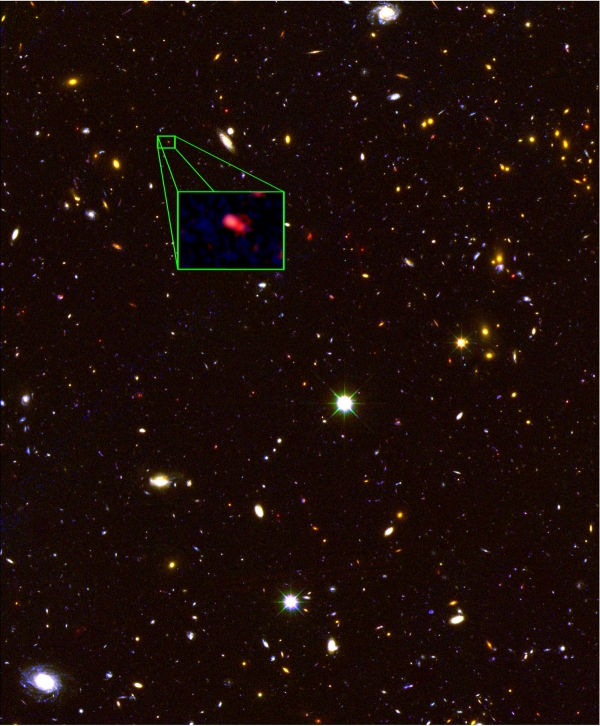
A team of astronomers from the University of Texas at Austin has discovered and measured the distance to the most distant galaxy ever found. With a redshift of 7.51, the galaxy is seen as it was at a time just 700 million years after the Big Bang, when the universe was only about 5 percent of its current age of 13.8 billion years. Although observations with NASA's Hubble Space Telescope have identified many other candidate galaxies in the early universe, including some that may perhaps be even more distant, this galaxy is the farthest and earliest whose distance can be definitively confirmed with follow-up observations from the Keck I telescope.
ISON to (Hopefully) Slingshot Around the Sun on Thanksgiving Day
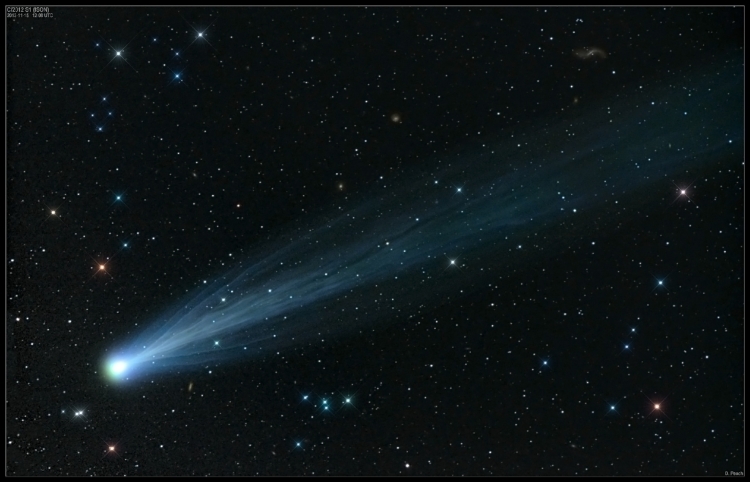
Comet ISON is now inside the orbit of Earth as it plunges headlong toward the Sun for a fiery close encounter on November 28th. Even though the comet is not yet as bright as many forecasters had predicted, according to Tony Phillips of NASA, it is still putting on a good show for observatories on the ground and in space. NASA spacecraft and amateur astronomers alike are snapping crisp pictures of the comet's gossamer green atmosphere and filamentary double-tail. Because ISON is a first-time visitor from the distant Oort cloud and has never passed through the inner solar system before, experts aren't sure what will happen next. Can the comet survive its Thanksgiving Day brush with the Sun? Will it emerge as a bright naked-eye object? We will just have to wait and see.
Lunar Orbiters Discover the Source that Powers Earth's Aurora and Radiation Belts

Solar storms - powerful eruptions of solar material and magnetic fields into interplanetary space - can cause what is known as "space weather" near Earth, resulting in hazards that range from interference with communications systems and GPS errors to extensive power blackouts and the complete failure of critical satellites. According to Emmanuel Masongsong of UCLA, some of the energy emitted by the sun during solar storms is temporarily stored in Earth's stretched and compressed magnetic field. Eventually, that solar energy is explosively released, powering Earth's radiation belts and lighting up the polar skies with brilliant auroras. And while it is possible to observe solar storms from afar with cameras, the invisible process that unleashes the stored magnetic energy near Earth had defied observation for decades.
NJIT is at the Forefront of Solar Storm Research

The devastation of Hurricanes Sandy and Katrina were very painful reminders of our vulnerability to violent terrestrial weather. According to Dean L. Maskevich of New Jersey Institute of Technology (NJIT), we are equally at risk, perhaps even more so, from another type of natural threat whose source is some 93 million miles away -- the Sun. While the star closest to Earth sustains all life on our planet, it also generates roiling interplanetary weather that can endanger and overwhelm our vital infrastructure. For more than a decade, NJIT has considerably expanded a range of unique solar research initiatives at its Center for Solar-Terrestrial Research, Big Bear Solar Observatory in California, and, in conjunction with California Institute of Technology (CalTech), the Owens Valley Solar Array.
A Chelyabinsk-like Meteor is Seven Times More Likely to Occur Than Originally Thought
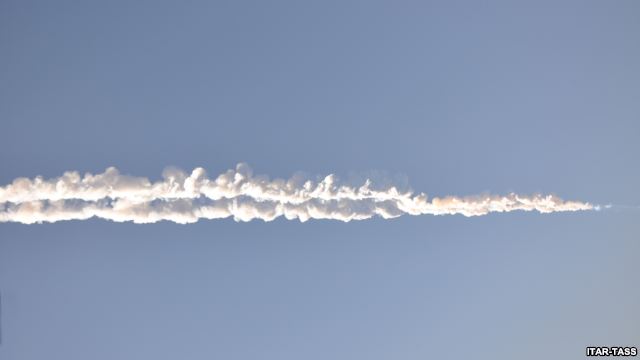
Scientists have been studying data on the meteor that exploded over Chelyabinsk, Russia in February 2013. The Chelyabinsk meteor is the largest known natural object to enter Earth's atmosphere since an object widely suspected to be an asteroid caused a powerful explosion in the sky over the Podkamennaya Tunguska River in Siberia in 1908. New studies suggest that such occurrences are about seven times greater than the current state of the telescopic surveys would indicate.
Funding Member
