News
Starbirth Surprisingly Energetic: ALMA observations give new insights into protostars
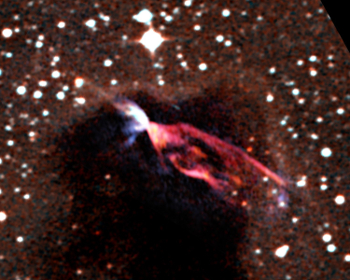
While observing a newborn star, astronomers using the Atacama Large Millimeter/submillimeter Array (ALMA) telescope discovered twin jets of matter blasting out into space at record-breaking speed. These surprisingly forceful molecular "winds" could help refine our understanding of how stars impact their cloudy nurseries and shape their emerging stellar systems.
Update on ISON -- The "Comet of the Century?"
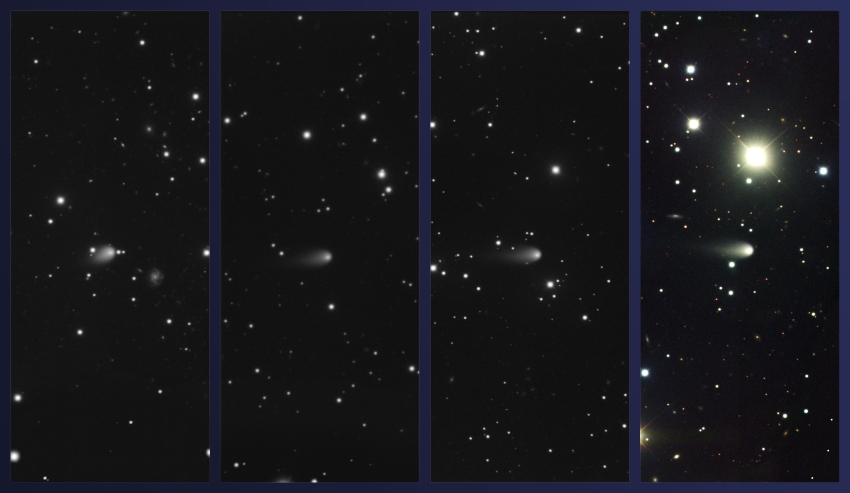
On November 28, 2013, Comet ISON will make one of the closest passes ever recorded by a comet as it grazes the Sun, penetrating the million-degree outer atmosphere. If Comet ISON survives that close encounter, it may appear in our morning sky before dawn in early December and become one of the greatest observable comets in recent memory. However, comets are notoriously unpredictable. Will we get a spectacular show? Stay tuned...
Voyager 1 Has Left the Solar System, Says New Study

Voyager 1 appears to have, at long last, left our solar system and entered interstellar space, says a University of Maryland-led team of researchers. Carrying Earthly greetings on a gold plated phonograph record and still-operational scientific instruments, including the Low Energy Charged Particle detector designed, built and overseen, in part, by UMD's Space Physics Group, NASA's Voyager 1 has traveled farther from Earth than any other human-made object. And now, these researchers say, it has begun the first exploration of our galaxy beyond the Sun's influence.
The Sun's Magnetic Field is About to Flip and Change Polarity

Something big is about to happen on the Sun. According to measurements from NASA-supported observatories, the Sun's vast magnetic field is about to flip. It looks like we're no more than 3 to 4 months away from a complete field reversal. But not to worry -- The Sun's magnetic field changes polarity approximately every 11 years. It happens at the peak of each solar cycle as the Sun's inner magnetic dynamo re-organizes itself.
Thirty Meter Telescope (TMT) Reaches Milestone

With the signing last week of a "master agreement" for the Thirty Meter Telescope — destined to be the most advanced and powerful optical telescope in the world — the University of California and UCLA moved a step closer to peering deeper into the cosmos than ever before. Work on the Thirty Meter Telescope (TMT), named for its 30-meter primary mirror — three times the diameter of the largest existing telescopes — is scheduled to begin in April 2014 atop Hawaii's dormant Mauna Kea volcano. The TMT's scientific operations are slated to start in 2022.
Astrophysicists Confirm Existence of a New Class of Astronomical Phenomenon -- The Fast Radio Burst

Astrophysicists from the Swinburne University of Technology in Australia are part of an international team that has confirmed the existence of a new class of astronomical phenomenon known as the Fast Radio Burst(FRB). An FRB is a short milliseconds-duration burst of radio emissions originating billions of light years away. The team's work confirms the authenticity of a previously detected signal known as the "Lorimer Burst," a mysterious event that occurred in 2001 and has until now been quite controversial. The unique frequency spectrum pattern produced by FRBs could be useful in helping determine the mass and evolution of the Universe.
The Mysterious Centaurs -- Are They Asteroids or Comets?

Similar in many ways to the asteroid belt between Mars and Jupiter, there is another belt of small celestial bodies orbiting the Sun between Jupiter and Neptune. These objects are called the Centaurs and their true identity is one of the enduring mysteries of astrophysics. Are they asteroids or comets? A new study of observations from NASA's Wide-field Infrared Survey Explorer (WISE) uncovers some interesting results.
Exotic Pulsar and White Dwarf Binary Pair Help Prove That Einstein Was Right

Astronomers using ESO's Very Large Telescope, along with radio telescopes around the world, have discovered an exotic binary pair that consists of a tiny, but unusually heavy neutron star that spins 25 times each second, orbited every two and a half hours by a white dwarf star. This strange new binary provides a unique laboratory that allows tests of Einstein's theory of gravity in ways that were not possible up to now. So far the new observations exactly agree with the predictions from General Relativity. Einstein's General Theory of Relativity, which explains gravity as a consequence of the curvature of space-time created by the presence of mass and energy, has withstood all tests since it was first published almost a century ago.
Smile and Wave -- Cassini to Take Photo of Earth From Saturn on July 19th
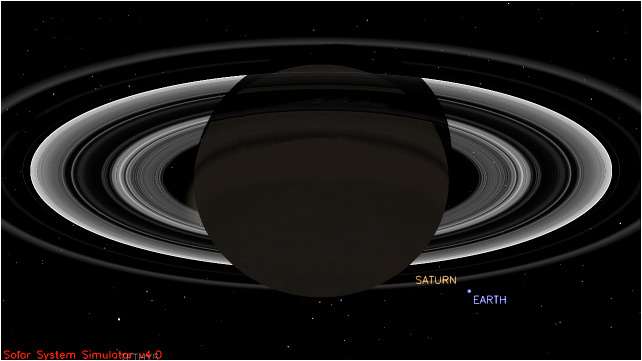
On July 19, 2013, NASA's Cassini spacecraft will take a picture of Earth from about 898 million (1.44 billion kilometers) away, or nearly ten times the distance between Earth and the Sun. It will be the first time we have had advance notice that our picture will be taken from interplanetary distances.
Sounding Rocket-based Camera Reveals Sharpest Images Yet of Sun's Outer Atmosphere

Using an innovative new camera, an international team of scientists have captured the sharpest images yet of the Sun's outer atmosphere. The team used a sounding rocket to launch the NASA High Resolution Coronal Imager (Hi-C) from the White Sands Missile Range in New Mexico. During its short flight, the Hi-C team obtained images of the solar atmosphere (the solar corona) five times sharper than anything seen before.
It's the End of the Line for NASA's GALEX Galaxy Hunter Spacecraft
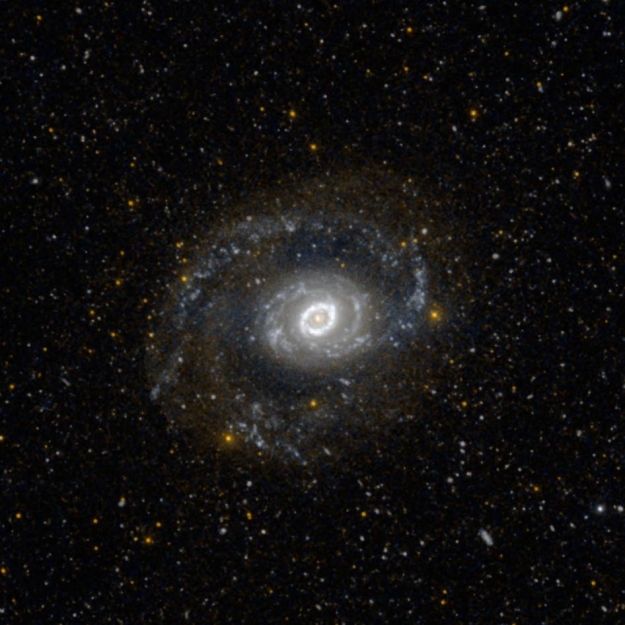
NASA has turned off its Galaxy Evolution Explorer (GALEX) after a decade of operations in which the venerable space telescope used its ultraviolet vision to study hundreds of millions of galaxies across 10 billion years of cosmic time. The spacecraft will remain in orbit for at least 65 more years, then fall to Earth and burn up upon re-entering the atmosphere. GALEX met its prime objectives and the mission had been extended three times before finally being cancelled.
Dr. James E. Gunn with Prestigious Bruce Gold Medal Award

Dr. James E. Gunn is the 2013 recipient of its prestigious Catherine Wolfe Bruce Gold Medal. Dr. Gunn, of Princeton University, is recognized for his lifetime achievements in astronomical theory, observation and instrumentation.
Low Sodium Diet is the Key to Old Age for Stars

Astronomers expect that stars like our Sun will ultimately blow off much of their atmospheres into space near the ends of their lives. But new observations with the European Southern Observatory (ESO) Very Large Telescope (VLT) of a huge star cluster in the constellation Pavo have shown - against all expectations - that a majority of the stars studied simply did not get to this final stage in their lives at all. This has created a major headache for current stellar theories. It seems that the amount of sodium in the stars is a very strong predictor of how they end their lives.
NASA's Chandra Turns Up a Black Hole Bonanza in the Andromeda Galaxy

The Chandra X-ray Observatory is the world's most powerful X-ray telescope. It has eight-times greater resolution and is able to detect sources more than 20-times fainter than any previous X-ray telescope. Using data from NASA's Chandra X-ray Observatory, astronomers have discovered an unprecedented bonanza of black holes in the Andromeda Galaxy, the nearest galaxy to the Milky Way.
NASA's Van Allen Probes Reveal a New Radiation Belt Around Earth

After most NASA science spacecraft launches, researchers wait patiently for months as instruments on board are turned on one at a time and tested to make sure they work at full capacity. Such a schedule was in place for the Van Allen Probes when they launched on August 30, 2012 to study the two giant belts of radiation that surround Earth. But a group of scientists on the mission made a case for changing the plan. They asked that the probes be turned on early so that their observations could overlap with another mission called SAMPEX, which was soon going to de-orbit and re-enter Earth's atmosphere. It was a lucky decision. Within mere days of launch, NASA's Van Allen Probes discovered a previously unknown third radiation belt around Earth.
Funding Member
