News
New Dwarf Planet Discovered in the Outer Reaches of Our Solar System

The Solar System has a new most-distant member, bringing its outer frontier into better focus. Astronomers reported today the discovery of a distant dwarf planet called 2012 VP113. This is likely one of thousands of distant objects that are thought to form the so-called inner Oort cloud. What's more, their work indicates the potential presence of an enormous planet, perhaps up to 10 times the size of Earth, not yet seen, that is possibly influencing the orbit of 2012 VP113 as well as other inner Oort cloud objects. Up to now, only one dwarf planet, Sedna, was known to exist in the Oort cloud. But the newly found 2012 VP113 has an orbit that stays even beyond Sedna, making it the furthest known in the Solar System.
NASA's Kepler Mission Discovers a Planet Bonanza -- 715 New Worlds
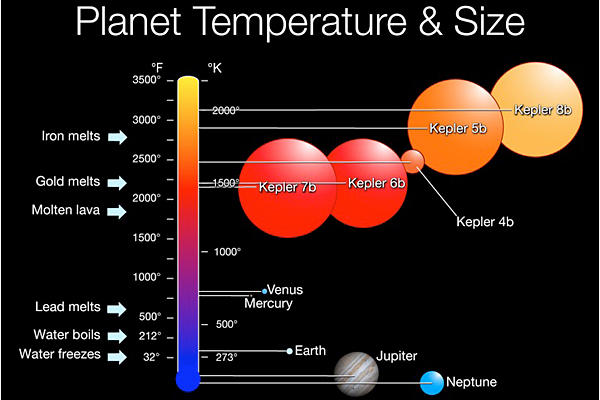
NASA's Kepler mission has announced the discovery of 715 new planets. These newly-verified worlds orbit 305 stars, revealing multiple planet systems -- some like our own solar system.
Astrophysicists Announce Direct Gravitational Wave-based Evidence of Cosmic Inflation After the Big Bang

Our universe burst into existence with the Big Bang 13.8 Billion years ago. Moments later, space itself ripped apart, expanding exponentially in an episode known as "Inflation." Astrophysicists announced today that they have acquired the first direct evidence that gravitational waves rippled through our infant universe during this explosive period of growth, providing the strongest confirmation yet for cosmic inflation theories, which say that the universe expanded by 100 Trillion-Trillion times in less than the blink of an eye.
ESO's VLT Spots the Largest Yellow Hypergiant Star to Date... And It's an Exotic Binary
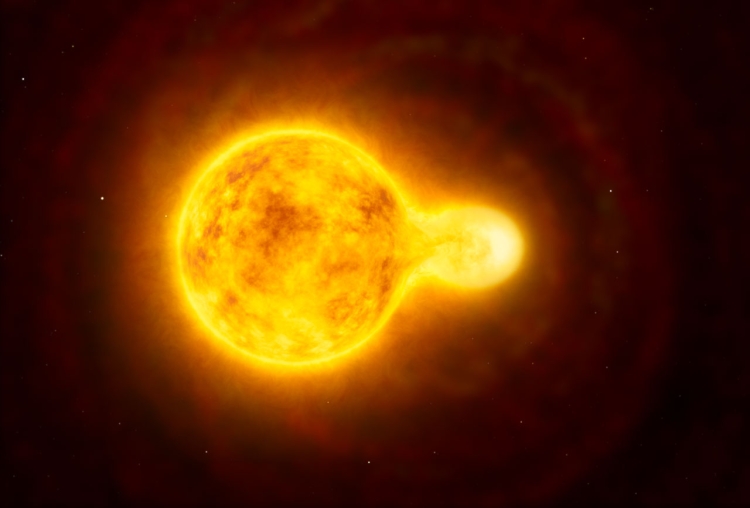
ESO's Very Large Telescope Interferometer has revealed the largest yellow star -- and one of the ten largest stars found so far. This hypergiant has been found to measure more than 1300 times the diameter of the Sun and to be part of a double star system, with the second component so close that it is in contact with the main star. Observations spanning over sixty years, some from amateur observers, also indicate that this rare and remarkable object is changing very rapidly and has been caught during a very brief phase of its life.
NASA-funded Sounding Rocket Launches Straight Through an Aurora Over Alaska

On the early morning of March 3, 2014, a NASA-funded sounding rocket launched straight into an aurora over Venetie, Alaska. The Ground-to-Rocket Electrodynamics - Electron Correlative Experiment, or "GREECE" sounding rocket mission, which launched from the Poker Flat Research Range in Alaska, was used to study classic curls of the aurora in the night sky. The mission seeks to understand what events that set up these auroral curls in the charged, heated gas - or plasma - where aurorae form. This piece of information will help paint a picture of the Sun-Earth connection and how energy and particles from the Sun interact with Earth's magnetic system, the Magnetosphere.
Spanish Researchers Discover the First Black Hole Orbiting a Fast-spinning Star
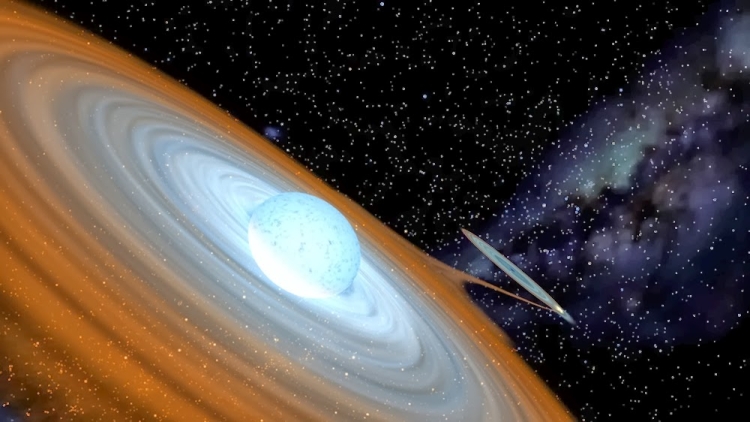
Spanish scientists have discovered the first binary system consisting of a black hole and a fast-spinning star known as a Be-type star. Although predicted by theory, none had previously been found. The observations that led to the discovery were performed with the Liverpool and Mercator telescopes at the Observatorio del Roque de los Muchachos in the Canary Islands. The newly discovered black hole orbits a Be-type star located in the constellation Lacerta (the Lizard), 8,500 light years from Earth. The distinctive property of Be-type stars is their strong centrifugal force. They rotate very fast - close to their break-up speed - often exceeding 1 million kilometers per hour.
Astronomers Spot Record-Breaking Lunar Impact
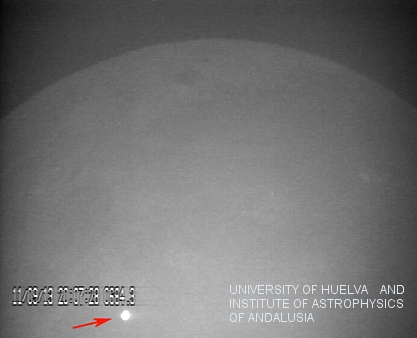
A meteorite with the mass of a small car crashed into the Moon last September, according to Spanish astronomers. The impact, the biggest seen to date, produced a bright flash and would have been easy to spot from the Earth. The scientists publish their description of the event in the journal Monthly Notices of the Royal Astronomical Society.
Despite Ten-fold Increase in Sensitivity, LUX Fails to Detect Dark Matter

Dark matter is thought to account for about 80 percent of the mass of the universe. Though it has not yet been detected directly, its existence is a near certainty among physicists. Without the gravitational influence of dark matter, galaxies and galaxy clusters would simply fly apart into the vastness of space. It's not clear exactly what dark matter is, but the leading idea is that it consists of subatomic particles called WIMPs, short for Weakly Interacting Massive Particles. WIMPs are thought to be practically ubiquitous in the universe, but because they interact so rarely with other forms of matter, they generally pass right through the Earth and everything in it without anyone knowing it. A new calibration of the Large Underground Xenon (LUX) Dark Matter Detector brought a ten-fold increase in calibration accuracy, yet failed to detect dark matter. If low-mass WIMP particles had passed through the detector, LUX would have found them.
Jean Texereau (1920-2014)

Jean Texereau, Master Optician One of the giants of telescope making has died. He shared his years of professional experience with amateurs around the world.
John L. Dobson 1915-2014
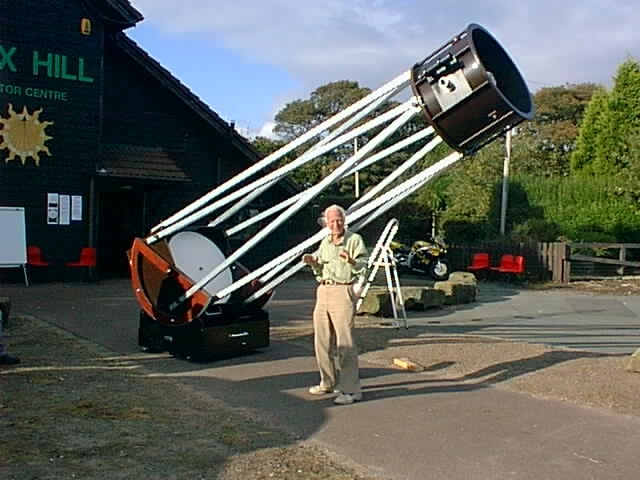
John Dobson, the self-taught stargazer who designed the powerful, inexpensive Dobsonian telescope, died January 15, 2014 at a hospital in Burbank, California. He was 98. His death was confirmed by the Burbank chapter of Sidewalk Astronomers, an international organization that John Dobson helped found in 1968. John Dobson was arguably the most influential person in amateur astronomy in the last 30 years. He almost single-handedly revolutionized amateur astronomy by making deep space accessible to millions. Through his free star parties and slide shows, he encouraged both young and old to think about the Universe and observe its beauty with their own eyes.
Water Detected on the Dwarf Planet Ceres

Scientists using the European Space Agency's Herschel Space Observatory have made the first definitive detection of water vapor on the largest and roundest object in the asteroid belt, Ceres. Plumes of water vapor are thought to shoot up periodically from Ceres when portions of its icy surface warm slightly. Ceres is classified as a dwarf planet, a solar system body bigger than an asteroid and smaller than a planet.
Solving a 30-Year-Old Problem in Massive Star Formation
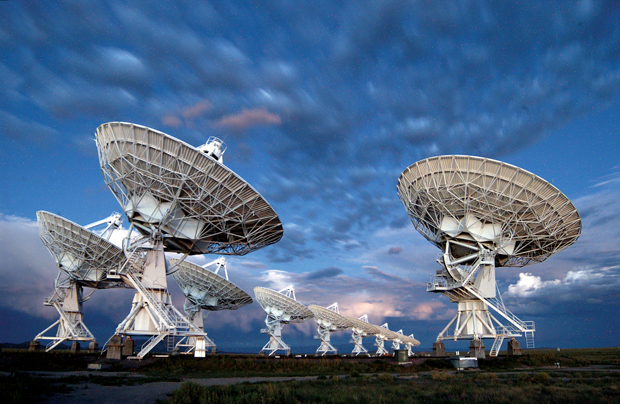
An international group of astrophysicists has found evidence strongly supporting a solution to a long-standing puzzle about the birth of some of the most massive stars in the universe. Young massive stars, which have more than 10 times the mass of the Sun, shine brightly in the ultraviolet, heating the gas around them. It has long been a mystery why the hot gas doesn't explode outwards. Now, observations made by a team of researchers using the Jansky Very Large Array (VLA), a radio astronomy observatory in New Mexico, have confirmed a predication that as the gas cloud collapses, it forms dense filamentary structures that absorb the star's ultraviolet radiation when it passes through them. As a result, the surrounding heated nebula flickers like a candle.
Green Bank Telescope Reveals Rivers of Hydrogen Flowing through Space
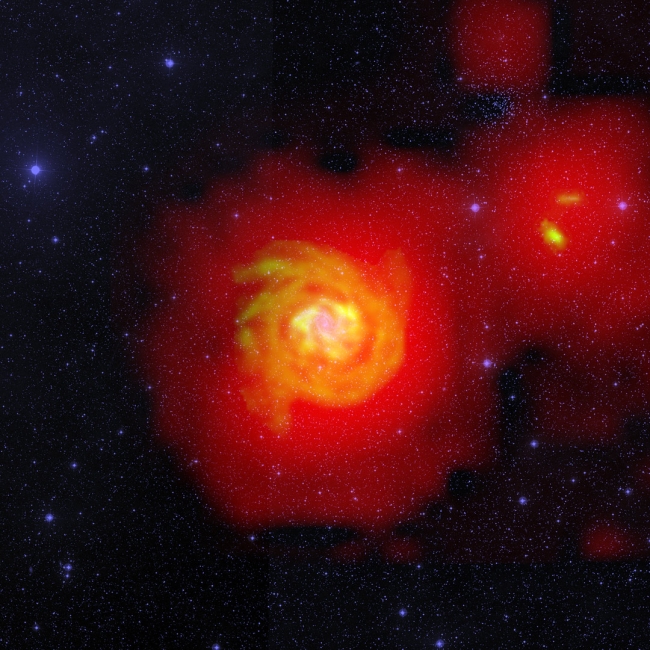
Using the National Science Foundation's Robert C. Byrd Green Bank Telescope (GBT), astronomer D.J. Pisano from West Virginia University has discovered what could be a never-before-seen river of hydrogen flowing through space. This very faint, very tenuous filament of gas is streaming into the nearby galaxy NGC 6946 and may help explain how certain spiral galaxies keep up their steady pace of star formation with no readily identifiable source of fuel. Rivers of hydrogen - known as cold flows - may be ferrying hydrogen through intergalactic space, clandestinely fueling star formation in galaxies. But this tenuous hydrogen has been simply too diffuse to detect -- until now.
Extreme Power of a Black Hole is Revealed

Astronomers have used NASA's Chandra X-ray Observatory and a suite of other telescopes to reveal one of the most powerful black holes known, in a galaxy cluster located about 3.9 billion light years from Earth. The black hole has created enormous structures in the hot gas surrounding it and has prevented trillions of stars from forming. It is believed that this black hole may be "ultramassive" in size rather than simply supermassive, with a mass more than 10 billion times that of the sun.
Distant Quasar Illuminates a Filament of the Cosmic Web

Astronomers have discovered a distant quasar illuminating a vast nebula of diffuse gas, revealing for the first time part of the network of filaments thought to connect galaxies in a cosmic web. Cosmologists generally believe that matter in intergalactic space is distributed in a vast network of interconnected filamentary structures of gas known as the cosmic web. The vast majority of atoms in the Universe reside in this web as primordial hydrogen -- vestigial matter left over from the Big Bang. Researchers from the University of California at Santa Cruz and the Max Planck Institute for Astronomy have now captured an image of these filamentary structures for the first time. To achieve this, they exploited the intense radiation generated by a supermassive black hole in a quasar.
Funding Member
