News
The Approach of Comet Nevski-Novichonok (Comet ISON)
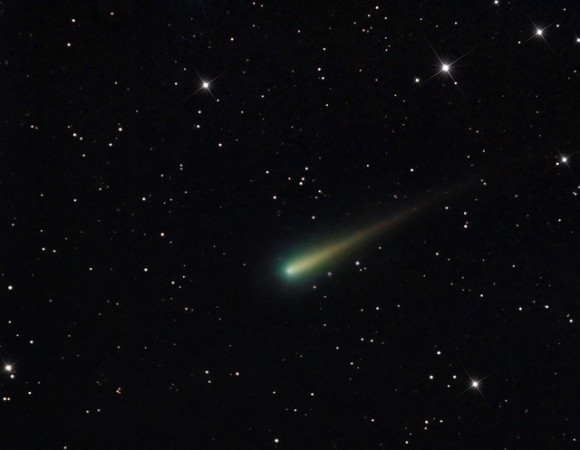
Will Comet ISON (C/2012 S1) rival Comet Ikeya-Seki (C/1965 S1)?
Astronomers Discover Gravitational Lens at Record Distance -- and Can Hardly Believe Their Luck

Light is affected by gravity, and light passing a distant galaxy will be deflected as a result. Since the first find in 1979, numerous such gravitational lenses have been discovered. A team of astronomers from the Max Planck Institute for Astronomy has found the most distant gravitational lens yet - a galaxy that, as predicted by Albert Einstein's general theory of relativity, deflects and intensifies the light of an even more distant object. But this discovery also poses a mystery. Lenses of this kind should be exceedingly rare. Given this and recent other finds, astronomers either have been phenomenally lucky or, more likely, they have underestimated substantially the number of small, very young galaxies in the early universe.
Halloween On Saturn: A Hex(agon) On You

A bizarre hexagonal feature at Saturn's North Pole has been a puzzle for twenty-five years
Massive Black Hole at the Center of the Milky Way
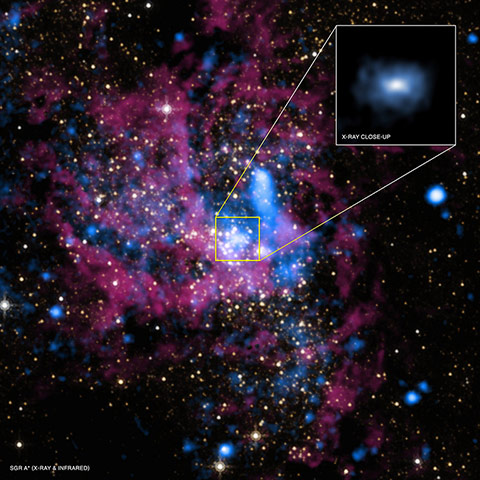
Hot gas pouring down the 'throat' of a massive black hole.
The Largest Star Known is Tearing Itself Apart
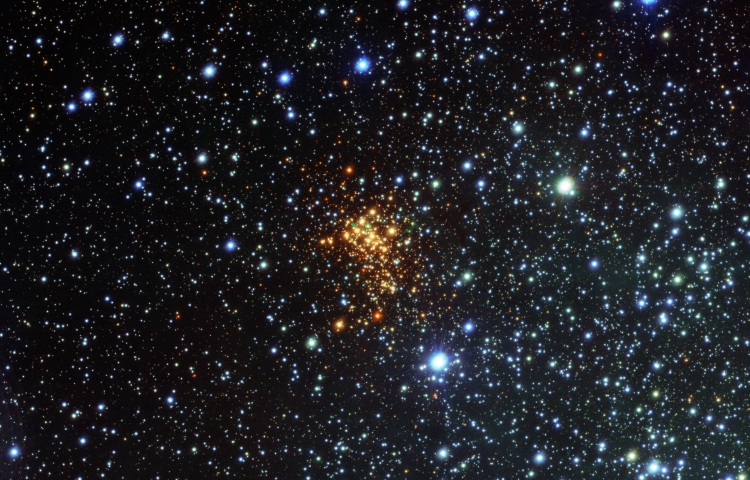
Stars with masses greater than ten times that of the Sun live very short and dramatic lives compared to their less massive siblings. Some of the most massive stars have lifetimes of less than a few million years before they exhaust their nuclear fuel and explode as supernovae. An international team of astronomers has observed part of the final death throes of W26, the largest known star in the Universe, as it throws off its outer layers. W26 is a Red Super Giant and has a radius 1500 times larger than the Sun. The discovery is a vital step in understanding how massive stars return enriched material to the interstellar medium -- the space between stars -- which is necessary for forming planetary systems.
Sky Survey Captures Key Details of Cosmic Explosions
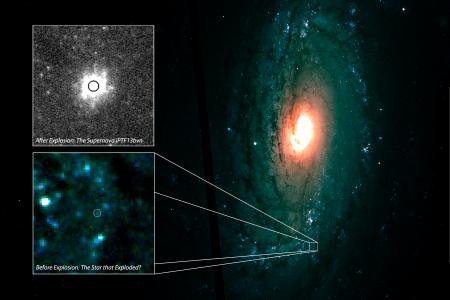
Developed to help scientists learn more about the complex nature of celestial objects in the universe, astronomical surveys have been cataloguing the night sky since the beginning of the 20th century. The intermediate Palomar Transient Factory (iPTF)—led by the California Institute of Technology (Caltech)—started searching the skies for certain types of stars and related phenomena in February. Since its inception, iPTF has been extremely successful in the early discovery and rapid follow-up studies of transients—astronomical objects whose brightness changes over timescales ranging from hours to days—and two recent papers by iPTF astronomers describe first-time detections: one, the progenitor of a rare type of supernova in a nearby galaxy; the other, the afterglow of a gamma-ray burst in July.
ALMA Discovers Large "Hot" Cocoon around a Small Baby Star
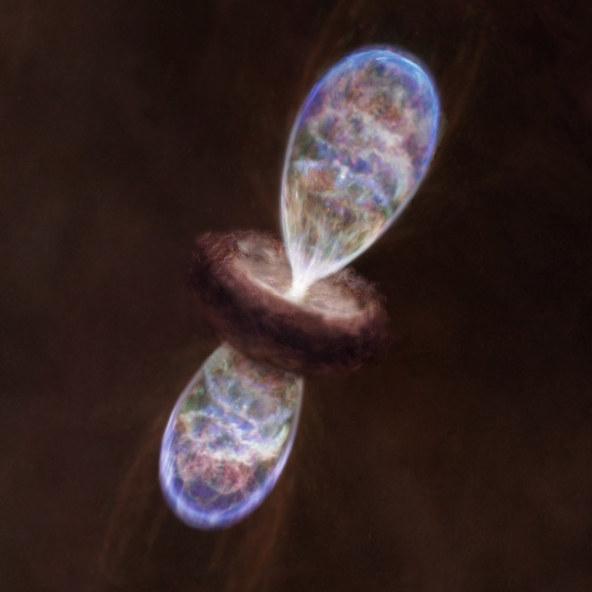
A large hot molecular cloud around a very young star was discovered by ALMA. This hot cloud is about ten times larger than those found around typical solar-mass baby stars, which indicates that the star formation process has more diversity than ever thought. This result was published in the Astrophysical Journal on September 20th, 2013.
Scientists generate first map of clouds on an exoplanet
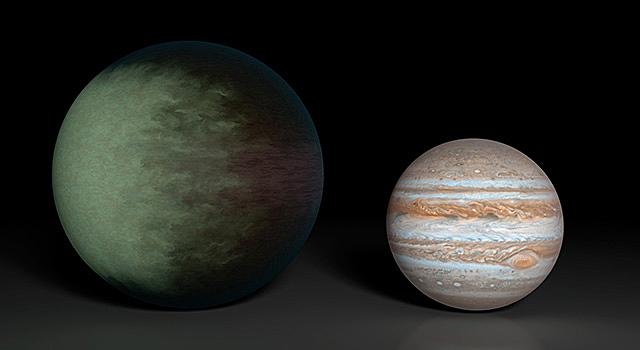
On the exoplanet Kepler 7b, the weather is highly predictable, an international team of scientists has found: On any given day, the exoplanet, which orbits a star nearly 1,000 light-years from Earth, is heavily overcast on one side, while the other side likely enjoys clear, cloudless weather. The new work, by researchers from MIT and other institutions, is the first mapping of the distribution of clouds on an exoplanet. The scientists observed that one of Kepler 7b's hemispheres is blanketed with a dense layer of clouds - far denser than any found on Earth, and so thick that it reflects a significant portion of its host star's incoming light. This shield of clouds makes the planet cooler than others of its type, creating an atmosphere that encourages further cloud formation.
Heavy Metal Stars Have Lead in Their Atmospheres

A team of astronomers from the Armagh Observatory in Northern Ireland report the discovery of two unusual stars with extremely high concentrations of lead in their atmospheres. The two stars have surfaces containing ten thousand (10,000) times more lead than is present on the surface of the Sun. These stars form a new group of stars coined "Heavy Metal Sub-Dwarfs," and are believed to be a crucial link between bright red giants (stars thirty or forty times the size of the Sun) and faint blue sub-dwarfs (stars one fifth the size, but seven times hotter and seventy times brighter than the Sun). For these rare stars, it is still not known how they form and what they will eventually become.
UK Scientists Believe That Life is Continuously Entering Earth's Atmosphere From Space
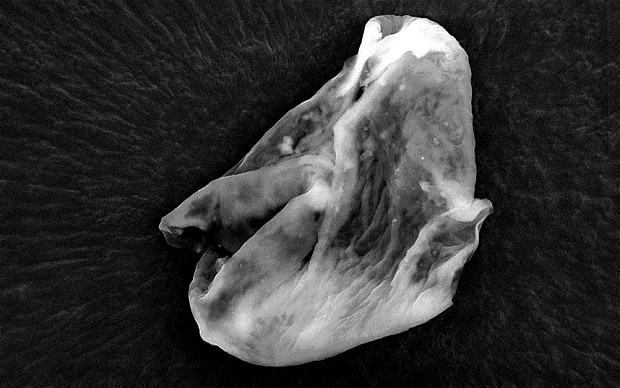
By using a balloon that was sent up into the stratosphere, scientists from the University of Sheffield in the UK believe they have found microscopic alien life forms that have arrived to Earth from space. If this is true, and life does continuously enter from space, then we will have to completely change our views of biology and evolution. The group's findings have been published in the Journal of Cosmology. The team hopes to extend and confirm its results by carrying out the test again in October 2013 to coincide with the upcoming Haley's Comet-associated meteorite shower, when there will be large amounts of cosmic dust entering the atmosphere from space.
That's Odd -- Butterfly-Shaped Planetary Nebulae Tend to be Mysteriously Aligned
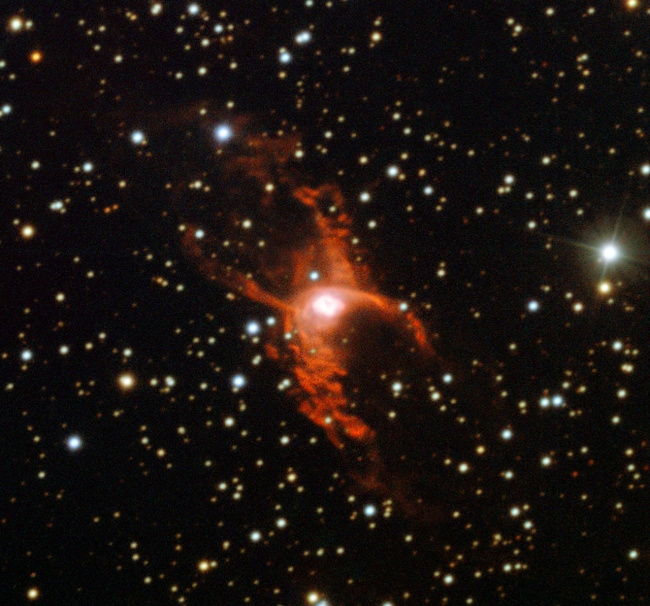
The final stage of life for a star like our Sun results in the star blowing its outer layers into the surrounding space, forming an object known as a planetary nebula. Planetary nebulae are created in a wide range of beautiful and striking shapes. One type, known as the Bipolar Planetary Nebulae, takes on a ghostly hourglass or butterfly shape around its parent star. Astronomers using ESO's New Technology Telescope (NTT) and the NASA/ESA Hubble Space Telescope have studied 130 planetary nebulae in the central bulge of our galaxy and have made a discovery that has them scratching their heads. It seems that butterfly-shaped planetary nebulae tend to be mysteriously aligned — a surprising result given their different histories and varied properties.
Texas Astronomers Unravel 20-Year Dark Matter Mystery with New Computer Models
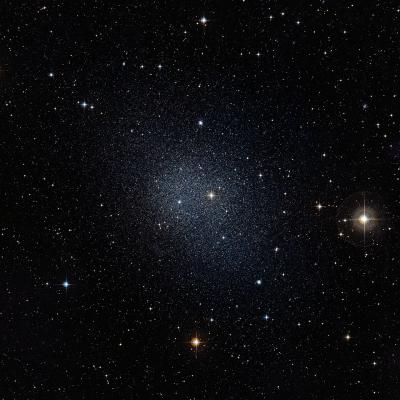
Astronomers at The University of Texas at Austin believe they have discovered the answer to a 20-year debate over how the mysterious cosmic "dark matter" is distributed in small galaxies. Graduate student John Jardel and his advisor Karl Gebhardt found that the distribution, on average, follows a simple law of decreasing density from the galaxy's center, although the exact distribution often varies from galaxy to galaxy. The findings are published today in The Astrophysical Journal Letters.
Japanese Astronomers Measure the Velocity of a Supernova Shockwave
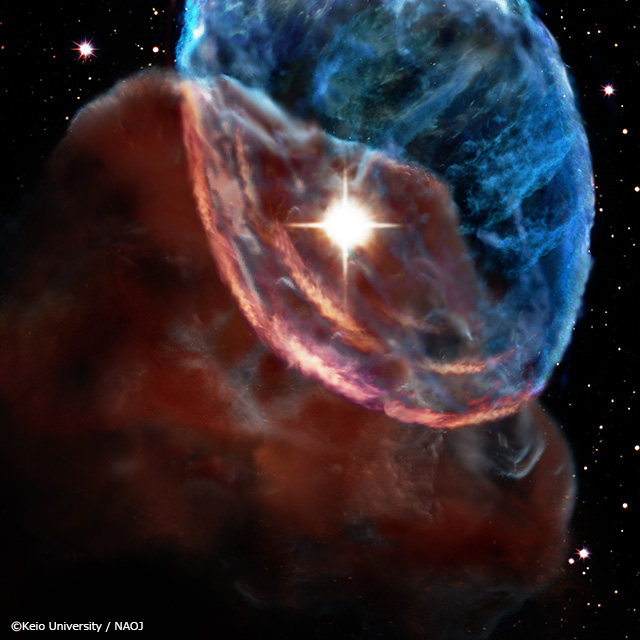
Dying stars that undergo a supernova explosion cause shockwaves that have a tremendous impact on the physical state of all surrounding interstellar materials. Because of limitations in measuring equipment, there has been little to no quantitative research on the expansion velocity and kinetic energy of supernova shockwaves -- until now. A research team from Keio University in Japan has succeeded in precisely measuring the expansion velocity of the shockwave of supernova remnant W44. The remnant is located in the constellation Aquila, approximately 10,000 light-years away from our solar system. The team observed the high-temperature and high-density molecular gas in the millimeter and sub-millimeter wave ranges and showed that the expansion velocity of the W44 shockwave is 12.9 km/sec. In addition, other molecular gas with an extremely high velocity greater than 100 km/sec was also detected, but the origin of this super-high-velocity molecular gas remains unclear at this time.
Einstein@Home discovers 24 new pulsars in archival data
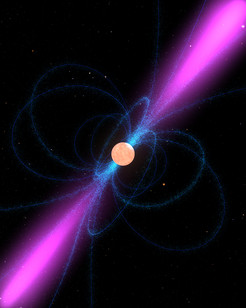
The combined computing power of 200,000 private PCs helps astronomers take an inventory of the Milky Way. The Einstein@Home project connects home and office PCs of volunteers from around the world to a global supercomputer. Using this computer cloud, an international team lead by scientists from the Max Planck Institutes for Gravitational Physics and for Radio Astronomy analysed archival data from the CSIRO Parkes radio telescope in Australia. Using new search methods, the global computer network discovered 24 pulsars – extraordinary stellar remnants with extreme physical properties. These can be used as testbeds for Einstein's general theory of relativity and could help to complete our picture of the pulsar population.
Rogue Planets -- Born Free as the Wind Blows
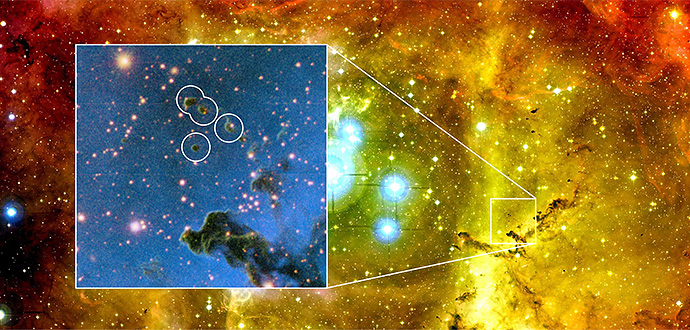
Tiny, round, cold clouds in space have all the right characteristics to form rogue planets with no parent star. New observations, made with Chalmers University of Technology telescopes in Sweden, show that not all free-floating planets were thrown out of existing planetary systems. Many may have been be born free and there may be as many as 200 billion free-floating planets wandering aimlessly in our galaxy alone.
Funding Member
