News
Holy Smoke -- The Vatican Runs Quite an Impressive Observatory

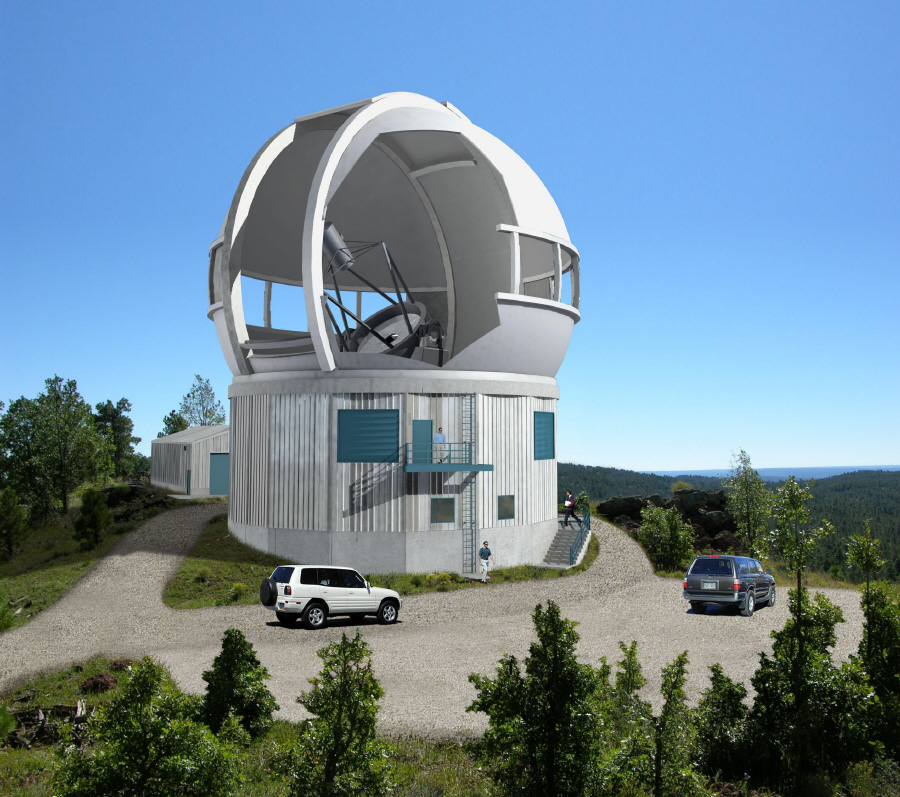
In 1633, the Inquisition of the Roman Catholic Church "persuaded" Galileo Galilei to recant his ideas that the Earth moves around the Sun --taking a firm (but incorrect) stand on the Ptolemaic - Copernican controversy of the 16th and 17th centuries. In 1992, Pope John Paul II officially declared that Galileo was right. From the time of Galileo to the present day, the Vatican has changed dramatically in its views and in the last couple of hundred years has embraced and funded much serious astronomical research. Continuing in that tradition, today the Vatican operates the 1.83 meter Vatican Advanced Technology Telescope (VATT) on Mount Graham in Arizona.
Astronomers Find First Earth-like Planet in a Habitable Zone

Using the European Southern Observatory (ESO) 3.6-m telescope in La Silla, Chile, a team of Swiss, French, and Portuguese astronomers have discovered the most Earth-like planet outside our Solar System to date. The planet orbits a red dwarf star named Gliese 581. The planet lies in the habitable zone -- that is the region around a star where water could be liquid. The Earth-like planet's name is Gliese 581 c.
A love affair...

It's often said that 5" is the sweet spot for refractors. This week's review contest winner has a definite soft spot for Takahashi's latest achievement in apochromatic craftsmanship.
Living on the Edge of a Planetary Danger Zone

"The further on the edge, the hotter the intensity." Astronomers at the University of Arizona have mapped out planetary "danger zones," which are areas where winds and radiation from super hot stars can strip young, cooler stars (like our sun) of their planet-forming materials. Results show that cooler stars are safe as long as they lie beyond 1.6 light-years (or nearly 10 trillion miles) of these hot stars.
They can't all be winners...

The product may not be the best thing since cheap apos but this week's winning review definitely defines the problems...
Gravity Probe B Proves Einstein Right: Gravity Warps the Fabric of Space-Time

Time and space, according to Einstein's theory of relativity, are woven together, forming a four-dimensional fabric called "space-time." The tremendous mass of Earth dimples this fabric, much like a heavy person sitting in the middle of a trampoline. Analysis of data gathered from NASA's Gravity Probe B proves Einsteins conjecture that Earth is in a vortex of space-time as shown in this image.
Lowell Observatory Finds Water in Atmosphere of Extrasolar Planet
For the first time, water has been identified in the atmosphere of an extrasolar planet. Through a combination of previously published Hubble Space Telescope measurements and new theoretical models, Lowell Observatory astronomers have found strong evidence for water absorption in the atmosphere of transiting planet HD209458b, about 150 Light Years from Earth.
A Priceless Telescope?

We often express frothing rage at their very existence in our universe but these cheap "department store" telescopes are ubiquitous in the marketplace. This week's winning review takes a look at and through one of these little devils. Are they all truly as evil as we say they are?
A Sad Tale of Gas-Poor Galaxies and "Homeless" Stars
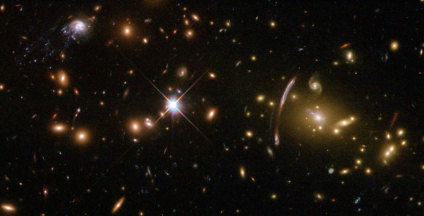
NASA's Hubble Space Telescope has captured a galaxy being ripped apart by the strong gravitational field of a nearby galaxy cluster. The findings shed light on the mysterious process by which gas-rich spiral-shaped galaxies turn into gas-poor irregular galaxies and reveal one possible mechanism for how millions of "homeless" stars end up scattered throughout galaxy clusters.
Universe Wide Wiki...
WIKISKY is a new non-commercial project. The main purpose is to consolidate astronomical, astrophysical and other information about different space objects and astrophysical facts.
AstroMart site makes Cool Pick of the Day!
Because, well.. we ARE cool!
Diabolical Duo?

This week's review contest winner pairs components from different manufacturers in search of an ideal combo...
Fundamental Properties of Galaxies Have Not Changed in 8 Billion Years
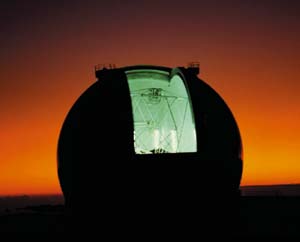
A new study using data collected by the W. M. Keck Observatory in Hawaii has revealed that certain fundamental properties of galaxies have actually changed very little over the last 8 billion years.
A Hexagon at Saturn's Active North Pole
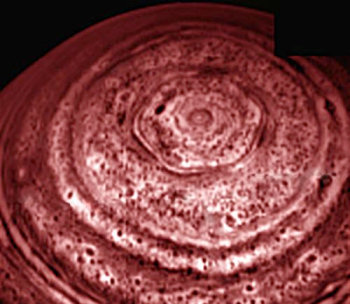
A bizarre six-sided feature encircling the north pole of Saturn near 78 degrees north latitude has been spied by the visual and infrared mapping spectrometer on NASA's Cassini spacecraft.
The Purple Rose of Virgo Reveals the Brightest SuperNova of the Year
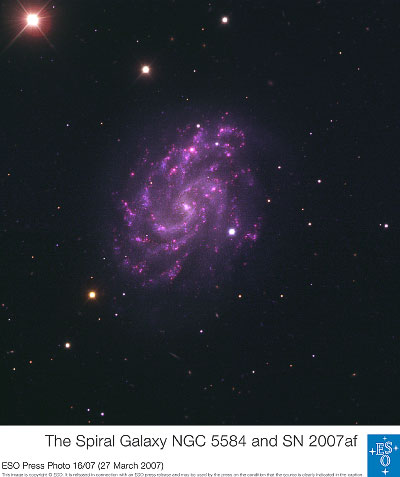
Until now NGC 5584 was just one galaxy among many others located to the West of the Virgo Cluster. Known only by its NCG number in galaxy surveys, its sheer beauty is now revealed in all its glory in a new image from the European Southern Observatory (ESO) Very Large Telescope (VLT). Since March 1, 2007, this purple cosmic rose also holds the brightest SuperNova explosion of the year, known as SN 2007af.
Funding Member
