News
Seven Dwarfs Discovered Orbiting the Milky Way

An international team of scientists has discovered seven dwarf galaxies orbiting the Milky Way. The galaxies were discovered as part of the Sloan Digital Sky Survey (SDSS-II), the most ambitious survey of the sky ever undertaken.
William Optics FLT110mm F/7 takes a spin to the stars a back.

This week's review contest winner takes a triplet on a shakedown cruise...
Have the "Pillars of Creation" been Destroyed by a SuperNova?

The three iconic space pillars photographed by NASA's Hubble Space Telescope in 1995 might have met their demise, according to new evidence from NASA's Spitzer Space Telescope. A new, striking image from Spitzer shows the intact dust towers next to a giant cloud of hot dust thought to have been scorched by the blast of a nearby star that went supernova.
Hubble Maps the Cosmic Web of 'Clumpy' Dark Matter in 3-D
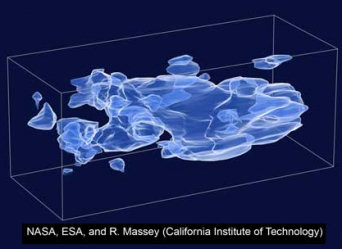
An international team of astronomers using NASA’s Hubble Space Telescope has created the first three-dimensional map of the large-scale distribution of dark matter in the universe.
Google Joins Team to Digitally Record the Entire Universe
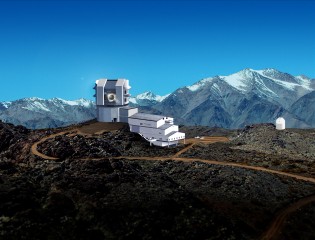
Google has joined a group of nineteen universities, national labs, and private foundations in building the Large Synoptic Survey Telescope (LSST). Scheduled to begin operations in 2013, the 8.4-meter LSST will survey the entire visible sky in multiple colors every night with its three-billion pixel digital camera. The decade-long LSST sky survey will generate more than 30 TeraBytes (that is 30,000 GigaBytes) of image data every night.
Titan Has Liquid Lakes, Scientists Report in Nature
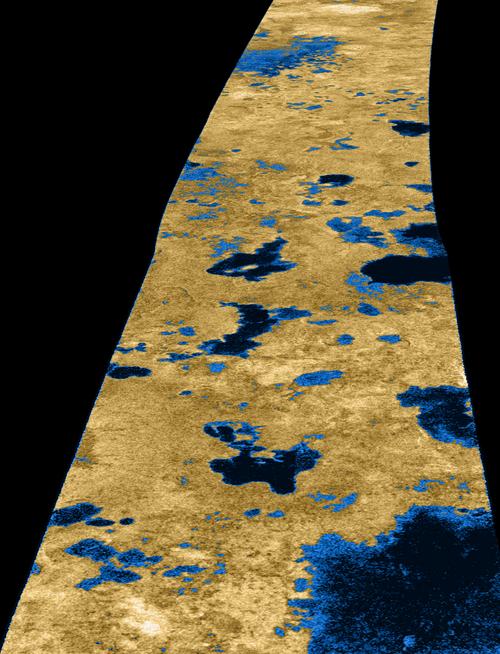
Scientists report definitive evidence of the presence of lakes filled with liquid methane on Saturn's moon Titan in this week's journal Nature cover story. The discovery revealed about 75 lakes on this exotic world – lakes with shorelines and maybe even waves. Unlike those on Earth, Titan's lakes are probably filled with liquid methane and ethane.
This little scope rolls up a steep cone of light. How does it taste?

This week's review contest winner delivers the scoop on the Skywatcher 120 F/5...
Hinode's First Images Provide an Extraordinary View of our Violent Sun
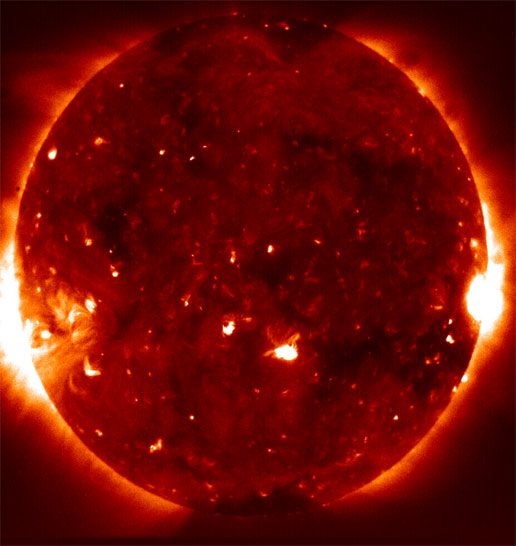
Instruments aboard the Japan Aerospace Exploration Agency (JAXA) satellite named Hinode, or "Sunrise," are returning extraordinary new images of our sun. The international mission to study the forces that drive the violent, explosive power of the sun was launched from Japan in September 2006. These first images leave no doubt that Hinode will revolutionize the knowledge of our nearest and most important star, the sun.
Beginner's Astronomy Camp

This week's review contest winner takes us on a great trip under the Arizona stars...

Astronomers Peek Inside a Quasar for the First Time

For the first time, using a novel technique, astronomers have looked inside a quasar and have measured the so-called accretion disk around the black hole. The study lends further confirmation to what scientists have long suspected -- that the supermassive black holes of quasars are surrounded by super-heated disks of material that is spiraling into them.
Researchers Find Surprise in Makeup of a Comet
Comets are not all made of interstellar dust and ice, but instead may contain material shot from the heart of the solar system during its tumultuous birth, scientists reported Thursday after examining pristine particles of a comet that were brought back by the Stardust spacecraft.
Say it Ain't So -- Arecibo May Go Dark in 5 Years

An advisory panel to the National Science Foundation (NSF)has recommended a 24 percent funding cut over the next three years for Arecibo. The panel also recommended that outside funding to cover another 40 percent cut be found by 2011 or Arecibo risks closure.
This week's review contest winner, by a nose

A reindeer's namesake takes the cake this time around...
Astronomers Detect Two Supernovas in One Galaxy
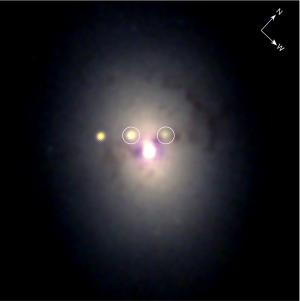
On average, large galaxies spawn three supernovas per century. Scientists using NASA's Swift satellite stumbled upon a rare sight -- two supernovas side by side in galaxy NGC 1316, a massive elliptical galaxy about 80 million light years away.
Funding Member
