News
A new ep gets it's first dose of photons...

A First Impression of the Siebert 5.9mm StarSplitter Modified Ortho takes this week's Review Contest Trophy...
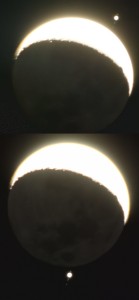
solar eclipse 29/03/2006

... and you are invited!
Black Holes Much More Prevalent than Originally Thought

Astrophysicists at Penn State University have found that Super Massive Black Holes, like those found in the center of Galaxies, are more numerous than originally thought. Extrapolations from the 600 black holes recently found by the Chandra Space Observatory suggest that there are about 300 million Super Massive Black Holes in the whole sky detectable from Earth.
This review of a high power plossl gets high marks

This week's review contest winner covers the Meade 5000 Series 5.5mm Plossl...
Spinning Black Hole Leaves Dent in Space-Time

Using NASA's Rossi X-Ray Timing Explorer (XRTE), MIT astrophysicists have found a black hole that has chiseled a remarkably stable indentation in the fabric of space and time. The finding may help scientists measure a black hole's mass and how it spins, two long-sought measurements, by virtue of the extent of this indentation.
New satellite data on universe's first trillionth second.

Scientists peering back to the oldest light in the universe have new evidence for what happened within its first trillionth of a second, when the universe suddenly grew from submicroscopic to astronomical size in far less than a wink of the eye.
Cosmic Jet Looks Like Giant Tornado in Space

Astronomers examining a region where new stars are forming found a surprise - an object that looks like a giant tornado in space. The apparent tornado is shaped by a cosmic jet packing a powerful punch as it plows through clouds of interstellar gas and dust. The scientists could only speculate about the source of the spiral appearance.
Big Red

Many an amateur astronomer has cast a covetous glance at Software Bisque's Paramount ME. In this week's review contest winner, the author describes how to rope this big mount into a semi portable configuration...
Hubble's Latest Look at Pluto's Moons Supports a Common Birth

The latest NASA Hubble Space Telescope images of Pluto's two newly discovered satellites reveal that the new moons have the same color as Charon. <b>NOTE: French, German, Italian, and Spanish translations follow...</b>
Proteins and DNA Building Blocks Found in Stellar Disk

NASA's Spitzer Space Telescope has been used to discover some of life's most basic ingredients in the dust swirling around a young star. The ingredients -- gaseous precursors to DNA and protein -- were detected in a region around the star where rocky planets such as Earth are thought to be born. The findings represent the first time that these gases, called acetylene and hydrogen cyanide, have been detected outside of our Solar System.
A Review AND a Tutorial all in one...

Just like the old Certs commercials, this week's review contest winner is 2 mints in one. Learn all about the Celestron CGE mount.
Now is the Best Time to View Comet Pojmanski
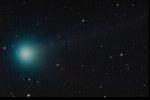
Comet Pojmanski 2006/A1, the first comet discovered in 2006, is now at its maximum brightness in the eastern sky at dawn, not far from Venus, which dominates the morning sky. At magnitude 5.4, Comet Pojmanski is just bright enough now to be a good target for early-risers with binoculars. The comet was at its closest approach to Earth (just over 100 million kilometers away) on March 5.
Evolution of Andromeda Galaxy is Found to be Similar to Milky Way's
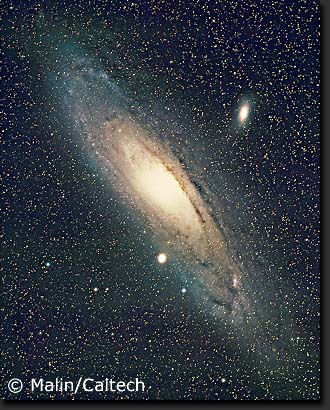
For the last decade, astronomers have thought that the Andromeda Galaxy M31, our nearest galactic neighbor, was rather different from the Milky Way. But a group of researchers at Cal Tech have determined that the two galaxies are probably quite similar in the way they evolved.
Jupiter grows a new Red Spot!
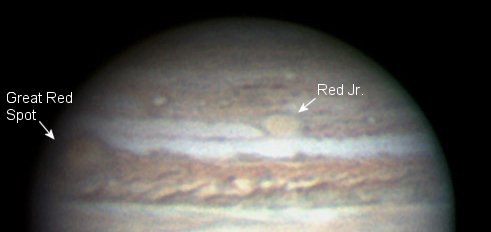
The official name of this storm is "Oval BA," but Red Jr. might be better. I's about half the size of the GRS and almost exactly the same color.
Budget Cuts Back Much- Promoted NASA Missions
Some of the most highly promoted missions on NASA's scientific agenda would be postponed indefinitely or perhaps even canceled under the agency's new budget
Funding Member
