News
Huge "Superbubble" of Gas Blowing Out of Milky Way

Astronomers using the National Science Foundation's Robert C. Byrd Green Bank Telescope (GBT) have discovered a huge "superbubble" of hydrogen gas rising nearly 10,000 light-years above the plane of our Milky Way Galaxy. <b>NOTE: French, German, Italian, and Spanish translations follow...</b>
Pulsar Spinning at an Incredible 716 Revolutions per Second
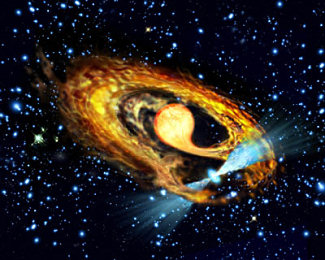
A team of astronomers at McGill University in Montreal has discovered the fastest-spinning Pulsar ever found. The 20-mile diameter superdense Pulsar, spinning at 716 revolutions per second, whirls twice as fast as the average kitchen blender.
A Wooden Refractor? A novel idea from a very creative artist.

The Travel Star 11 gets the once over in this week's review contest winner.
Vanderbuilt Astronomers Map the Star Forming Winds of M42 -- the Orion Nebula
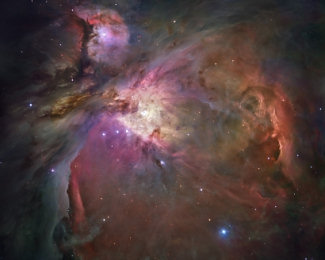
Located at a distance of about 1,600 light years from Earth, the Orion Nebula is the brightest diffuse nebula in the sky and is visible to the naked eye. Utilizing new data from the Hubble Space Telescope, Vanderbuilt University astronomers have been mapping the winds blowing in M42 to get a better idea of how stellar forming currents are incubating new stars.
Stardust Capsule Lands in Utah Desert

Nasa's Stardust sample return capsule touched down at 10:10 U.T.
The girl who named a planet

How the ninth planet was named by an 11-year-old girl.
The World’s Most Famous Equation Turned 100 in 2005... and Now it is Proven Accurate to One Part in a Million

In 1905 Albert Einstein published three landmark papers that revolutionized our understanding of the Universe -- papers on Brownian motion, the Photoelectric Effect, and Special Relativity. The most famous formula in science, E=mc(squared), turned 100 years old in 2005. To mark the occasion, 2005 was designated by the United Nations as the International Year of Physics. Now, physicists at MIT, the National Institute of Standards and Technology (NIST) in the US, and the Institute Laue Langevin (ILL) in France have determined that the formula predicting that energy and mass are equivalent is correct to an incredible accuracy of better than one part in a million.
Cornell Astronomers Ask: What Happens When Worlds Collide?

In about five billion years, the Milky Way and Andromeda Galaxies will collide much like the two galaxies NGC 4038 and NGC 4039 in this image, which are known as the Antennae Galaxies. Most of the hundreds of billions of stars in each of the galaxies will never actually collide, but will pass rather freely between each other with little damage. This however, will not be the case for the interstellar matter consisting largely of clouds of debris, dust, and gas. The high relative velocities and pressures between the interacting interstellar clouds will pull, twist, and distort the two galaxies and trigger a firestorm of star formation.
Reshaping Nikon's Film Camera Assortment

Nikon to End Production of Most Film Cameras
XMM-Newton Detects Debris Circling a Black Hole at One Tenth the Speed of Light
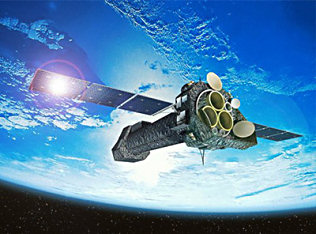
Astrophysicists from the University of Oxford, using the European Space Agency (ESA) XMM (X-ray Multi-Mirror) Newton Observatory, have been able to trace gas and debris on a complete journey around a massive black hole, clocking it at one tenth the speed of light as it swirls around the accretion disk.
Bad News Good News

The bad news is that when the editor goes on vacation, the review contest gets skipped. The good news is that, when he returns, it's Double Winner Day!!
Size Of Pluto's Moon Charon Determined With Unprecedented Accuracy

MIT and Willams College Astronomers used the 8-meter Gemini South, the 6.5-meter Clay, the 2.5-meter du Pont, and the 0.8-meter Cerro Armazones telescopes in Chile to take advantage of a rare stellar occultation that permitted Charon's size to be determined with unprecedented accuracy -- 606 km ± 8 km.
U of Iowa Astronomers Find a Star Orbiting a Black Hole in M82

University of Iowa researchers have found a star orbiting a "medium-sized" black hole -- about 1,000 times more massive than the sun -- in the nearby galaxy M82. The discovery may help confirm the existence of a class of black holes that are larger than black holes produced by the collapse of a single normal star and smaller than the supermassive black holes found in the center of galaxies.
Imaging tech inventors win top honors

SAN JOSE, California (AP) -- The inventors of a light-sensitive component integral to digital cameras, camcorders and medical imagers will share a $500,000 award for work that has revolutionized how people view themselves, the world and the universe.
The New Year Arrived One Second Late

The speed of the Earth's rotation is continually changing -- partly due to varying weather patterns and geological disturbances, but more importantly due to the friction of tides raised by the Sun and Moon, which cause a systematic lengthening of the day. To account for this gradual slowing down of the Earth's rotation, a leap second was added at the end of 2005 by the U.S. Naval Observatory (USNO), thus delaying the arrival of 2006 by one second.
Funding Member
