News
Youngstown State Astronomers Make Their Precious Hubble Time Pay Off
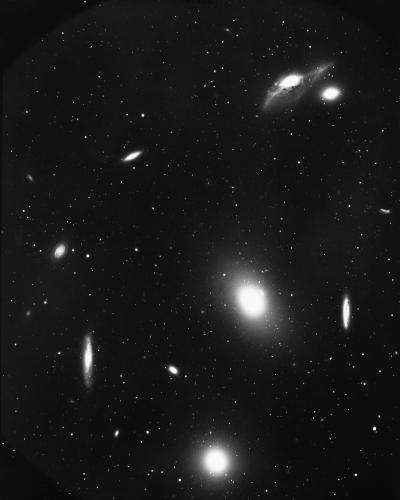
When Pat Durrell of Youngstown State University (YSU) and his team of astronomers were granted time to use the Hubble Space Telescope to conduct research, his hope was to discover stars that had been ripped away from galaxies. He found the stars... and much, much more. The team discovered a new, never-before-detected dwarf galaxy and four unknown star clusters in Virgo.
Polaris is a Triple Star System -- It’s Closest Companion is Finally Found
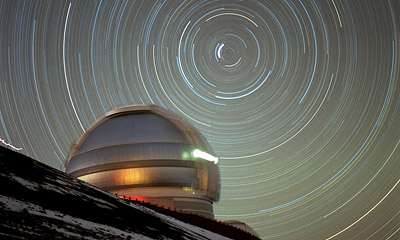
Polaris is actually a triple star system. While one companion can be seen easily through small telescopes, the other hugs Polaris so tightly that it has never been seen directly until now... And every available bit of Hubble's resolution was required to see it.
Formidable feline ?

Attention Cat Fanciers... This week's review winner takes the bullwhip and chair to a big pretty kitty sitting calmly on a nicely machined perch.
Dwarf Galaxy on Collision Course with the Milky Way has Already Breached the Perimeter
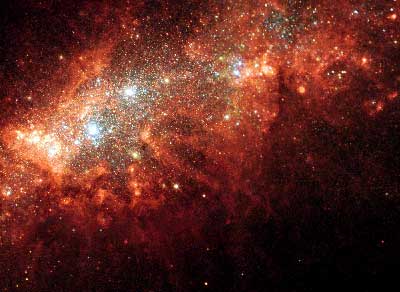
Princeton and University of Washington astronomers have detected a previously undiscovered dwarf galaxy on a collision course with our Milky Way Galaxy. The yet unnamed dwarf galaxy appears to have already breached the perimeter of the Milky Way and currently lies about 30,000 light years from Earth. This dwarf galaxy is apparently so close and its stars are spread over such a huge swath of the sky, that until now it has been lost in the sea of more numerous Milky Way stars. In effect, the galaxy is so close that we couldn't see it before, even though some of its individual stars have been observed with telescopes for centuries.
Riding Rockets - by one who's been there

The space shuttle is a cousin topic to amateur astronomy - often generating heated threads about it's value. Here is a book by a Shuttle Astronaut that tells it like it is, and with more than a modicum of writing skill. <b>NOTE: French, German, Italian, and Spanish translations follow...</b>
RIT Astronomers Peek into a Black Hole
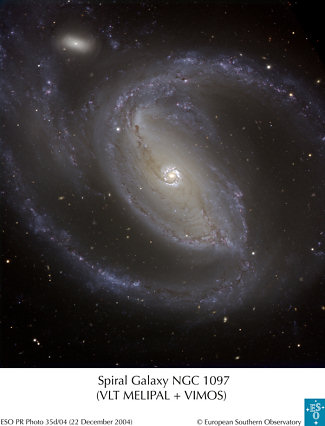
Astronomers have been trying for a long time to understand how matter is pulled down towards a black hole. Directly watching the feeding process requires very high spatial resolution at the center of galaxies. A new study by Rochester Institute of Technology (RIT) astronomers of Galaxy NGC 1097 provides the best glimpse yet of the death spiral of material as it descends into the core of a large black hole on a one-way trip into oblivion. The researchers peek to within 10 light-years of the galactic core.
Dust Found in Earth Sediment Traced to Breakup of the Asteroid Veritas 8.2 Million Years Ago
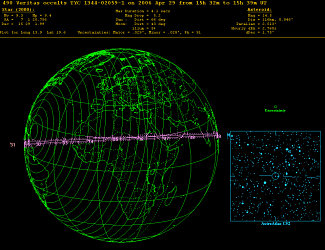
PASADENA, Calif.--In a new study that provides a novel way of looking at our solar system's past, a group of planetary scientists and geochemists announce that they have found evidence on Earth of an asteroid breakup or collision that occurred 8.2 million years ago. <b>NOTE: French, German, Italian, and Spanish translations follow...</b>
America's "Nano" Refractor?

This week's review contest winner nominates a very small scope to that high office.
Rapidly Spinning Star Vega has Cool Dark Equator
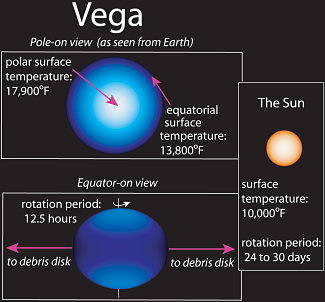
Strong darkening observed around the equator of Vega suggests that the fifth brightest star in Earth’s sky has a huge temperature difference of 4,000 degrees Fahrenheit from its cool equatorial region to its hot poles. <b>NOTE: French, German, and Italian translations follow...</b>
Two Exiled Stars Are Leaving Our Galaxy Forever
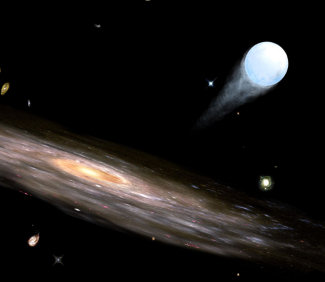
Cambridge, MA - TV reality show contestants aren't the only ones under threat of exile. Astronomers using the MMT Observatory in Arizona have discovered two stars exiled from the Milky Way galaxy. Those stars are racing out of the Galaxy at speeds of more than 1 million miles per hour - so fast that they will never return. <b>NOTE: French, German, Italian, and Spanish translations follow...</b>
Astronomers Find Smallest Extrasolar Planet Yet Around Normal Star

Using an armada of telescopes, an international team of astronomers has found the smallest planet ever detected around a normal star outside our solar system. <b>NOTE: French, German, and Italian translations follow...</b>
It's big - but is it any good?

This week's review contest winner takes a look through Meade's big 56mm Plossl to see what's on the other side.
Dusty Planetary Disks Around Two Nearby Stars Resemble Our Kuiper Belt

These two bright debris disks of ice and dust appear to be the equivalent of our own solar system's Kuiper Belt, a ring of icy rocks outside the orbit of Neptune and the source of short-period comets. <b>NOTE: French, German, Italian, and Spanish translations follow...</b>
The Milky Way Galaxy is Warped

UMass and Berkeley astrophysicists belive that two of the Milky Way's satellite galaxies - the Large and Small Magellanic Clouds - are interacting with dark matter in the Milky Way to create a mysterious warp in our galactic disk. The warp, which extends across the entire 200,000-light year diameter of the galaxy, has been described by the researchers in terms of a rather simple mathematical model.
New Horizons is on a Fast Track to Pluto
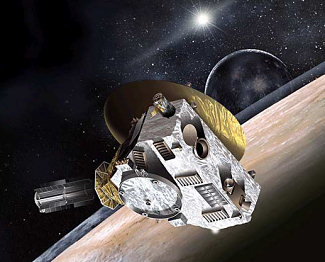
The New Horizons spacecraft will cross the entire 3 billion mile span of the solar system and conduct flyby studies of Pluto and Charon in 2015. NASA's most powerful launcher, the Atlas 5, rocketed the spacecraft away from Earth at a record 36,000 miles per hour. At that speed, and with a "gravity slingshot assist" it will get from Jupiter in 2007, the spacecraft will take over 9 years to reach Pluto.
Funding Member
