News
Happy Sweet Sixteen, Hubble Space Telescope
The NASA/ESA Hubble Space Telescope, launched on April 24, 1990, turned 16 this month. In its 16 years of viewing the sky, Hubble has taken roughly 750,000 exposures and probed about 24,000 celestial objects, while making nearly 93,500 trips around our planet and racking up almost 4 billion kilometres.
Mounts Matter...

A solid quote from this week's review contest winner who covers the TeleVue Panoramic Alt-Az mount.
Arecibo Finds a Binary Pulsar that is only 112 Thousand Year Old

Astronomers using a new state-of-the-art receiver system on the Arecibo Radio Telescope in Puerto Rico have discovered a new binary pulsar system which promises to be an important test bed for Einstein's theory of General Relativity. What makes this different from other binary pulsars is the relative youthfulness of the pulsar -- only about 112 thousand years old.
Eta Carinae: A Spectacular Show From A Convulsing Massive Star
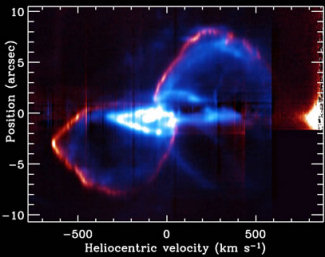
New high-resolution measurements of the famous massive star Eta Carinae using the NOAO-built Phoenix infrared spectrograph on Gemini South show that the star's bipolar nebula is the result of an aspherical explosion during its mid-19th century outburst, as opposed to the nebula being “pinched” by surrounding material. <b>NOTE: French, German, Italian, and Spanish translations follow...</b>
This week's review contest winner - bino's on the cheap

Just how good ARE these $30 Celestron binoculars?
New Telescope Searches for Signs of Extraterrestrial Life
Could humans be the only intelligent beings in all the vastness of the universe? Or are we just one humble race, a member of a vast intergalactic fraternity of advanced civilizations? For the past 25 years, The Planetary Society, founded in 1980 by Carl Sagan, Bruce Murray, and Louis Friedman, has worked with SETI (the Search for Extraterrestrial Intelligence) to make sure we never stop seeking these answers. This week a new optical telescope at an observatory in Harvard, Massachusetts -- one designed solely to search for light signals from extraterrestrial civilizations -- has been constructed to continue this quest. Its 72-inch primary mirror is larger than that of any optical telescope in the US east of the Mississippi River.
Hubble Finds that the 'Tenth Planet' is Slightly Larger than Pluto.

NASA's Hubble Space Telescope has resolved the "tenth planet," nicknamed "Xena" for the first time, and has found that it is only just a little larger than Pluto.
Big Bino Review Wins Big

This week's winning review pokes around the sky with a big pair of peepers...
Astronomers Finds 100 New Star Clusters in the Galactic Plane
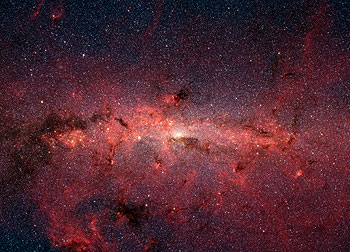
From Earth, most of the Milky Way Galaxy is concentrated in a blurry band of light that stretches across the galactic plane. Many of the stars in the plane cannot be seen with visible-light telescopes because the clouds of dust and gas that fill the galactic spiral arms block the starlight from view. Using the dust-piercing infrared eyes of NASA’s Spitzer Space Telescope, Boston University (BU) astronomers have discovered nearly 100 new star clusters in the galactic plane, with each cluster containing tens to hundreds of never before seen stars.
Killer Asteroids May Not Have Been the Cause of Mass Extinctions After All
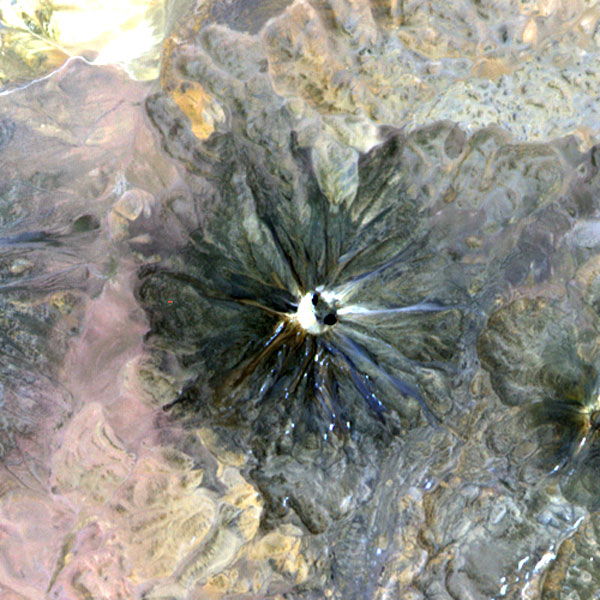
Earth history has been punctuated by several mass extinctions that have rapidly wiped out nearly all life forms on our planet. What causes these catastrophic events? Are they really due to asteroid impacts? Scientists at the University of Leicester and Imperial College in the UK and at the Utrecht University in the Netherlands now believe that the world's largest mass extinctions occurring about 250 Million and 65 Million years ago were probably caused by vast amounts of poisonous volcanic gas from within our own planet -- an unpredictable event that could repeat at any time.
Mars Recon Orbiter grabs some HiRISE pix

The first image of Mars by the High Resolution Imaging Science Experiment (HiRISE) on NASA's Mars Reconnaissance Orbiter shows a story of geologic change in the eastern Bosporos Planum region. <b>NOTE: French, German, Italian, and Spanish translations follow...</b>
Dark Matter - Is Its Existence Grossly Exaggerated?

Many Astrophysicists believe that most of the matter in the universe is dark -- that is it cannot be detected from the light which it emits (or fails to emit). By some accounts, 90% of the universe is made up of this mystereious Dark Matter. Its presence is inferred indirectly from the motions of astronomical objects - specifically stars, galaxies, galaxy clusters, and galaxy superclusters. However, there may be another possible explanation. Instead of the existence of unseen material, maybe our understanding of Gravity is incorrect. If that is the case, then current calculations for the amount of Dark Matter in the Universe are grossly exaggerated. New research has revealed that a simple "fine-tuning" of Einstein's theory of gravity could solve the Dark Matter mystery that has baffled Astrophysicists for three-quarters of a century.
A Photo from the Mediterranean Eclipse

Rush off the boat, rush off the plane...send the picture to Amart!
NASA's Chandra Finds Evidence for Quasar Ignition

New data from NASA's Chandra X-ray Observatory may provide clues to how quasars "turn on." Since the discovery of quasars over 40 years ago, astronomers have been trying to understand the conditions surrounding the birth of these immensely powerful objects. <b>NOTE: French, German, Italian, and Spanish translations follow...</b>
Comets May Be the Source of Earth's Ocean Water

The Earth is believed to have formed hot and dry, meaning that its current water content must have been delivered after the planet cooled. Now, a new class of hybrid Comet/Asteroids orbiting among the rocky asteroids in the main asteroid belt between Mars and Jupiter may hold clues to the original source of Earth's ocean water.
Funding Member
