News
Large Ground-Based Telescopes May Become Worthless in 40 Years
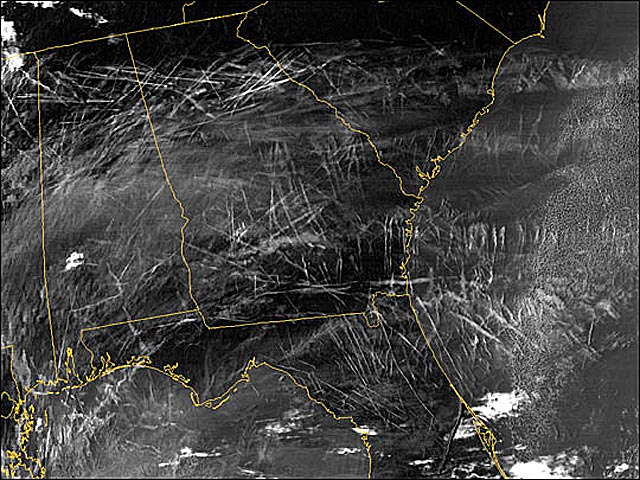
Global warming and artificial clouds created by jet contrails may increase so dramatically in the next decades that they may change the Earth's climate and seriously hinder our ability to study the skies from ground-based telescopes. Contrails from jet aircraft are significantly increasing the cloudiness of the Earth, reflecting sunlight back into space by day and radiating heat back to Earth at night. In the future, all large optical and infrared observatories may need to be space-based. However, ground-based radio astronomy should be able to continue unimpaired.
Spitzer Finds a Massive Cluster of Red Supergiant Stars
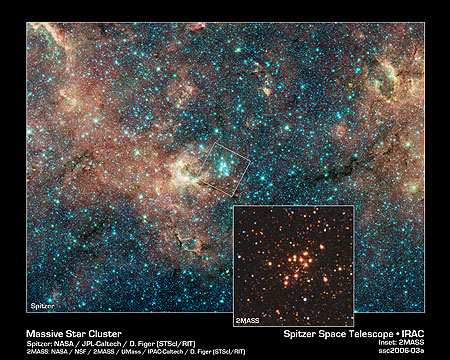
Astronomers from the Rochester Institute of Technology (RIT) have discovered a massive cluster of red supergiants — super-sized stars on the verge of exploding. The cluster was discovered in the Milky Way, about 18,900 light-years from Earth, by a group of astronomers using the Spitzer Space Telescope’s infrared technology to penetrate the thick dust that cloaks much of our galaxy.
A Foxy Refractor?

The Vixen ED103SWT gets dissected in this week's review contest winner.
Hubble's Largest Galaxy Portrait Offers a New High-Definition View.
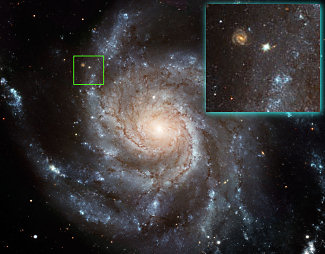
Highway 101 revisited... <b>NOTE: French, German, Italian, and Spanish translations follow...</b>
SuperNova is Unfolding in Aries -- Expected to Peak in One Week
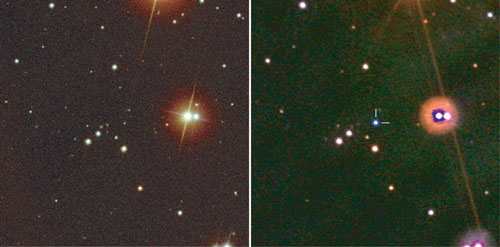
Scientists using NASA's Swift space observatory have detected a cosmic explosion that appears to be a precursor to a SuperNova in the constellation Aries, which is expected to reach peak brightness in one week. Amateur astronomers in the northern hemisphere in dark skies should be able to see the explosion with a 16-inch telescope as it hits 16th magnitude in brightness.
Historic Lowell Observatory -- Still Going Strong After All These Years
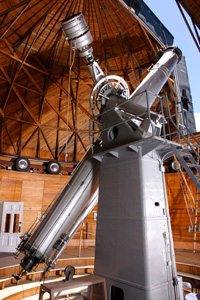
With over 50 years of uninterrupted service under its belt, the Lowell Observatory’s 21-inch, equitorially mounted Cassegrain Reflector remains productive in monitoring the variability in brightness of Uranus and Neptune. With fully robotic photometric telescopes now taking over much of the type of research pioneered by the telescope, the future of this historic workhorse is in question. Nevertheless, it continues to fill a niche. Astronomers at the Lowell Observatory are positioned to assemble the most complete decades-long seasonal picture of how Uranus varies in brightness as the planet, on its 84-year long trip around the Sun, reaches equinox and the Sun crosses its equator from South to North.
How to the TeleVue plossls stand up?

3 of these time tested tools are taken to task in this week's review contest winner...
Parkes Radio Telescope Discovers RRATs in Space
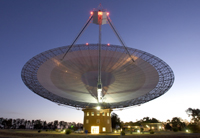
A team of astronomers from Australia, the UK, USA, Italy, and Canada using the CSIRO Parkes radio telescope in eastern Australia has found a new kind of cosmic object: a small, compressed Neutron Star that shows no activity most of the time but once in a while spits out a single burst of high energy radio waves. This new class of objects have been dubbed Rotating Radio Transients or RRATs.
RS Ophiuchi Recurrent Nova Errupts!
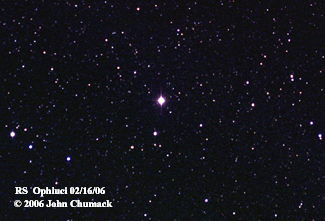
Nova Jumps to "Naked Eye" visibility 4.8 mag
Another Short Tale of the Little Scope that Could...

...and Did and Does and Takes the prize as this week's review contest winner.
Most Ambitious Star Survey Ever is Met with "RAVE" Reviews

An international team of astronomers has announced the first results from the Radial Velocity Experiment (RAVE) project, an ambitious all-sky spectroscopic survey aimed at measuring the speed, temperature, surface gravity, and composition of up to a million stars passing near our Sun.
Sky Publishing Completes Sale to New Track Media LLC

Cambridge, MA - Sky Publishing Corporation, the privately held publisher of astronomy periodicals and books, announced today that it has completed the sale of its business to New Track Media LLC, an entity formed in the fall of 2005 by Stephen J. Kent and Boston Ventures. Terms of the transaction were not disclosed. <b>NOTE: French, German, Italian, and Spanish translations follow...</b>
Bright Supernova in M100 Spiral Galaxy

SN 2006X Brightening Fast!!!! Go take a look....
The Cosmic Shredder and the Magnetar

No, it is not the title of the next Harry Potter book - but the latest discoveries from NASA's SWIFT mission which is studying gamma-ray bursts (GRBs) - the most powerful explosions occurring in the Universe. Astronomers from the University of Hertfordshire have discovered that some "short" gamma-ray bursts occur much closer to home than previously thought and could result from the tearing and shredding apart of an exotic object called a Magnetar.
Spitzer Reveals Unexpected Disks Around Interacting Stars.
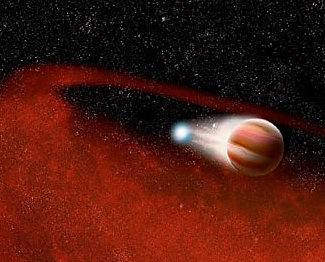
New Spitzer Space Telescope observations of an unusual class of interacting binary stars detected excess amounts of infrared radiation, suggesting that these odd objects are surrounded by large disks of cool dust. <b>NOTE: French, German, Italian, and Spanish translations follow...</b>
Funding Member
