News
Vast Petroleum Reservoirs Discovered in the Horsehead Nebula
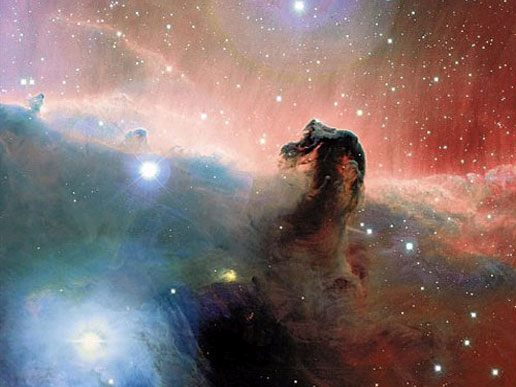
The Horsehead Nebula, 1,300 light years from Earth, is located in the Orion constellation, which will become more visible in the night skies over the next few weeks. Due to its famous and easily recognizable shape, the Horsehead Nebula is one of the most photographed objects by astronomers. But the nebula is also a fantastic interstellar chemistry lab where high density gas and intense stellar light continuously interact and trigger many-layered chemical reactions. Using the 30 meter radio telescope of the Institute for Radio Astronomy near Pico del Veleta in the Spanish Sierra Nevada, astronomers have detected the interstellar molecule C3H+. The molecule belongs to the hydrocarbon family and a major energy resource of our planet -- petroleum and natural gas.
We made it

Time for a new calendar :-)
Hubble Team Releases a New Extreme Deep Field Image

The Hubble Team has assembled a new, improved portrait of mankind's deepest-ever view of the universe. Called the eXtreme Deep Field, or XDF, the photo was assembled by combining 10 years of NASA Hubble Space Telescope photographs taken of a patch of sky at the center of the original Hubble Ultra Deep Field. The new full-color XDF image reaches faint galaxies and includes very deep exposures in red light from Hubble's new infrared camera and shows about 5,500 galaxies. The universe is 13.7 billion years old and the XDF reveals galaxies that span back 13.2 billion years in time.
NASA-NOAA Satellite Reveals Stunning Views of Earth at Night

Scientists unveiled an unprecedented new look at our planet at night. A global composite image, constructed using cloud-free night images from a new NASA and National Oceanic and Atmospheric Administration (NOAA) satellite, shows the glow of natural and human-built phenomena across the planet in greater detail than ever before. Unlike a camera that captures a picture in one exposure, this satellite produces an image by repeatedly scanning a scene and resolving it as millions of individual pixels. The instrument can capture images on nights with or without moonlight, producing crisp views of Earth's atmosphere, land, and ocean surfaces.
Lost in Space -- Giant Orphan Planet Hurtles Through Space Without a Parent Star
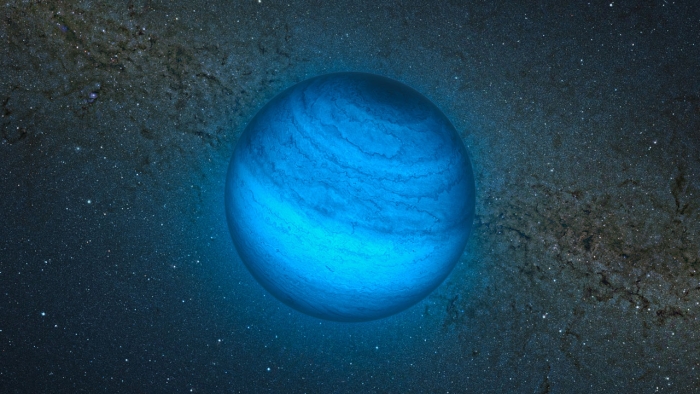
Astronomers using ESO's Very Large Telescope and the Canada-France-Hawaii Telescope have identified a body that is very probably a planet wandering through space without a parent star. This is the most exciting free-floating planet candidate so far and the closest such object to the Solar System at a distance of about 100 light-years. Its comparative proximity and the absence of a bright star very close to it, has allowed researchers to study its atmosphere in great detail.
Hobby-Eberly Telescope Finds a Massive Black Hole That is 4 Light Days in Diameter

Astronomers at The University of Texas at Austin's McDonald Observatory have measured the mass of what may be the most massive black hole yet - 17 billion Suns - in galaxy NGC 1277. The unusual black hole, which is 4 light days in diameter, makes up 14 percent of its galaxy's mass, rather than the usual 0.1 percent. This galaxy could change theories of how black holes and galaxies form and evolve.
ESA's Planck Space Telescope Spots Colossal Intergalactic Bridge

The Planck space telescope has made the first conclusive detection of a bridge of hot gas connecting a pair of galaxy clusters across 10 million light-years of intergalactic space. In the early Universe, filaments of gaseous matter pervaded the cosmos in a giant web, with clusters eventually forming in the densest nodes. However, much of this tenuous, filamentary gas remains undetected. The presence of hot gas between the clusters was first hinted at in X-ray data from ESA's XMM-Newton and the new Planck data confirms the observation.

Big News From Mars? Curiosity Rover Scientists are Mum For Now

According to Joe Palca of NPR, Scientists working on NASA's Curiosity rover have some exciting new results from one of the rover's instruments. However, they'll have to wait before making an announcement because they want to make sure their results are true. Is this going to be one for the history books or just a false alarm? For now, we'll have to wait to see. In time we'll find out what's got the Mars rover scientists so excited.
Max Planck Scientists Use NASA's Fermi to Discover Record-Breaking Millisecond Pulsar

Pulsars are the compact remnants from explosions of massive stars. Some of them spin around their own axis hundreds of times per second, emitting beams of radiation into space. Until now, they could only be found through their pulsed radio emissions. Scientists at the Max Planck Institute in Hanover, Germany, using data collected by NASA's Fermi Gamma-Ray Space Telescope, have discovered a millisecond pulsar solely via its pulsed gamma radiation. The pulsar spins 390 times per second, emitting gamma-ray photons into space in the form of a beam, similar to a lighthouse. The novel gamma-ray analysis method developed by the Max Planck researchers has opened the door to an easier way of finding these elusive celestial objects.
We are grateful

To the veterans of every service, we are a deeply grateful nation.
Earth-Sized Planet Discovered Orbiting Alpha Centauri B

A Swiss-based team at the University of Geneva, searching for exoplanets (i.e., planets that exist outside our solar system), has detected an Earth-mass planet orbiting the star Alpha Centauri B. The idea that one or more planets might orbit the star system closest to Earth has been a favorite subject of science-fiction writers for decades. It is no surprise then that the possibility of an Earth-mass planet orbiting Alpha Centauri B has piqued substantial interest among astronomers and the general public.
Hyperbolic Sungrazer Comet May Put On a Spectacular Show Next Year
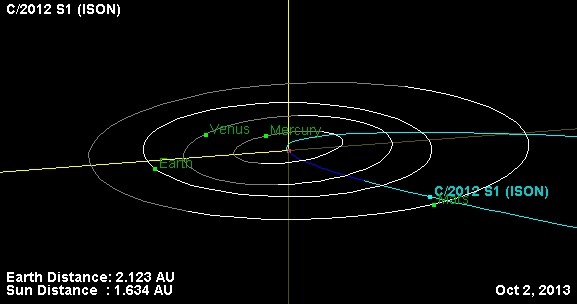
Currently located beyond the orbit of Jupiter, Comet C/2012 S1 (aka. ISON) is heading for a very close encounter with the sun next year. These types of comets are called "Sungrazers" because their hyperbolic orbits closely brush the Sun. In November 2013, ISON will pass less than 0.012 AU (1.8 million km) from the solar surface. The fierce heating it experiences could turn the comet into a bright and spectacular naked-eye object, possibly even visible during daylight.
Super-Massive Black Holes - Cosmic Traffic Jams at the Exit Doors of this Universe

The point of no return -- In astronomy, it's known as a black hole — a region in space where the pull of gravity is so strong that nothing, not even light, can escape. Super-Massive black holes are the "exit doors" of our Universe and the most extreme objects predicted by Albert Einstein's theory of gravity. Now, an international team, led by researchers at MIT's Haystack Observatory, has for the first time measured the radius of a black hole at the center of a distant galaxy — the closest distance at which matter can approach before being irretrievably pulled into the black hole.
Elusive Element 113 Found at Last

The search for superheavy elements is a difficult and painstaking process. Such elements do not occur in nature and must be produced through experiments involving nuclear reactors or particle accelerators, via processes of nuclear fusion or neutron absorption. Since the first such elements were discovered in the 1940s, Germany, Russia, and the United States have made all of the discoveries. Now the RIKEN Linear Accelerator Facility near Tokyo has achieved the distinction of discovering Element 113, setting the stage for Japan to claim naming rights for the new element.
Funding Member
