News
Space-Warping White Dwarfs Produce Gravitational Waves

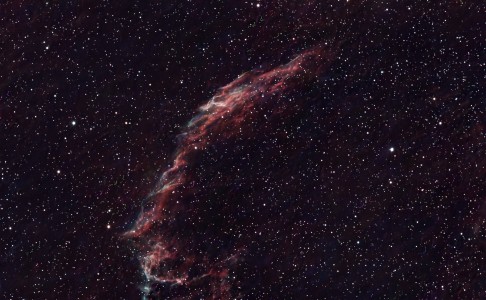
Gravitational waves, much like the recently discovered Higgs Boson, are notoriously difficult to observe. Scientists first detected these ripples in the fabric of space-time indirectly, using radio signals from a pulsar-neutron star binary system. The find, which required exquisitely accurate timing of the radio signals, garnered its discoverers a Nobel Prize. Now a team of astronomers has detected the same effect at optical wavelengths, in light from a pair of eclipsing white dwarf stars.
Mystery Spheres on Mars
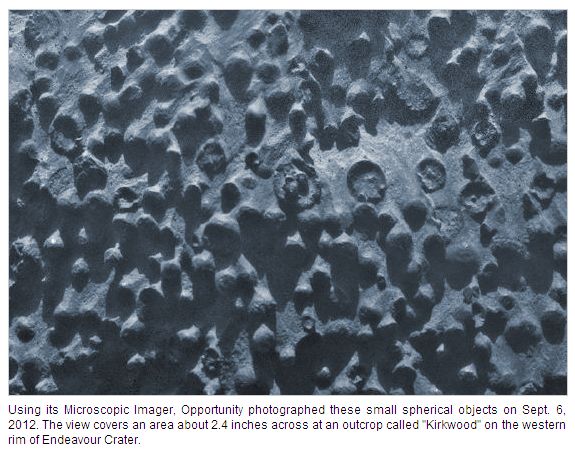
Sept. 14, 2012: NASA's long-lived rover Opportunity has returned an image of the Martian surface that is puzzling researchers.
We Remember

The memory and honor of those we lost will live on in our hearts forever.
Dark Matter and Dark Energy Lead to Revamped Gravitational Field Equations

A pair of mathematicians have proposed a unified theory of dark matter and dark energy that alters Einstein's equations describing the fundamentals of gravity. Their work, resulting in a set of revamped gravitational field equations, suggests that the laws of energy and momentum conservation are valid only when normal matter, dark matter, and dark energy are all taken into account. For normal matter alone, energy and momentum are no longer conserved, they argue.
Neil Armstrong - A Reluctant American Hero 1930-2012

Neil Armstrong, the first man to walk on the moon during the 1969 Apollo 11 mission, has died. He was 82. "Neil Armstrong was a reluctant American hero who always believed he was just doing his job. He served his Nation proudly, as a navy fighter pilot, test pilot, and astronaut."
Mars rover: Wind sensor damaged on Nasa's Curiosity
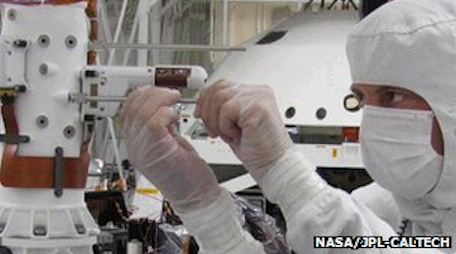
Nasa has reported its first setback in the Curiosity rover mission to Mars.
Worried About the Fiscal Cliff? We May Already be on the Wrong Side of the Ecosystem Cliff

A prestigious group of scientists from around the world is warning that population growth, widespread destruction of natural ecosystems, and climate change may be driving Earth toward an irreversible change in the biosphere -- a planet-wide tipping point that would have destructive consequences. Currently, to support a population of 7 billion people, about 43 percent of Earth's land surface has been converted to agricultural or urban use. The researchers argue that, although many warning signs are emerging, no one knows how close Earth is to a global tipping point, or if it is inevitable. We may already be past the tipping point in particular regions of the world.
NASA Probes to Explore Harsh Environment of the Van Allen Radiation Belts

Final preparations have begun for NASA's launch on Thursday, August 23, 2012 of two Radiation Belt Storm Probes (RBSP) designed to study the harsh environment of our planet's Van Allen Radiation Belts. Named after its discoverer, James Van Allen of the Univerist of Iowa following the Explorer 1 and Explorer 3 satellite missions in 1958, the radiation belts can be hazardous to both spacecraft and astronauts. The mission will last two years. The spacecraft, carrying the best and most comprehensive instrumentation ever sent into the radiation belts, will fly through surging and swelling belts of energized particles that would damage ordinary spacecraft.
USA USA USA
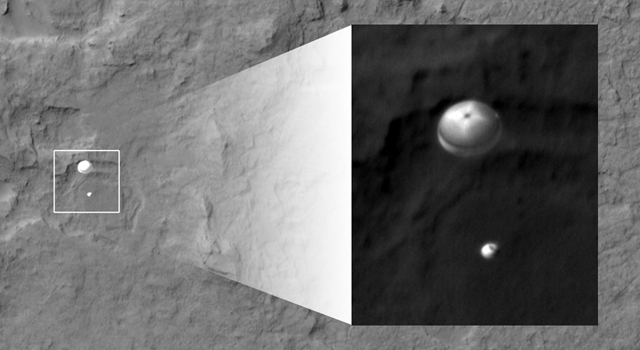
Curiosity Spotted on Parachute by Orbiter
Curiosity - Two Days Until Touchdown on Mars

With less than two days to go before touchdown on the Red Planet, Curiosity remains in good health, with all systems operating as expected. As of today, the Mars Science Laboratory spacecraft was approximately 468,000 miles (753,200 kilometers) from Mars, or a little less than twice the distance from Earth to the moon. It is traveling at about 8,000 mph (3,576 meters per second). It will gradually increase in speed to about 13,200 mph (5,900 meters per second) by the time it reaches the top of the Martian atmosphere. That's when the seven minutes of terror will start...
The Discovery Channel Telescope Sees First Light
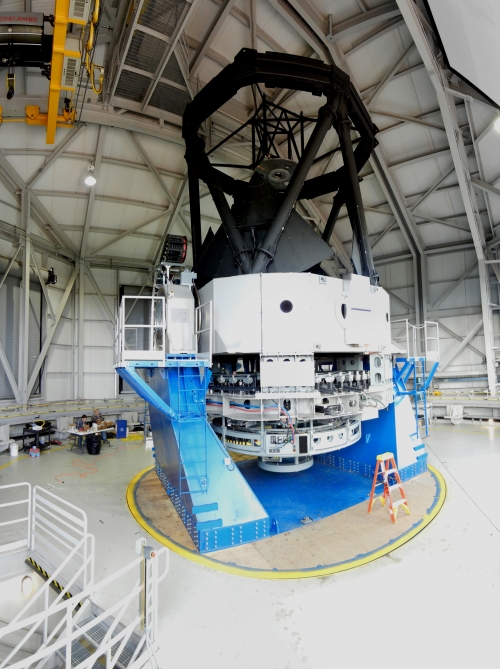
Forty miles southeast of Flagstaff, Arizona, at the Happy Jack site, the Discovery Channel Telescope (DCT) has reached completion. This 4.3-meter Ritchey-Chretien telescope rises seven stories above the top of a cinder cone. Lowell Observatory and Discovery Communications built this $53 million facility to push the frontier of knowledge and bring the marvels of the cosmos to millions. The DCT will be Lowell's flagship research telescope. Through its programming and online content, Discovery Channel will bring viewers an ongoing, inside look at the DCT and its fascinating science. The Discovery Channel will air the "Making of the DCT" film documentary this fall.
Distant Galaxy Cluster Found in Plain View
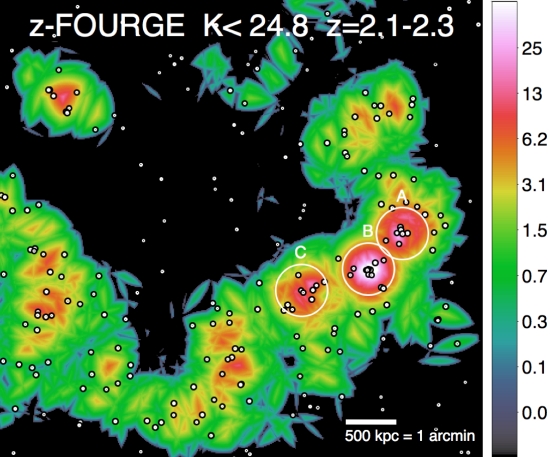
A team of astronomers has discovered the most distant example of a galaxy cluster lying in the middle of one of the most well-studied regions in the sky. Galaxy clusters are the "urban centers" of the universe and may contain thousands of galaxies. This cluster is located 10.5 billion light-years away from the Milky Way galaxy and is made up of a dense concentration of 30 galaxies. The discovery of this early system will help astronomers understand how galaxies are influenced by their environment. We see the end result of this process in nearby galaxy clusters, but it is critical to study distant clusters to develop a broad timeline of how galaxies were transformed in densely packed regions.
ESO Plans to Build the Largest Optical/Infrared Telescope
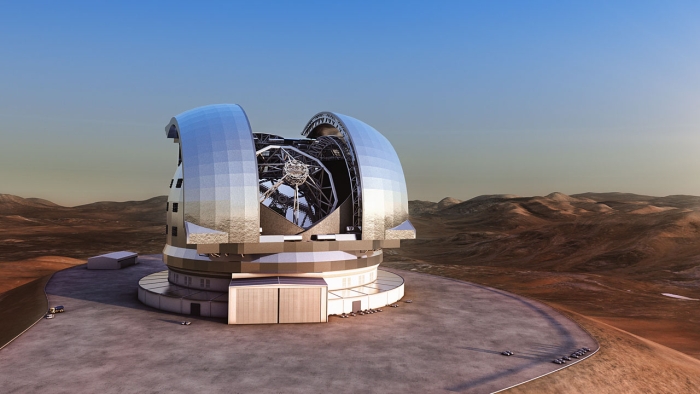
The European Southern Observatory (ESO) plans to build the largest optical/infrared telescope in the world. The European Extremely Large Telescope (E-ELT) will be a 39.3-metre segmented-mirror telescope situated on Cerro Armazones in northern Chile, close to ESO's Paranal Observatory. With the start of operations planned for early in the next decade, the E-ELT will address many of the most pressing unsolved questions in astronomy.
Solar System Ice: Source of Earth's Water

ScienceDaily (July 12, 2012) — Scientists have long believed that comets and, or a type of very primitive meteorite called carbonaceous chondrites were the sources of early Earth's volatile elements -- which include hydrogen, nitrogen, and carbon -- and possibly organic material, too. Understanding where these volatiles came from is crucial for determining the origins of both water and life on the planet. New research led by Carnegie's Conel Alexander focuses on frozen water that was distributed throughout much of the early Solar System, but probably not in the materials that aggregated to initially form Earth.
Fifth moon around Pluto
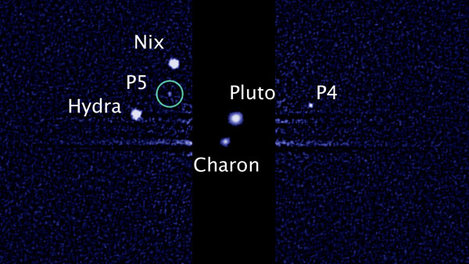
Hubble telescope finds fifth moon around Pluto
Funding Member
