News
SpaceX Launches Falcon 9 Dragon on Historic Mission

A SpaceX Falcon 9 rocket thundered into space and delivered a Dragon cargo capsule into orbit on May 22, 2012. The launch began an ambitious mission to show that the company is ready to deliver cargo to the International Space Station.
NASA's NuSTAR Black Hole Hunter to Launch from Kwajalein Atoll
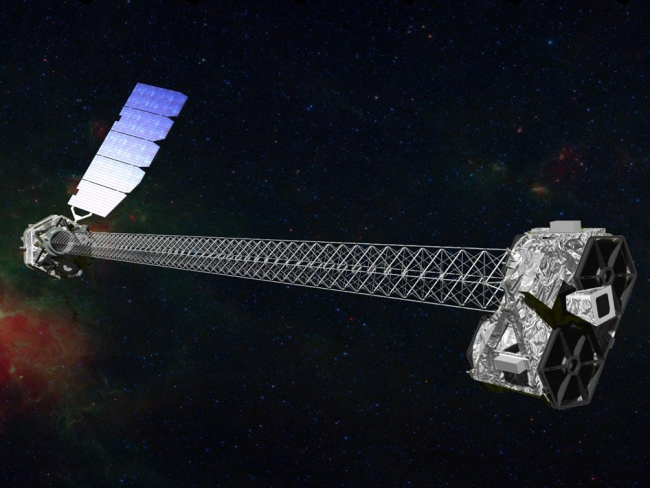
An amazing discovery of the last twenty years is that many galaxies have massive black hole in their centers. Dust and gas that fall into black holes radiate in the X-ray part of the spectrum. So if we look at the sky in visible light, we see stars. If we look at the sky in X-rays, we see black holes. NuSTAR will use advanced optics and detectors to observe the high-energy X-ray sky with much greater sensitivity and clarity than ever before. This June, NuSTAR will lift off on an Orbital Sciences Pegasus XL rocket. The rocket will be released from the bottom of a specially modified Lockheed L-1011 aircraft taking off from the Reagan Test Site on the Kwajalein Atoll in the Marshall Islands.
NASA Releases Spectacular Time-Lapse Video of Earth
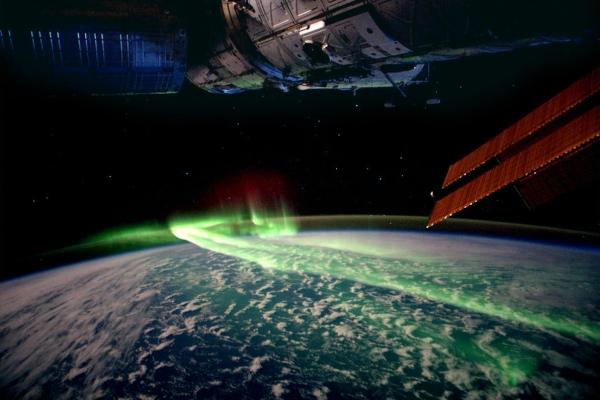
NASA released a stunning video featuring a series of time lapse sequences photographed by the crew of the International Space Station. The video takes viewers on a journey around the world, over brightly lit cities at night, through auroras, and over dazzling lightning displays.
IBEX Spacecraft Measures "Alien" Particles from Outside Our Solar System
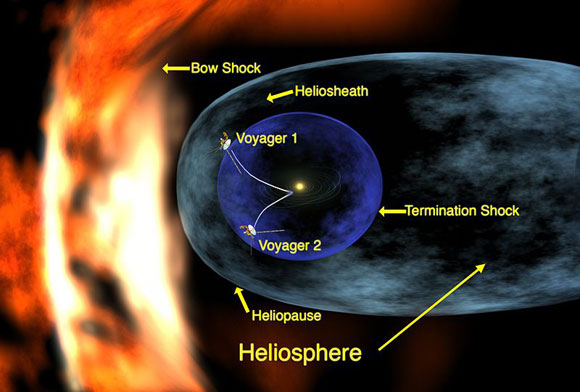
A great magnetic bubble surrounds the solar system as it cruises through the galaxy. The sun pumps the inside of the bubble full of solar particles that stream out to the edge until they collide with the material that fills the rest of the galaxy, at a complex boundary called the heliosheath. On the other side of the boundary, electrically charged particles from the galactic wind blow by, but rebound off the heliosheath, never to enter the solar system. Neutral particles, on the other hand, cross the boundary as if it was not there, continuing on another 7.5 billion miles for 30 years until they get caught by the sun's gravity and sling shot around the star. Here, NASA's Interstellar Boundary Explorer (IBEX) methodically measures these "Alien"samples of the mysterious neighborhood beyond our home.
Astronomers Watch Delayed Broadcast of the Massive Eta Carinae Explosion of 1837 -- In Real-time
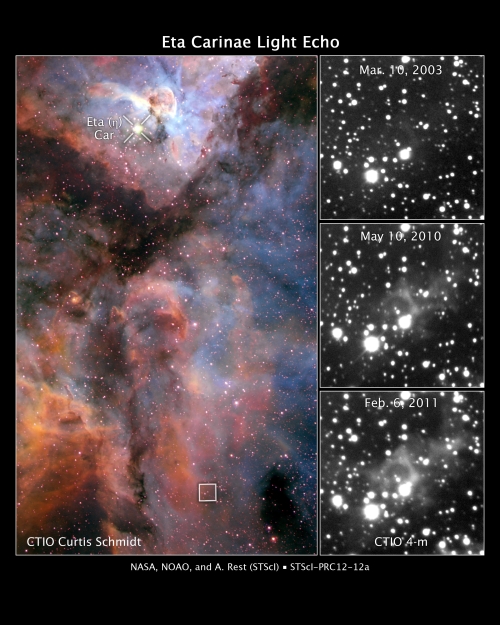
Astronomers are watching in real-time a delayed broadcast of a spectacular outburst from the unstable, behemoth double-star system called Eta Carinae -- an event initially seen on Earth nearly 175 years ago. Dubbed the "Great Eruption" at the time, the outburst first caught the attention of astronomers in 1837 and continued through 1858. But how is this possible you ask? Luckily for today's astronomers, some of the light from the eruption was heading in a different direction, away from our planet, when it bounced off dust clouds and was re-routed to Earth, an effect called a "light echo." Because of its longer path, the light is now reaching Earth 175 years later than the light that arrived directly. This cosmic re-run is being observed for the first time with today's sophisticated instruments, providing astronomers an opportunity to accurately record the star system's explosive activity.
Canon Introduces the EOS 60Da DSLR Camera For Astrophotography
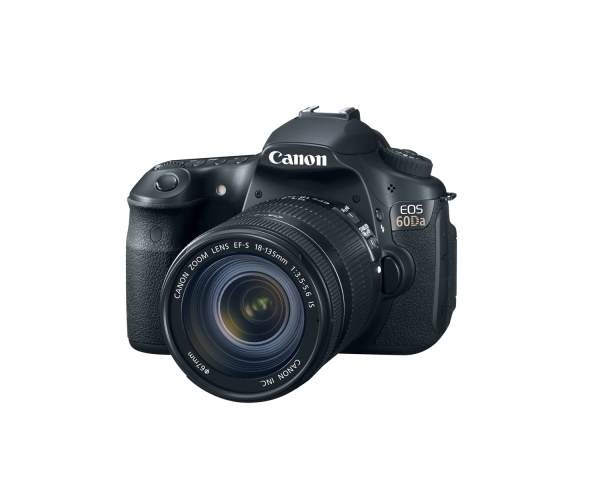
Canon today introduced the EOS 60Da Digital SLR Camera, the long-awaited successor to the EOS 20Da, which is optimized for astrophotography. This DSLR caters to amateur astronomers who enjoy capturing the beauty of the night sky by offering a modified infrared filter and a low-noise sensor with heightened hydrogen-alpha sensitivity. These modifications allow the camera to capture magnificent images of "red hydrogen emission" nebulae and other cosmic phenomena.
Hypervelocity Planets Being Ejected from the Milky Way at Relativistic Speeds
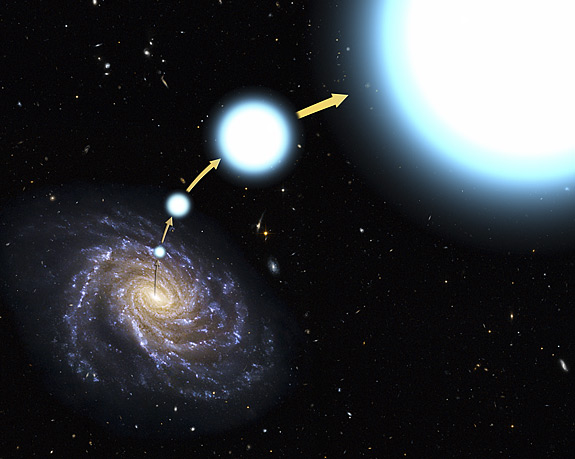
Seven years ago, astronomers found the first runaway star flying out of our Galaxy at a speed of 1.5 million miles per hour. The discovery intrigued theorists, who wondered if a star can get tossed outward at such an extreme velocity, could the same thing happen to planets? New research shows that the answer is yes. Not only do runaway planets exist, but some of them zoom through space at a few percent of the speed of light - up to 30 million miles per hour.
The Ring and Environs
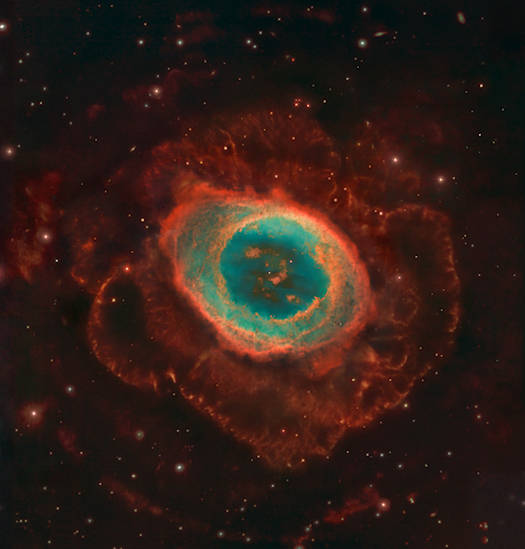
Another home run from the team of Gendler, Subaru and Hubble.
APEX Turns its Eye to the Dark Clouds in Taurus
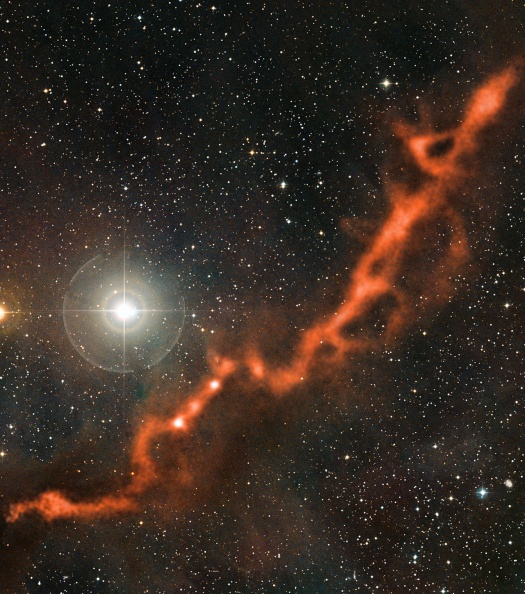
The Taurus Molecular Cloud in the constellation of Taurus (The Bull) lies about 450 light-years from Earth. A new image from the APEX (Atacama Pathfinder Experiment) telescope in Chile shows a sinuous filament of cosmic dust more than ten light-years long. In it, newborn stars are hidden and dense clouds of gas are on the verge of collapsing to form yet more stars. The cosmic dust grains are so cold that observations at wavelengths of around one millimetre are needed to detect their faint glow.
Celestron Founder Thomas J. Johnson Passes Away
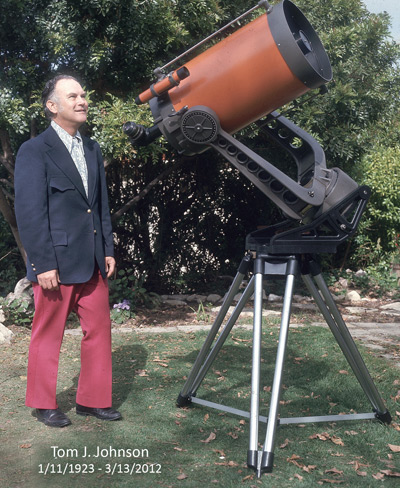
We are deeply saddened to hear that Celestron founder, Thomas J. Johnson, passed away on March 13, 2012.
Solar Storm Strikes Earth's Magnetic Field

The Sun's surface erupted with a series of solar storms this week, sending a barrage of electrically charged particles crashing into the Earth's magnetic field. So far, the solar blasts have caused only minor disruptions to terrestrial communications systems. But more solar eruptions are on the way over the next few days. The Sun is mid-way through an 11-year solar storm cycle that can have a major impact on activities here on Earth - and in space.
Pulsars -- The Most Extraordinary Physics Laboratories in the Universe
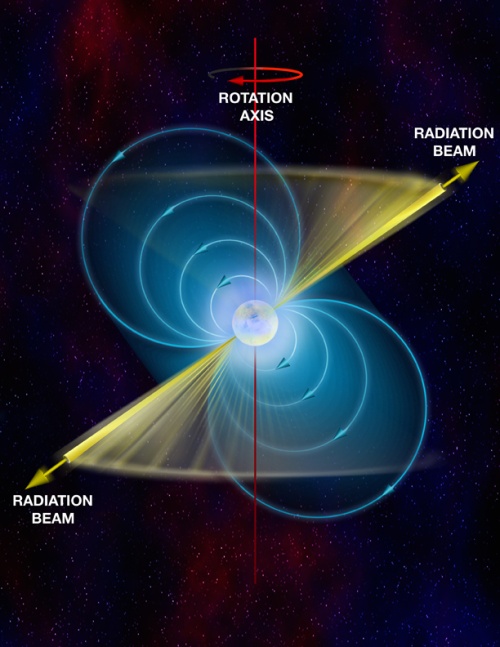
Neutron stars are the remnants of massive stars that exploded as supernovae. They pack more than the mass of the Sun into a sphere no larger than a medium-sized city, making them the densest objects in the Universe. Pulsars, neutron stars that emit beams of radio waves outward from the poles of their magnetic fields, are perhaps the most extraordinary physics laboratories in the Universe. Research on these extreme and exotic objects already has produced two Nobel Prizes.
Chandra finds fastest wind from stellar-mass black hole
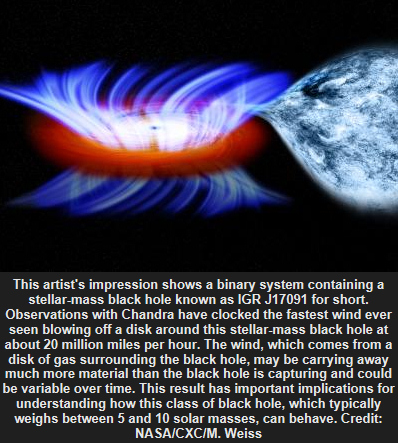
Astronomers using NASA's Chandra X-ray Observatory have clocked the fastest wind yet discovered blowing off a disk around a stellar-mass black hole.
US Celebrates the 50th Anniversary of John Glenn's Historic Mission

Fifty years ago, astronaut John H. Glenn, Jr. became the first American to orbit the Earth. At exactly 9:47 a.m. EST on February 20, 1962, about 45 million Americans sat tensely in front of their black and white television sets and watched an Atlas booster rocket with a small and cramped Mercury spacecraft named Friendship 7 manned by John Glenn, lift off its pad at Cape Canaveral, Florida and go roaring upward through the clear blue sky. With six manned flights from 1961 to 1963, Project Mercury opened the door for Projects Gemini and Apollo and led to a man on the moon before the end of the decade.
New Insights into the Behavior of Fast Rotating Millisecond Pulsars

Pulsars are among the most exotic celestial bodies known. They have diameters of about 20 kilometers, but at the same time roughly the mass of our Sun. A sugar-cube sized piece of its ultra-compact matter on the Earth would weigh hundreds of millions of tons. A sub-class of them, known as millisecond pulsars, are strongly magnetized old neutron stars in binary systems which have been spun up to high rotational frequencies by accumulating mass and angular momentum from a companion star. Today we know of about 200 such pulsars with spin periods between 1.4 to 10 milliseconds. These were first discovered in 1982 and are located in both the Galactic Disk and in Globular Clusters.
Funding Member
