News
Physicists At CERN Observe Clear Signs of the Higgs Boson

Scientists at CERN made an announcement about the Higgs Boson (aka the "God Particle") this morning. The Higgs Boson is a subatomic particle that has been predicted to exist, but has never actually been observed... Until now. Finding the Higgs Boson ties up a loose end of the Standard Model of physics, which requires a Higgs-like particle to exist. "We have reached a milestone in our understanding of nature," said CERN Director General Rolf Heuer. "The discovery of a particle consistent with the Higgs boson opens the way to more detailed studies... and is likely to shed light on other mysteries of our universe."
Kennedy Space Center Celebrates 50 Years of Success

On July 1, 1962, NASA officially activated the Launch Operations Center at the seaside spaceport known as the Missile Firing Laboratory at Cape Canaveral, Florida. The following year the center was renamed to honor the president who put America on the path to the moon. NASA's John F. Kennedy Space Center has helped set the stage for America's adventure in space for five decades. The spaceport has served as the departure gate for every American manned mission and hundreds of advanced scientific spacecraft. From the early days of Project Mercury to the Space Shuttle Program and International Space Station, from the Hubble Space Telescope to the Mars rovers, the center has enjoyed a rich heritage.
Earth's Oldest Known Impact Crater Found in Greenland
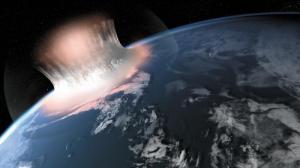
ScienceDaily (June 28, 2012) — A 100 kilometre-wide crater has been found in Greenland, the result of a massive asteroid or comet impact a billion years before any other known collision on Earth.
Robert Gendler Slideshow
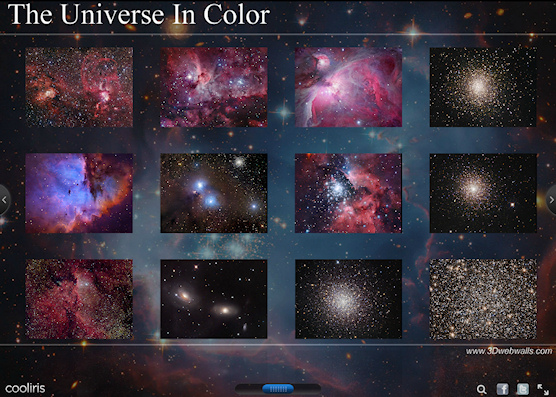
Need we say more?
Voyager 1 at the Final Frontier

For nearly 35 years, NASA's Voyager 1 probe has been hurtling toward the edge of the solar system, flying through the dark void on a mission unlike anything attempted before. One day, mission controllers hoped Voyager 1 would leave the solar system behind and enter the realm of the stars -- Interstellar space. That day may finally be upon us.
NASA's Lunar Reconnaissance Orbiter
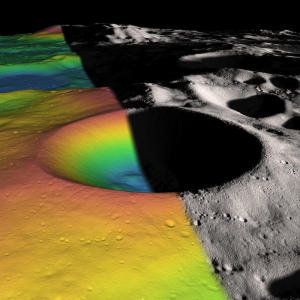
NASA's Lunar Reconnaissance Orbiter (LRO) spacecraft has returned data that indicate ice may make up as much as 22 percent of the surface material in a crater located on the moon's south pole.
Discovery of the Most Distant Galaxy in the Cosmic Dawn
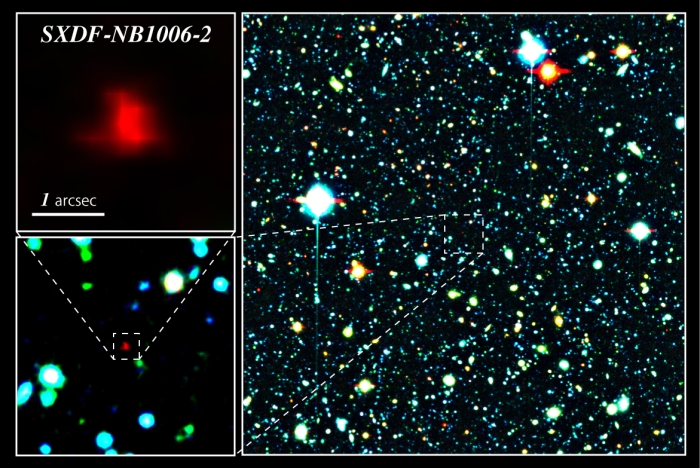
A team of astronomers has used the Subaru and Keck Telescopes to discover the most distant galaxy ever found, SXDF-NB1006-2, at a distance of 12.91 billion light years from the Earth. Astronomers think that the our Universe began 13.7 billion years ago at the Big Bang. The exteme temperature and density of this fireball decreased rapidly as its volume increased. Hot cosmic plasma composed mainly of protons and electrons recombined to form neutral hydrogen atoms within 380,000 years after the Big Bang. This was the beginning of the cosmic "dark age." From then on, the gas continued to cool and fluctuated in density. These findings help us to understand the nature of the early Universe during the "cosmic dawn," when the light of ancient celestial objects and structures first appeared from obscurity.
Dr. Sandra Faber Wins Bruce Medal

Dr. Faber, of the University of California Santa Cruz (UCSC), is recognized for her lifetime achievements in astronomical research.Faber's role in developing new instrumentation has included serving as a member of the Hubble Space Telescope's Wide Field Camera team, assisting in the diagnosis of Hubble's mirror flaw after launch, and serving on the team that proposed the successful recovery strategy that restored Hubble's potential.
NASA Mars Rover Team Aims for Landing Closer to Prime Science Site
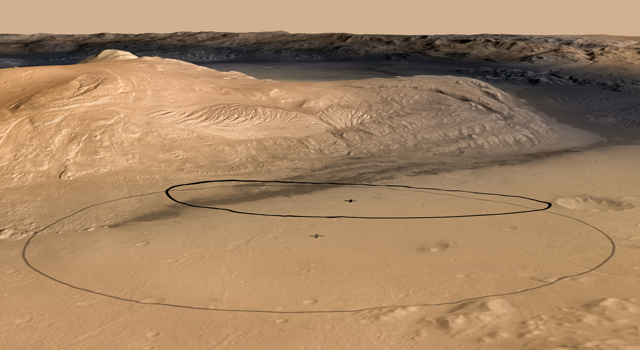
PASADENA, Calif. -- NASA has narrowed the target for its most advanced Mars rover, Curiosity, which will land on the Red Planet in August. The car-sized rover will arrive closer to its ultimate destination for science operations, but also closer to the foot of a mountain slope that poses a landing hazard.
Neighbor galaxies may have brushed closely
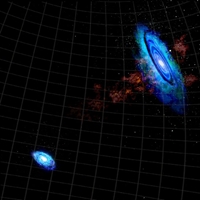
Recent studies with the National Science Foundation's Green Bank Telescope (GBT) indicate that two of our Milky Way's neighbor galaxies may have had a close encounter billions of years ago. The new observations confirm a disputed 2004 discovery of hydrogen gas streaming between the giant Andromeda Galaxy (M31) and the Pinwheel Galaxy (M33).
Highest-Energy Light from a Solar Flare Ever Detected
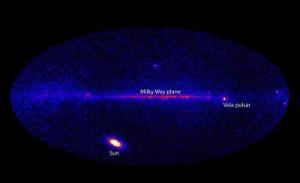
A solar flare is an explosive blast of light and charged particles. The powerful March 7 flare, which earned a classification of X5.4 based on the peak intensity of its X-rays, is the strongest eruption so far observed by Fermi's Large Area Telescope (LAT). The flare produced such an outpouring of gamma rays -- a form of light with even greater energy than X-rays -- that the sun briefly became the brightest object in the gamma-ray sky.
Kepler Telescope Star Data Creates Musical Melody
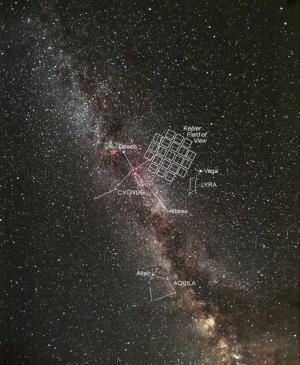
Making Music With Real Stars
Survey Counts Potentially Hazardous Asteroids
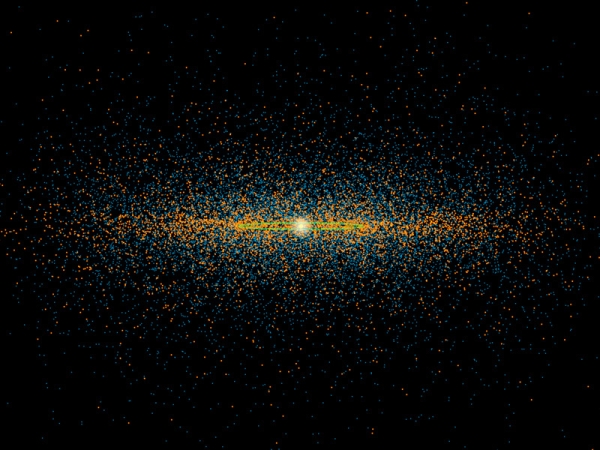
Observations from NASA's Wide-field Infrared Survey Explorer (WISE) have led to the best assessment yet of our solar system's population of potentially hazardous asteroids. The results reveal new information about their total numbers, origins and the possible dangers they may pose. Potentially Hazardous Asteroids, or PHAs, have the closest orbits to Earth's, coming within five million miles, and they are big enough to survive passing through Earth's atmosphere and cause damage on a regional, or greater, scale.
ESO's VLTI Reveals Dust Torus Around the Black Hole in a Galactic Nucleus
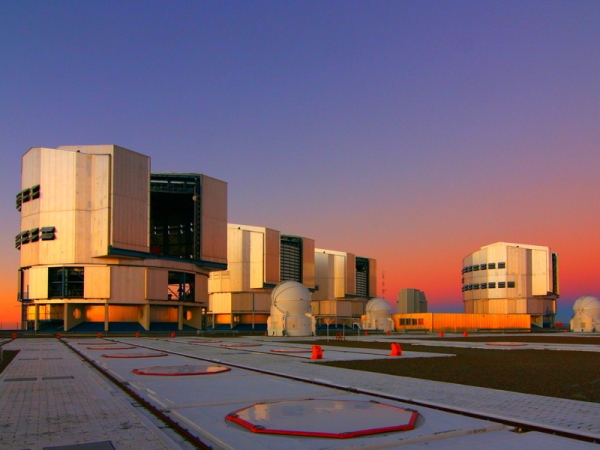
Black holes swallow everything that comes near them and are fuelled by gas and dust from their surroundings. An international research team at the Max Planck Institute for Radio Astronomy in Bonn, Germany has observed the inner region of galaxy NGC 3783, which contains a black hole surrounded by a so-called "Dust Torus." This torus apparently represents the reservoir of gaseous and dusty material that feeds the hot gas Accretion Disk and the supermassive black hole at the center of the galaxy. The observations were carried out with the Very Large Telescope Interferometer (VLTI) of the European Southern Observatory (ESO) in Chile.
The Fire Started Fifty Years Ago Today... It is Still Burning
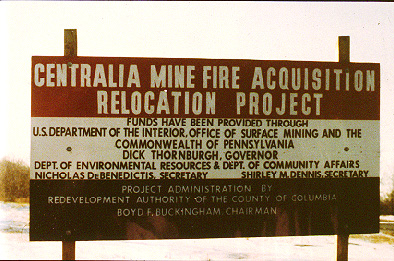
Fifty years ago today, on May 27, 1962, the town of Centralia, Pennsylvania was tidying up for Memorial Day celebrations. As part of the clean-up activities, the fire department set the town's landfill ablaze. Unfortunately, the fire ignited a coal outcropping at the landfill, which quickly spread into the vast network of Anthracite coal mines beneath the homes and businesses of Centralia. The fire is still burning today and will probably burn for another century. What does this have to do with astronomy? Absolutely nothing, but it does make interesting reading. For an astronomy tie-in, we could re-title this posting "Man Sets Planet Ablaze."
Funding Member
