News
NASA's Juno Spacecraft Starts Its Five Year Mission to Study Jupiter

NASA's solar-powered Juno spacecraft is on its way to Jupiter. It will take five years and 1,740 million miles (2,800 million kilometers) to complete the journey to Jupiter. The spacecraft will orbit the planet's poles 33 times and use its collection of eight science instruments to probe beneath the gas giant's obscuring cloud cover to learn more about its origins, structure, atmosphere and magnetosphere, and look for a potential solid planetary core.
Dwarf Planet Mysteries Beckon to New Horizons
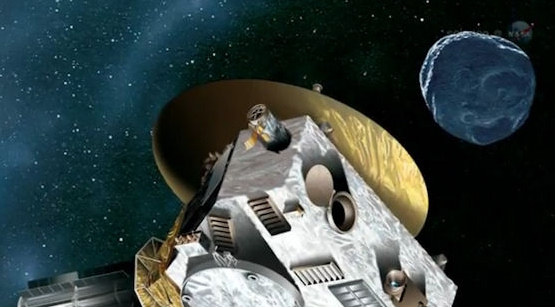
At this very moment one of the fastest spacecraft ever launched - NASA's New Horizons - is hurtling through the void at nearly one million miles per day. Launched in 2006, it has been in flight longer than some missions last, and still has four more years of travel to go. New Horizons is headed for the lonely world of Pluto on the outer edge of the solar system.
A Star is Born
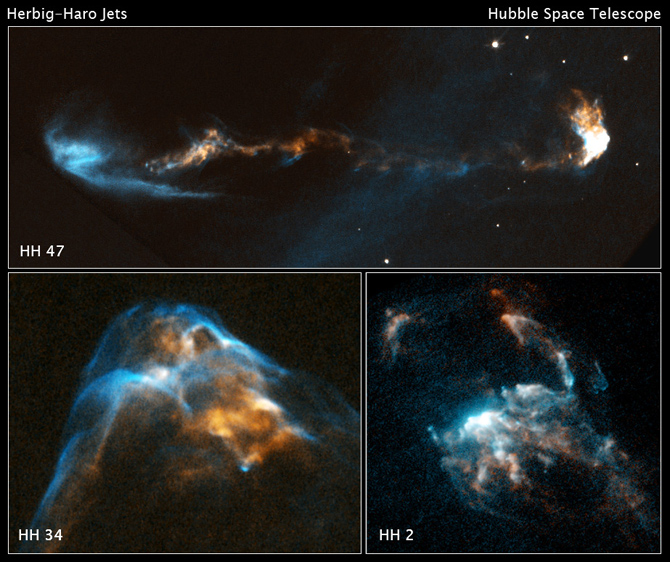
New movies created from years of still images collected by NASA's Hubble Space Telescope provide new details about the stellar birthing process, showing energetic jets of glowing gas ejected from young stars in unprecedented detail. The jets are a byproduct of gas accretion around newly forming stars and shoot off at supersonic speeds of about 100 miles per second in opposite directions through space. These phenomena are providing clues about the final stages of a star's birth, offering a peek at how our Sun came into existence 4.5 billion years ago.
Astronomers Find a Dense Planet Made of Crystalline Carbon -- A Diamond Planet
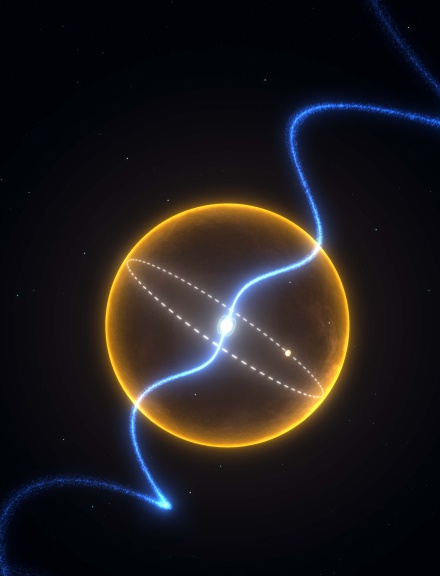
Astronomers think they've found a once-massive star that's been transformed into a small planet made of diamond, orbiting a pulsar. The pulsar and its planet are in the Milky Way's plane of stars and lie 4,000 light-years away from Earth in the constellation Serpens (the Snake).
Sunspot Breakthrough

A new breakthrough in sunspot detection could provide days of extra early warning for strong solar storms.
The Star that Changed the Universe

Though the universe is filled with billions upon billions of stars, the discovery of a single variable star in 1923 altered the course of modern astronomy. The star goes by the inauspicious name of Hubble variable number one, or V1, and resides in the outer regions of the neighboring Andromeda galaxy (M31). But in the early 1900s, most astronomers considered the Milky Way a single "island universe" of stars, with nothing observable beyond its boundaries. Andromeda was cataloged as just one of many faint, fuzzy patches of light astronomers called "spiral nebulae." The star V1 helped Hubble show that Andromeda was beyond our galaxy and settled the debate over the status of the spiral nebulae. The universe became a much bigger place after Hubble's discovery.
Like Watching a Train Wreck in Slow Motion

Arp 302 provides a textbook example of colliding galaxies seen in the early stages of their interaction. The edge-on galaxy near the top of the image and the face-on galaxy at the bottom of the image will merge millions of years from now -- much like the Milky Way and Andromeda will do in a few billions years. The image from NASA's Chandra X-ray Observatory (purple) is shown here along with optical data from the Hubble Space Telescope (red, green, blue). Arp 302 is located about 450 million light years from Earth.
Neptune Completes Its First Circuit Around The Sun Since Its Discovery in 1846
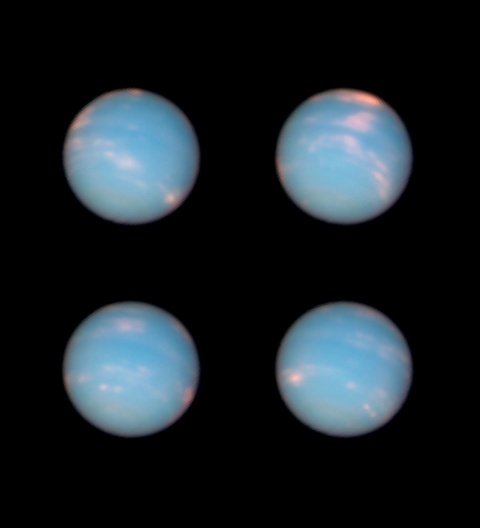
July 12, 2011 marked Neptune's first orbit around the Sun since it was discovered 165 years ago. These images were taken by NASA's Hubble Space Telescope to commemorate the event. The images were taken at roughly four-hour intervals, offering a full view of the blue-green planet.
ESO's Paranal Observatory Discovers 96 New Open Star Clusters
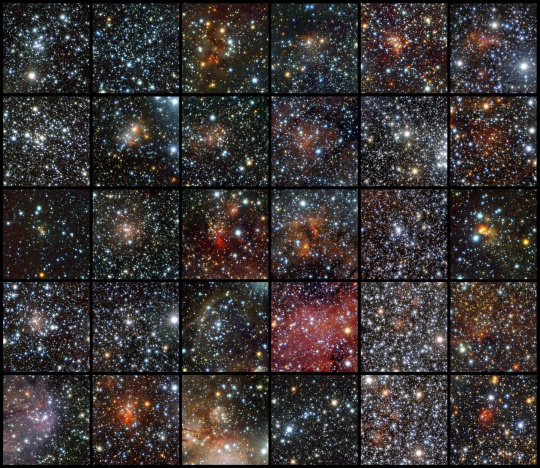
Using data from the VISTA infrared survey telescope at ESO's Paranal Observatory, an international team of astronomers has discovered 96 new open star clusters hidden by the dust in the Milky Way. These tiny and faint objects were invisible to previous surveys, but they could not escape the sensitive infrared detectors of the world’s largest survey telescope, which can peer through the dust. This is the first time so many faint and small clusters have been found at once. To date, 2500 open clusters have been found in the Milky Way, but astronomers estimate there might be as many as 30,000 still hiding behind the dust and gas.
Striking New Images of the Asteriod Vesta
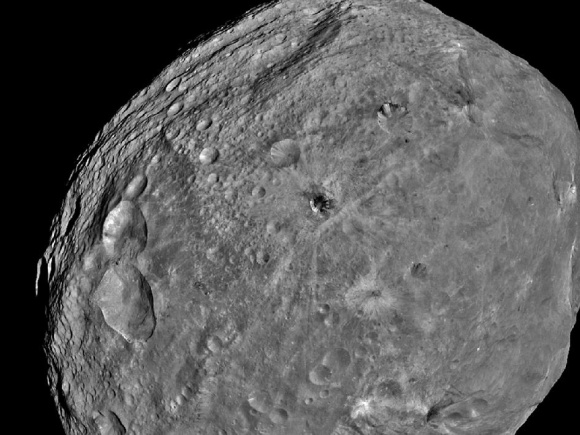
NASA's Dawn spacecraft is spiraling towards its first intensive science orbit of the asteroid Vesta. That initial orbit of the rocky world begins August 11, 2011 at an altitude of nearly 1,700 miles (2,700 kilometers) and will provide in-depth analysis of the asteroid. The Dawn team has begun unveiling the first full-frame images of Vesta. These images go all the way around Vesta, since the giant asteroid turns on its axis once every five hours and 20 minutes. Following a year at Vesta, the spacecraft will depart in July 2012 for the asteroid Ceres, where it will arrive in 2015.
Oxygen molecules found in space
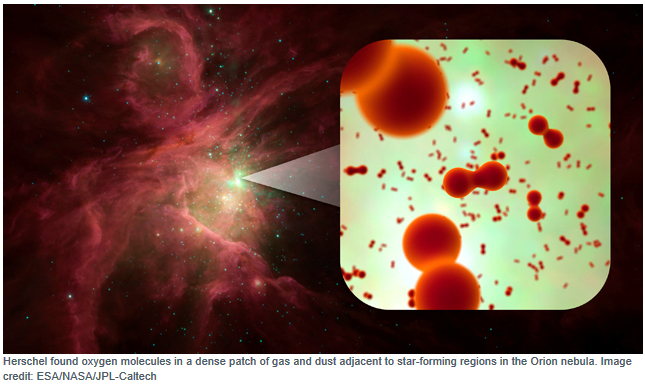
The Herschel Space Observatory's large telescope and state-of-the-art infrared detectors have provided the first confirmed finding of oxygen molecules in space.
Peculiar Gamma-Ray Emissions from Terzan 5

The High Energy Stereoscopic System (HESS) telescope system in Namibia discovered a new source of very-high-energy gamma-rays from the direction of the globular cluster Terzan 5. Being very likely located in the outer parts of Terzan 5, this source is the first example of gamma-ray emissions from a globular cluster. The off-center position of the source and the specific origin of the gamma-rays pose a puzzle for scientists.
Trojan asteroid seen in Earth's orbit by Wise telescope
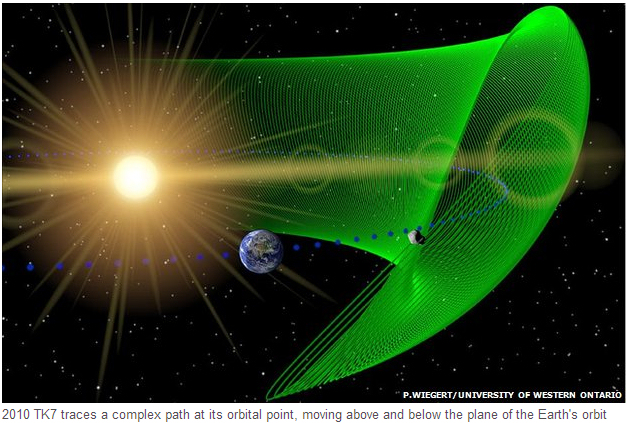
Story by Jonathan AmosScience correspondent, BBC News: 2010 TK7 traces a complex path at its orbital point, moving above and below the plane of the Earth's orbit
Meteorite discovered in China may be second-largest ever found

A massive space rock - one that could rank as one of the largest meteorites ever recovered - has been found in a remote and mountainous region in northwest China, according to news reports.
Dawn Arrives at Vesta - Next Stop is Ceres
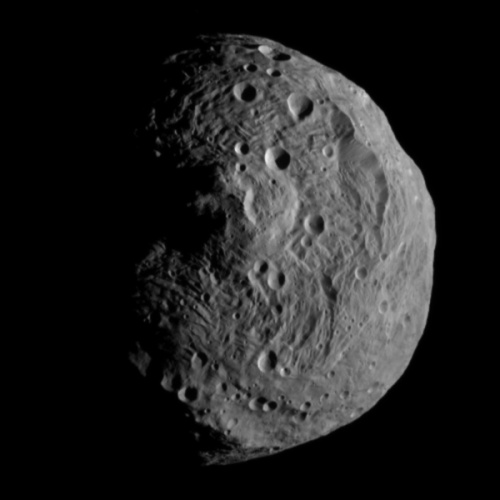
NASA's Dawn spacecraft has returned the first close-up images after beginning its orbit around the giant asteroid Vesta. On Friday, July 15, 2011, Dawn became the first probe to enter orbit around an object in the main asteroid belt between Mars and Jupiter. Vesta is 330 miles (530 kilometers) in diameter and the second most massive object in the asteroid belt. Ground- and space-based telescopes have obtained images of Vesta for about two centuries, but they have not been able to see much detail on its surface until now. Dawn will spend one year orbiting Vesta, then travel to a second destination, the dwarf planet Ceres, arriving in February 2015.
Funding Member
