News
Thank you

From the entire Astromart Community
After years of work, 'dream machine' set for launch to Mars
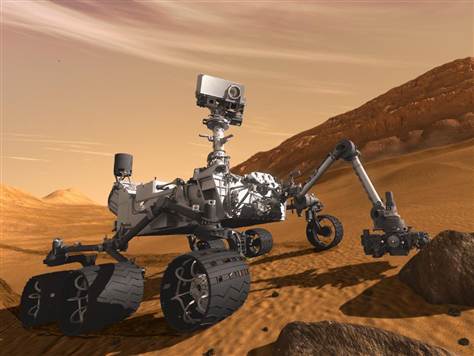
NASA is finally set to launch its next Mars rover this week.
What's Really Behind the Origin of Type Ia Supernovae?
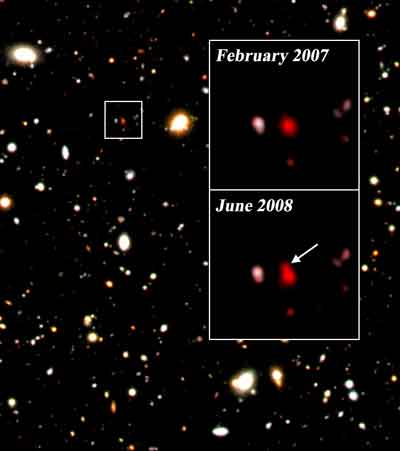
The largest survey to date of distant exploding stars is giving astronomers new clues to what's behind the Type Ia supernovae they use to measure distances across the cosmos. These stellar explosions helped astronomers conclude more than a decade ago that dark energy is accelerating the expansion of the universe. But what causes Type Ia supernovae to explode is still a mystery.
Will Future Telescopes Be Able To See Alien City Lights?

If an alien civilization builds brightly-lit cities like those shown in this artist's conception, future generations of telescopes might allow us to detect them. This would offer a new method of searching for extraterrestrial intelligence in our Galaxy.
A Star with Spiral Arms
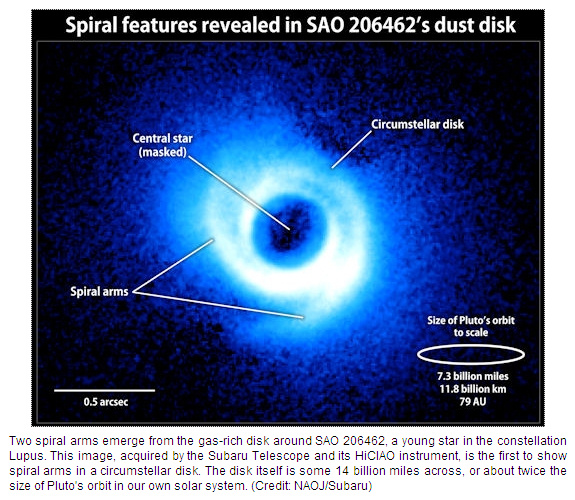
Say what? The name of the star is SAO 206462. It's a young star more than four hundred light years from Earth in the constellation Lupus, the wolf. SAO 206462 attracted attention because it has a circumstellar disk
Ancient Supernova Mystery Solved
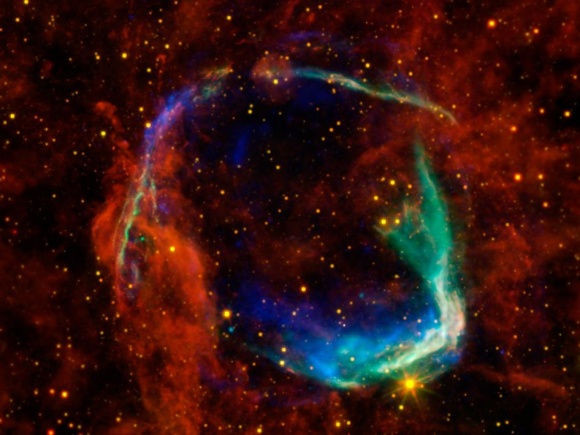
A mystery that began nearly 2,000 years ago, when Chinese astronomers witnessed what would turn out to be an exploding star in the sky, has been solved. In 185 A.D., Chinese astronomers noted a "guest star" that mysteriously appeared in the sky and stayed for about 8 months. By the 1960s, scientists had determined that the mysterious object was the first documented supernova. New infrared observations from NASA's Spitzer Space Telescope and Wide-field Infrared Survey Explorer, or WISE, reveal how this first supernova ever recorded occurred and how its shattered remains ultimately spread out to great distances.
Results of New Study -- We Know Less About Dark Matter Than We Did Before
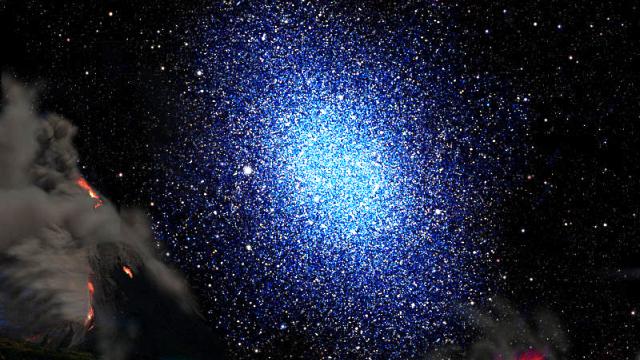
Like all galaxies, our Milky Way is home to a strange substance called dark matter. Dark matter is invisible, but betrays its presence only through its gravitational pull. Without dark matter holding stars together, our galaxy's speedy stars would fly off in all directions. The nature of dark matter is a mystery -- a mystery that a new study has only deepened.
Exotic Galaxy Reveals Tantalizing Tale
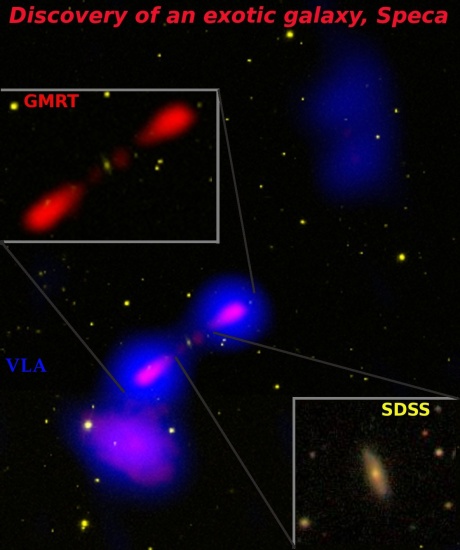
A galaxy with a combination of characteristics never seen before is giving astronomers a tantalizing peek at processes they believe played key roles in the growth of galaxies and clusters of galaxies early in the history of the Universe. The galaxy, dubbed Speca by the researchers, is only the second spiral galaxy known to produce large, powerful jets of subatomic particles moving at nearly the speed of light.
ALMA Opens Its Eyes
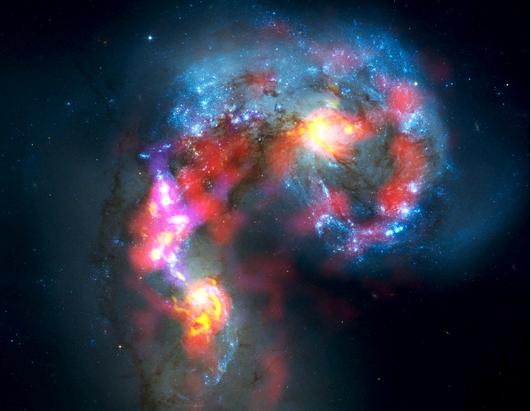
The most powerful and complex ground-based observatory, the Atacama Large Millimeter/ submillimeter Array (ALMA), has officially opened for business and revealed its first images. The first image, from the telescope still under construction, reveals a view of the Universe that cannot be seen by visible-light and infrared telescopes. ALMA views the Universe in long wavelengths of light, much longer than the optical light we see with our eyes. The sharpness, efficiency, and quality of its observations will increase dramatically as more antennas become available and the array grows in size.
Work on the Accelerating Expansion of the Universe Wins 2011 Nobel Prize in Physics

Saul Perlmutter of the University of California - Berkeley, Adam Riess of Johns Hopkins University, and Brian Schmidt of Australian National University's Mount Stromlo and Siding Spring Observatories have been awarded the 2011 Nobel Prize in Physics for discovering that galaxies are receding from one another faster now than they were billions of years ago. The accelerating expansion means that the universe could expand forever until, in the distant future, it becomes cold and dark. The teams' discovery led to speculation that there is a "dark energy" that is pushing the universe apart. Though dark energy theoretically makes up 73 percent of the matter and energy of the universe, astronomers and physicists have so far failed to discover the nature of this strange, repulsive force.
Space Telescopes Reveal Secrets of a Turbulent Black Hole

A fleet of spacecraft including NASA's Hubble Space Telescope has uncovered unprecedented details in the surroundings of a supermassive black hole in the distant galaxy Markarian 509. Unlike popular belief, not all the matter around a black hole is swallowed up. Supermassive black holes at the hearts of active galaxies swallow large amounts of gas. However, during this feast they spill a lot of their "food," which is discharged in turbulent outbursts. An international team of astronomers has revealed some striking features of such an outburst around a supermassive black hole. They found a very hot "convertor" corona hovering above the black hole and cold gas "bullets" in hotter diffuse gas, speeding outwards with velocities up to 700 km/s.
Mt Stromlo Observatory celebrates a century of observations with the return of the Oddie refractor
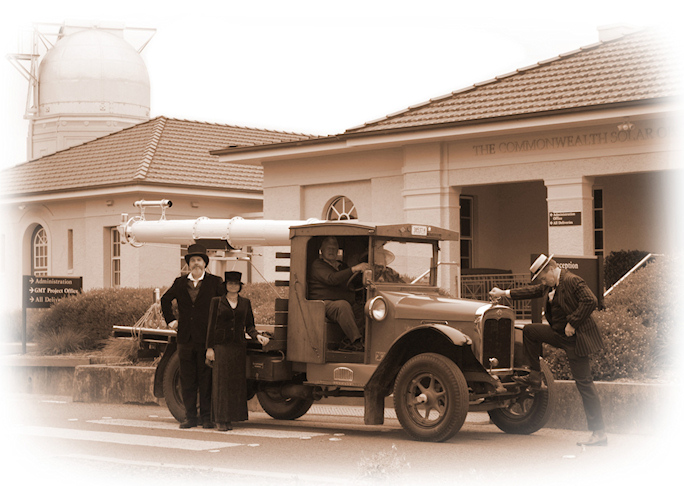
The age of the great refractors returns to Mt stromlo Observatory's outreach programs as the Oddie rises from the ashes in a special celebration of a century of astronomy at the site.
The Impossible Star

A team of European astronomers has used ESO's Very Large Telescope (VLT) to track down a star in the Milky Way that many thought was impossible. They discovered that this star is composed almost entirely of hydrogen and helium, with only remarkably small amounts of other chemical elements in it. This intriguing composition places it in the "forbidden zone" of a widely accepted theory of star formation, meaning that it should never have come into existence in the first place.
6-ton Satellite to Re-Enter Atmosphere and Crash into Earth Next Week
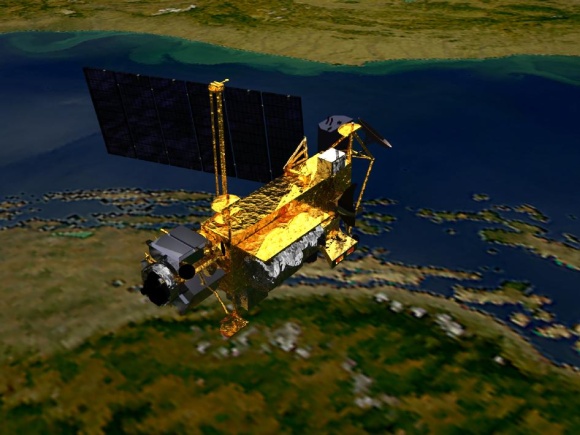
NASA's UARS Satellite is expected to re-enter Earth's atmosphere on Sept. 23, 2011 (plus or minus a day), almost six years after the end of a productive scientific life. Although the spacecraft will break into pieces during re-entry, not all of it will burn up in the atmosphere. It is too early to say what geographic area may be affected, but NASA is watching the satellite closely and will keep us informed. The risk to public safety or property is extremely small.
NASA Contemplates a Super-Charged Successor to the Saturn V Rocket

NASA is ready to move forward with the development of the Space Launch System (SLS) -- an advanced heavy-lift launch vehicle that will provide an entirely new national capability for human exploration beyond Earth's orbit. It will use a liquid hydrogen and liquid oxygen propulsion system, which will include the RS-25D/E engine from the Space Shuttle Program for the core stage and the J-2X engine for the upper stage. SLS will also use solid rocket boosters for the initial development flights. The SLS will have an initial lift capacity of 77 tons. The lift capacity will be evolvable to more than 143 tons. The first developmental flight is targeted for the end of 2017. By comparison, the Saturn V booster that sent men to the moon was able to lift 130 tons.
Funding Member
