News
How to Get a Star to Reveal Her Age

For many movie stars, their age is a well-kept secret. The same is true for stars in space. Like our Sun, most stars look almost the same for most of their lives. So how can we tell if a star is one billion or 10 billion years old? Astronomers may have found a promising new method called "gyrochronology" - measuring a star's spin.
Bright Star occultation of main belt astroid
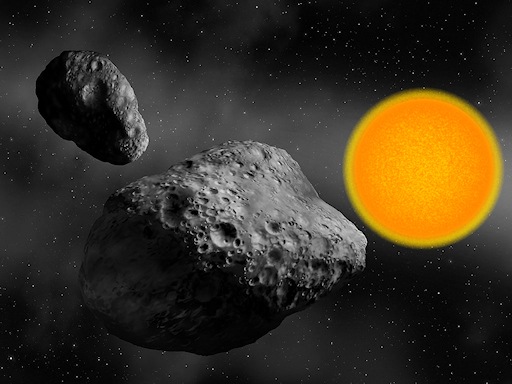
Early Tuesday morning, July 19th, the large binary asteroid (90) Antiope will occult 6.7-mag. LQ Aquarii
Some Like It Hot - The Sungrazer That Got Too Close

On the evening of Tuesday, July 5, 2011 a comet flew into the sun. Such comets are not unusual, and they're called "sungrazers" since they come so close to the star that they lose a great deal of mass during the approach or evaporate and disappear completely. However, no one has actually seen the end of that journey - until now. The most famous sungrazer in recent time was Comet Ikeya-Seki. In 1965 it appeared out of nowhere, dove toward the sun and swooped over the sun's surface only 450,000 km away. Because Ikeya-Seki's nucleus was large, about 5 km wide, it survived the encounter and emerged as one of the brightest comets of the past thousand years.
Most Distant Quasar Found

A team of European astronomers has used ESO's Very Large Telescope (VLT) and a host of other telescopes to discover and study the most distant quasar found to date. This brilliant beacon, powered by a black hole with a mass two billion times that of the Sun, is by far the brightest object yet discovered in the early Universe.
Asteroid Flyby coming
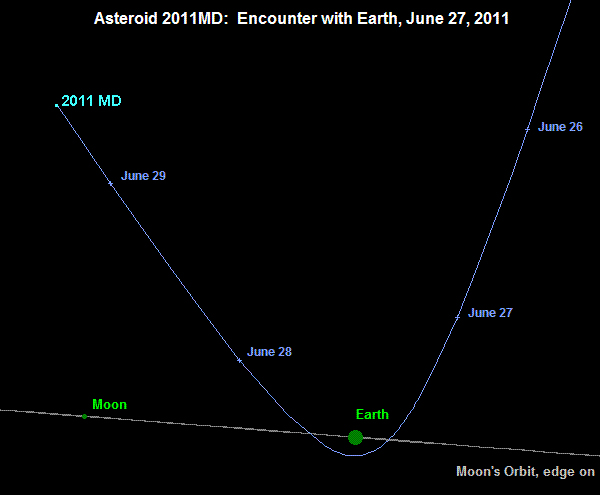
Small Asteroid to Whip Past Earth on June 27, 2011
NASA's Messenger Providing a Wealth of New Information About Mercury
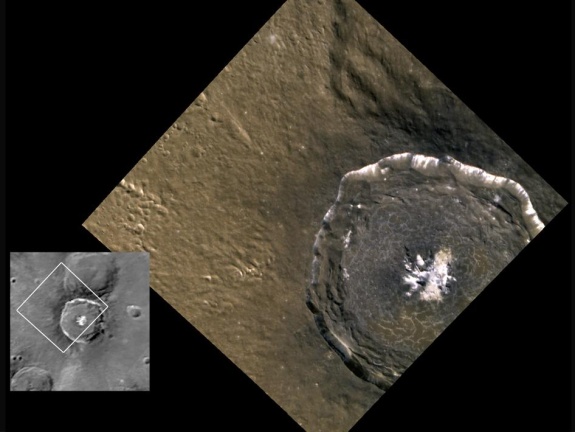
After becoming the first spacecraft to ever orbit around Mercury, Messenger is providing a wealth of new information about the planet. Tens of thousands of images of major features on the planet — previously seen only at comparatively low resolution — are now available in sharp focus. Measurements of the chemical composition of Mercury's surface are providing important clues as to the origin of the planet and its geological history. Maps of the planet's topography and magnetic field are revealing new clues to Mercury's interior dynamical processes. And scientists now know that bursts of energetic particles in Mercury's magnetosphere are a continuing product of the interaction of Mercury's magnetic field with the solar wind.
Black Hole Rips Apart a Star That Wandered Too Close

Observations led by astronomers at the University of Warwick have shown that the flash from one of the biggest and brightest bangs yet recorded by astronomers comes from a massive black hole at the center of a distant galaxy. The black hole appears to have ripped apart a star that wandered too close, creating a powerful beam of energy that crossed the 3.8 billion light years to Earth.
A Major Drop in Solar Activity is Predicted -- Next Solar Cycle May Not Happen at All
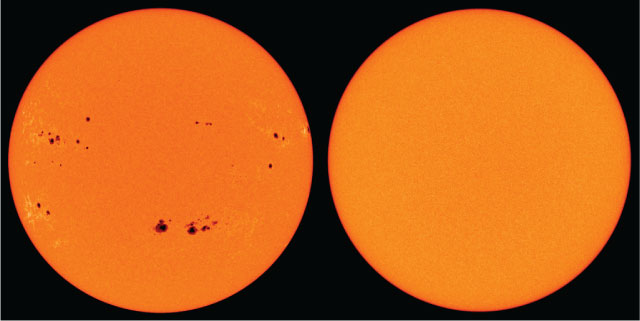
Since 1611, humans have recorded the comings and goings of black spots on the sun. The number of sunspots wax and wane over approximately an 11-year cycle -- more sunspots generally mean more activity and eruptions on the sun and vice versa. The number of sunspots can change from cycle to cycle and 2009 saw the longest and weakest solar minimum since scientists have been monitoring the sun with space-based instruments. Scientists at the National Solar Observatory (NSO) and the Air Force Research Laboratory (AFRL) are reporting on research that indicates the next 11-year solar sunspot cycle will be greatly reduced or may not happen at all.
A Big Surprise from the Edge of the Solar System
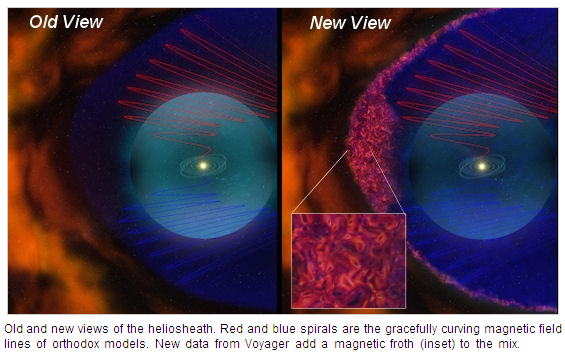
"The Voyager probes appear to have entered a strange realm of frothy magnetic bubbles," says astronomer Merav Opher of Boston University. "This is very surprising."
This is the Sun -- Having a Blast

The Sun unleashed an M-2 (medium-sized) solar flare, an S1-class (minor) radiation storm, and a spectacular Coronal Mass Ejection (CME) on June 7, 2011. The large cloud of particles mushroomed up and fell back down looking as if it covered an area of almost half the solar surface. Fortunately, this CME, which is is moving at 1400 km/s according to NASA models, is not-squarely directed at Earth. The CME should deliver a glancing blow to Earth's magnetic field during the late hours of June 8th or June 9th. High-latitude sky watchers should be on the alert for auroras when the CME arrives.
"Now This is What It's Like When Worlds Collide..."

Five billion years from now, our Milky Way galaxy will collide with the Andromeda galaxy. This will mark a moment of both destruction and creation. The galaxies will lose their separate identities as they merge into one. At the same time, cosmic clouds of gas and dust will smash together, triggering the birth of new stars. To understand our past and imagine our future, we must understand what happens when galaxies collide. But since galaxy collisions take place over millions to billions of years, we can't watch a single collision from start to finish. Instead, we must study a variety of colliding galaxies at different stages and NASA's Spitzer Space Telescope and Galaxy Evolution Explorer (GALEX) are the perfect tools to make those observations.
ECLIPSE OF THE MIDNIGHT SUN:
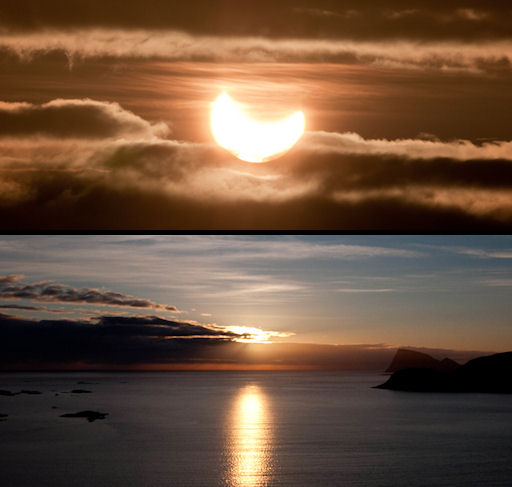
A solar eclipse at midnight? It's not only possible, it actually happened last night.
Eclipse Triple Header
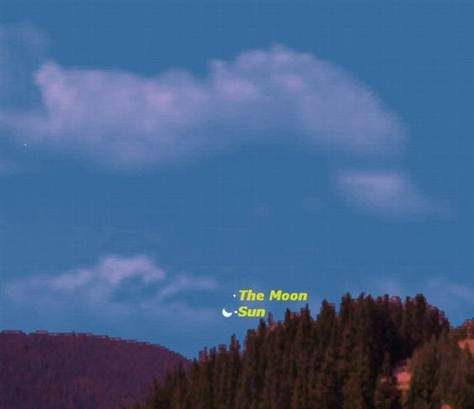
Over the next month, the world will experience three eclipses: two partial solar eclipses a month apart and one total lunar eclipse exactly in between, and it all starts with a so-called "midnight" eclipse of the sun.
Remembrance

At the big race, at the BBQ, at the cemetary...
Spirit's Six Years of Roving on Mars are Officially Over

NASA has ended operational activities for the Mars rover Spirit and transitioned the Mars Exploration Rover Project to a single-rover operation focused on Spirit's still-active twin, Opportunity. Spirit last communicated on March 22, 2010, as Martian winter approached and the rover's solar-energy supply declined. The rover operated for more than six years after landing in January 2004 for what was planned as a three-month mission.
Funding Member
