News
Hubble Spots a Barred Spiral Twin of the Milky Way Galaxy
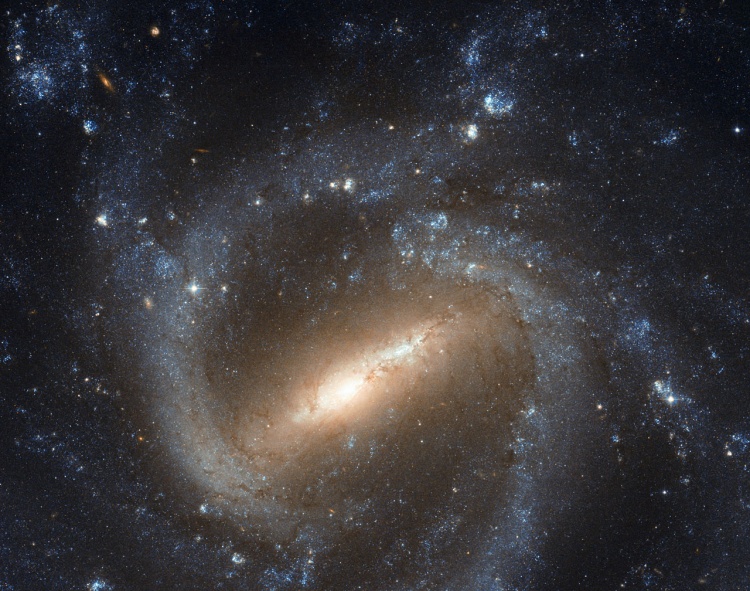
Most spiral galaxies in the Universe have bar structures in their centers and Hubble's image of NGC 1073 offers a particularly clear view of one of these. Our own Milky Way Galaxy is a similar barred spiral and the study of galaxies such as NGC 1073 helps astronomers learn more about our celestial home. While Hubble's image of NGC 1073 is in some respects an archetypal portrait of a barred spiral, there are a couple of quirks that are worth pointing out.
The "Pillars of Creation" as Never Before Seen
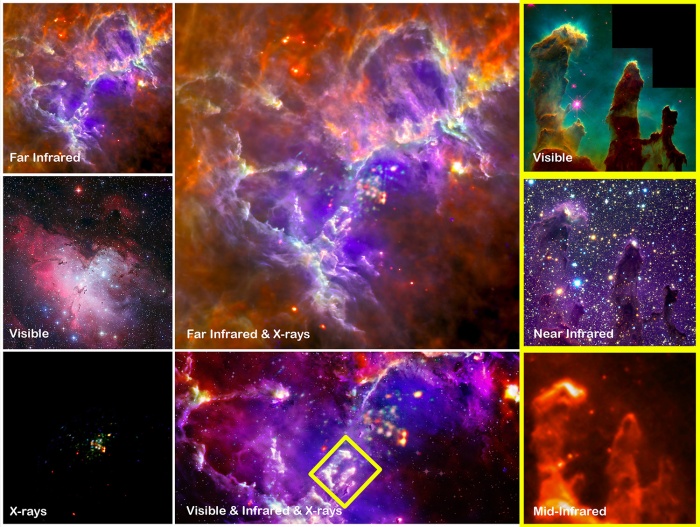
In 1995, the Hubble Space Telescope's "Pillars of Creation" image of M16, the Eagle Nebula, became one of the most iconic images of the twentieth century. Now, two of ESA's orbiting observatories have shed new light on this enigmatic star-forming region.
Did You Hear About the Bar at the Center of the Milky Way Galaxy?

It sounds like the start of a bad joke: "Did you hear the one about the bar at the center of the Milky Way Galaxy?" Astronomers first recognized almost 80 years ago that the Milky Way Galaxy is a huge spiral galaxy. It's as if the solar system is a bug on the spoke of a bicycle wheel. But in recent decades astronomers have suspected that the center of our galaxy has an elongated stellar structure, or bar, that is hidden from view by dust and gas. As part of a study dubbed BRAVA (for Bulge Radial Velocity Assay), a team analyzing stellar motions in the galactic center confirms a massive bar, with one end pointed almost in the direction of the sun, which is rotating like a solid object.
NASA Bids Farewell to the Rossi X-Ray Timing Explorer
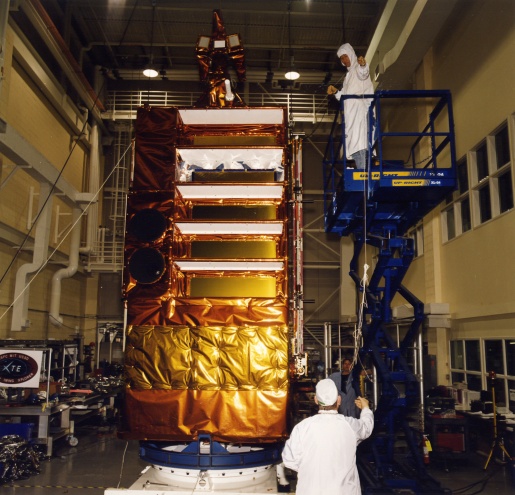
After 16 years in space, NASA's Rossi X-ray Timing Explorer made its last observation on January 4, 2012. Rossi opened a new window into the workings of neutron stars and black holes. Using its data, astronomers established the existence of highly magnetized neutron stars (known as magnetars) and discovered the first accreting millisecond pulsars. The observatory also provided the first observational evidence of "frame-dragging" in the vicinity of a black hole, an effect predicted by Einstein's general theory of relativity. The 7,000-pound satellite is expected to re-enter the atmosphere between 2014 and 2023.
The new space race: China and India to create world's biggest telescope

100-foot-wide optical telescope is nine times bigger than ones in use today - Will pick out objects 13 billion light years away - Sharp enough to pick out planets orbiting distant suns
Aristarchus: Up Close and Personal

Spectacular new images of a gigantic crater on the moon were captured recently by a low-skimming NASA satellite.
Jumping Jupiter - Was a Giant Gas Planet Ejected From the Early Solar System?

The orbits of the giant planets were affected by a dynamical instability when the solar system was only about 600 million years old. As a result, the giant planets and smaller bodies scattered away from each other and in the process the early solar system may have ejected a giant gas planet according to scientists at the Southwest Research Institute in San Antonio, Texas.
WISE Brings Home a Cosmic Christmas Wreath for the Holidays
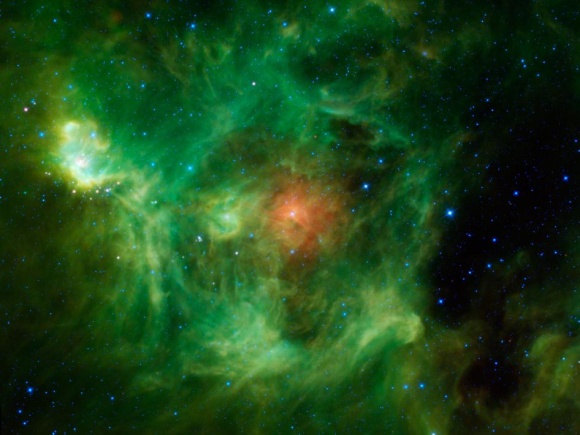
Just in time for the holidays, astronomers have come across a new image from NASA's Wide-field Infrared Survey Explorer (WISE) that some say resembles a wreath. You might even think of the red dust cloud as a cheery red bow, and the bluish-white stars as silver bells. This star-forming nebula is named Barnard 3. Baby stars are being born throughout the dusty region, while the "silver bell" stars are located both in front of and behind the nebula.
The Night After Christmas Sky Show
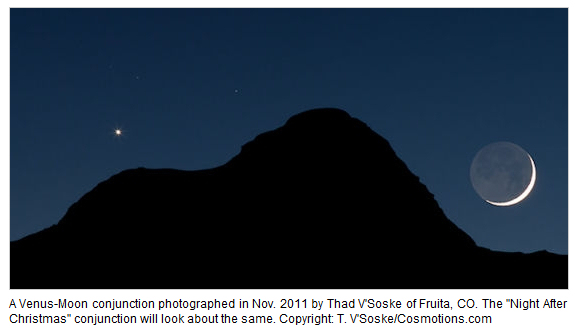
T'was the Night after Christmas and all through the house, not a creature was stirring ... because everyone was outside watching the planets align?
Has the Elusive Higgs Particle Finally Been Detected?

The Higgs boson is the only particle predicted by the Standard Model of particle physics that has not yet been experimentally observed. Its observation would be a major step forward in our understanding of how particles acquire mass. Conversely, not finding the Higgs boson would be very significant and would lead to a greater focus on alternative theories that extend beyond the Standard Model, with associated Higgs-like particles. In a seminar held at CERN this week, the ATLAS and CMS experiments presented the status of their searches for the Higgs boson. Significant progress in the search has been made, but not enough to make any conclusive statement on the existence or non-existence of the elusive Higgs. However, tantalising hints have been seen by both experiments, but these are not yet strong enough to claim a discovery.
Comet Lovejoy Plunges into the Sun and Survives
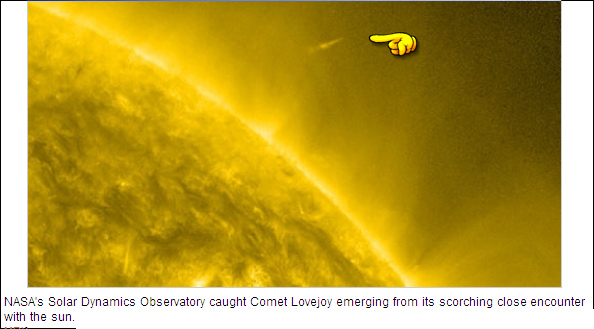
Dec. 16, 2011: This morning, an armada of spacecraft witnessed something that many experts thought impossible. Comet Lovejoy flew through the hot atmosphere of the sun and emerged intact.
Is Vesta the "Smallest Terrestrial Planet?
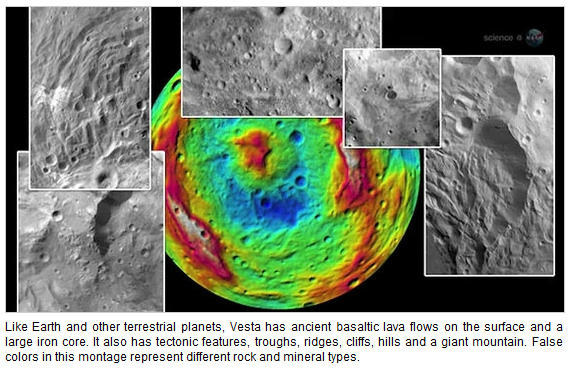
Dec 9, 2011: NASA's Dawn spacecraft spent the last four years voyaging to asteroid Vesta – and may have found a planet.
"Slam Dunk" Sign of Ancient Water on Mars

NASA's Mars rover Opportunity has found bright veins of a mineral, apparently gypsum, deposited by water near the rim of Endeavour Crater.
Strange New "Species" of Ultra-Red Galaxies Discovered
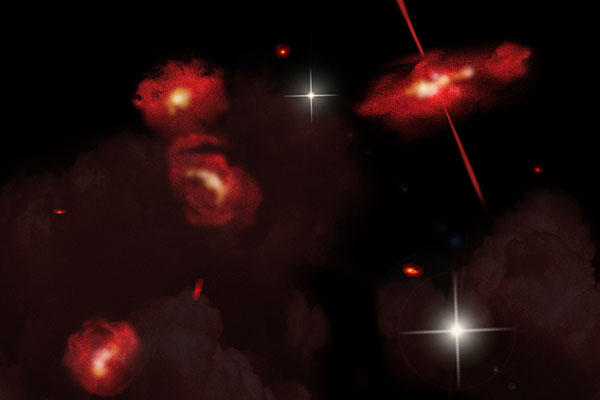
In the distant reaches of the universe, almost 13 billion light-years from Earth, a strange species of galaxies lay hidden. Cloaked in dust and dimmed by the intervening distance, even the Hubble Space Telescope couldn't spy it. It took the revealing power of NASA's Spitzer Space Telescope to uncover not one, but four remarkably red galaxies. And while astronomers can describe the members of this new "species," they can't explain what makes them so red.
Eris -- Pluto's Faraway Twin -- is Accurately Sized Up

Astronomers have accurately measured the diameter of the faraway dwarf planet Eris for the first time by catching it as it passed in front of a faint star. The observations show that Eris is an almost perfect twin of Pluto in size. Eris appears to have a very reflective surface, suggesting that it is uniformly covered in a thin layer of ice, probably a frozen atmosphere.
Funding Member
