News
Three years of supernova explosions become beautiful music
A musical record of over three years worth of Type Ia supernova bursts, which are caused when white dwarf stars explode.
COMET FIREBALL
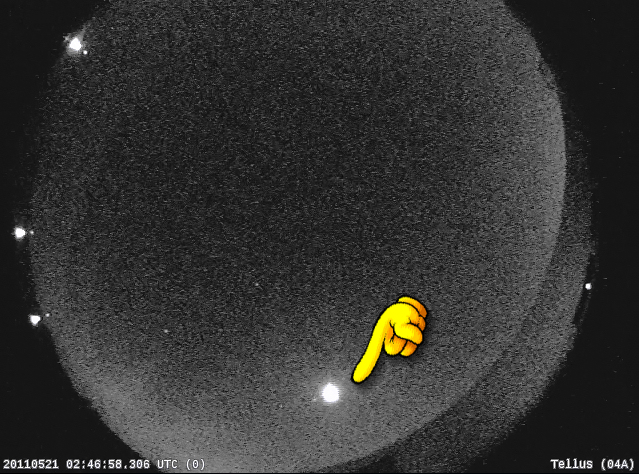
Residents of Atlanta, Georgia, and surrounding areas were startled on Friday night, May 20th around 10:47 EDT, when an object brighter than a full Moon streaked across the southern sky.
Violent Storms of Molecular Gas Strip Entire Galaxies Clean
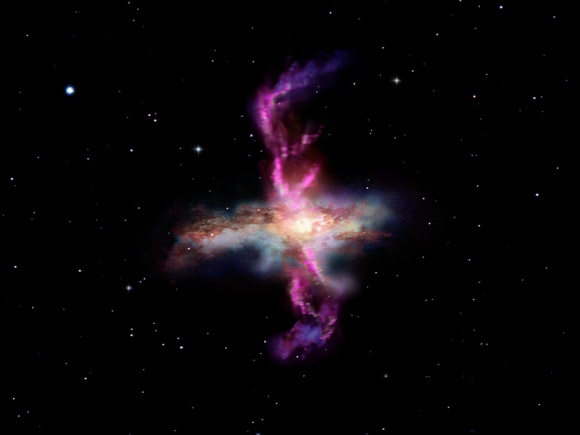
With observations from the PACS instrument on board the ESA Herschel space observatory, an international team of scientists led by the Max Planck Institute for Extraterrestrial Physics have found gigantic storms of molecular gas gusting in the centers of many galaxies. Some of these massive outflows reach velocities of more than 1000 kilometres per second. The observations show that the more active galaxies contain stronger winds, which can blow away the entire gas reservoir in a galaxy, thereby inhibiting both further star formation and the growth of the central black hole. This finding confirms accepted theories of galaxy evolution and is the first conclusive evidence for the importance of galactic winds in this episode of the history of elliptical galaxies.
Super Storm on Saturn
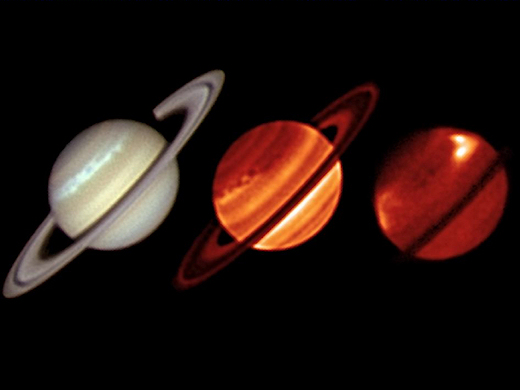
NASA's Cassini spacecraft and a European Southern Observatory ground-based telescope are tracking the growth of a giant early-spring storm in Saturn's northern hemisphere so powerful that it stretches around the entire planet.
Aircraft Carrier-Sized Asteroid to Pass Within Moon's Orbit

Near-Earth asteroid 2005 YU55 will pass within 0.85 lunar distances (325,000 kilometers or 201,700 miles) of the Earth on November 8, 2011. The close approach by this relatively large 400 meter-sized asteroid will present an excellent opportunity for ground-based optical, near infrared, and radar observations. The object will reach a visual brightness of 11th magnitude and should be easily visible to observers in the northern and southern hemispheres. Since the asteroid will approach the Earth from the sunward direction, it will be a daylight object until the time of closest approach. Although classified as a potentially hazardous object, 2005 YU55 poses no threat of an Earth collision over at least the next 100 years. This will be the closest approach to date by an object this large that we know about in advance. An event of this type will not happen again until 2028 when asteroid 2001 WN5 will pass to within 0.6 lunar distances.
Free-Floating Planets May Be More Common Than Stars
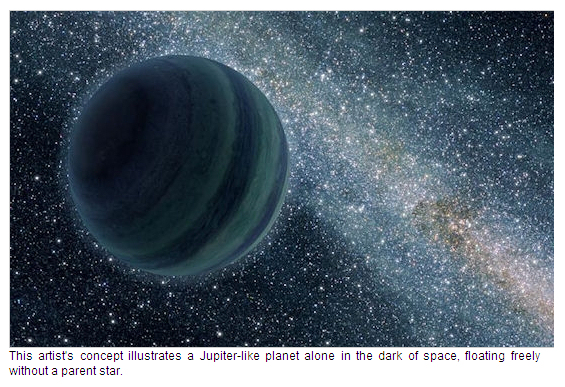
May 18, 2011: Astronomers have discovered a new class of Jupiter-sized planets floating alone in the dark of space
Unique Space Image of Alabama Tornado Tracks
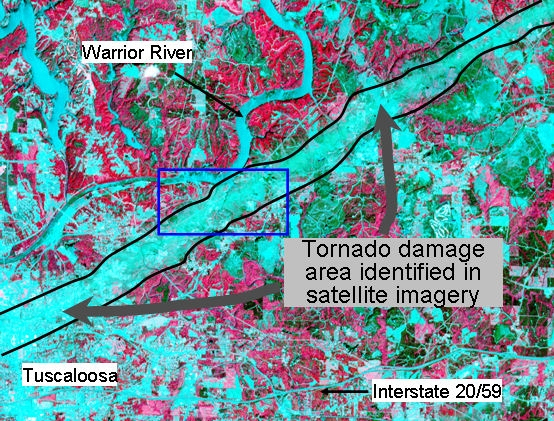
NASA has released a unique satellite image tracing the damage of a monster EF-4 tornado that tore through Tuscaloosa, Alabama, on April 27th. It combines visible and infrared data to reveal damage unseen in conventional photographs.
The night sky in 37,440 exposures
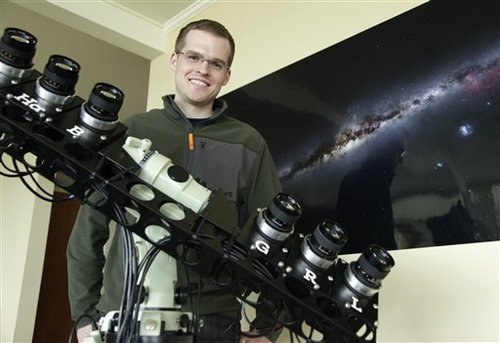
Nick Risinger has always gazed up at the sky. But last year the amateur astronomer and photographer quit his day job as a Seattle marketing director and lugged six synchronized cameras about 60,000 miles to capture an image of the entire night sky.
Hubble Reaches Legal Drinking Age -- Celebrates 21 Years in Orbit

When Galileo used his homemade telescope 400 years ago to view mountains on the Moon, satellites circling Jupiter, and the myriad of stars in our Milky Way Galaxy, he launched a revolution that changed our view of an Earth-centered universe. The launch of the Hubble Space Telescope aboard the space shuttle Discovery on April 24, 1990 initiated another revolution in astronomy. For the first time, a large telescope that sees in visible light began orbiting above Earth's distorting atmosphere. Astronomers anticipated great discoveries from Hubble. The telescope has delivered as promised and continues serving up new discoveries.
Planetary Alignments for Breakfast
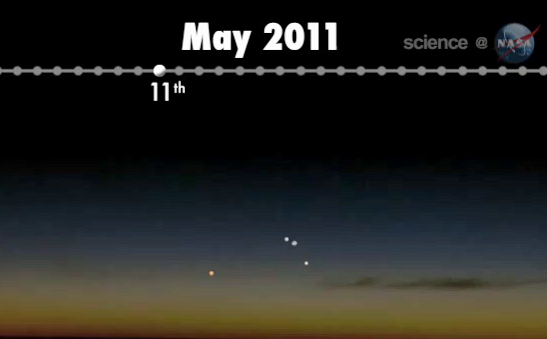
Have you ever woken up at the crack of dawn, shuffled to the kitchen counter for your first cup of joe, only to discover that you're out of coffee beans? Cruel.
NASA Telescopes Join Forces to Observe Unprecedented GRB Explosion

NASA's Swift satellite, Hubble Space Telescope, and Chandra X-ray Observatory have teamed up to study one of the most puzzling cosmic blasts ever observed. More than a week later, high-energy radiation continues to brighten and fade from its location. Astronomers say they have never seen such a bright, variable, high-energy, long-lasting burst before. Usually, gamma-ray bursts mark the destruction of a massive star, and flaring emission from these events never lasts more than a few hours. This brightness increase, which is called "relativistic beaming," occurs when matter moving close to the speed of light is viewed nearly head on. Astronomers plan additional Hubble observations to see if the galaxy's core changes brightness.
NASA Announces Results of Epic Space-Time Experiment
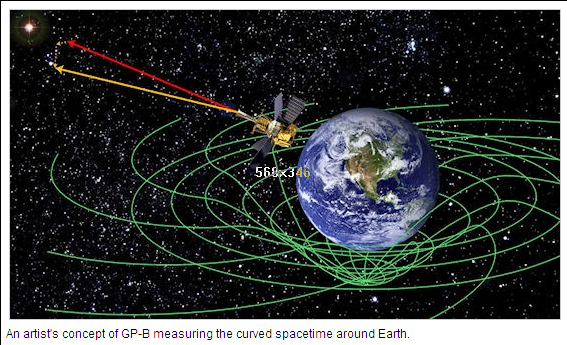
Today, NASA announced the results of an epic physics experiment which confirms the reality of a space-time vortex around our planet.
OSAMA BIN LADEN IS DEAD
Tune in almost any news source for details.
US Celebrates 50 Years of Human Space Flight

Fifty years ago, astronaut Alan B. Shepard, Jr. became the first American in space. At exactly 9:34 a.m. EST on May 5, 1961, about 45 million Americans sat tensely in front of their black and white television sets and watched a slim Redstone booster rocket with a small and cramped Mercury spacecraft manned by Alan Shepard, lift off its pad at Cape Canaveral and go roaring upward through the clear blue sky. Shepard's capsule, named Freedom 7, made an historic 15-minute suborbital flight, officially kicking off manned Project Mercury flights. With six manned flights from 1961 to 1963, Project Mercury's objectives were very specific: 1) to orbit a manned spacecraft around Earth, 2) to investigate man's ability to function in space, and 3) to recover both man and spacecraft safely -- a set of objectives it achieved with flying colors, thus opening the door for Projects Gemini and Apollo later in the decade.
Voyager Set to Enter Interstellar Space
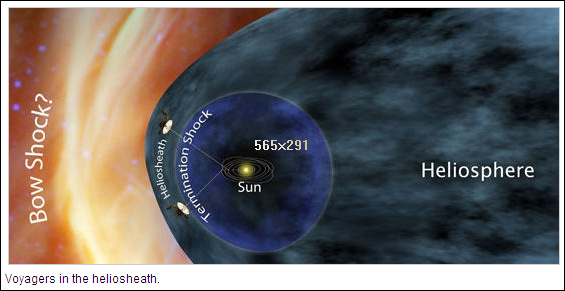
April 28, 2011: More than 30 years after they left Earth, NASA's twin Voyager probes are now at the edge of the solar system. Not only that, they're still working. And with each passing day they are beaming back a message that, to scientists, is both unsettling and thrilling.
Funding Member
