News
Researchers Find Clear Evidence of Water on the Moon
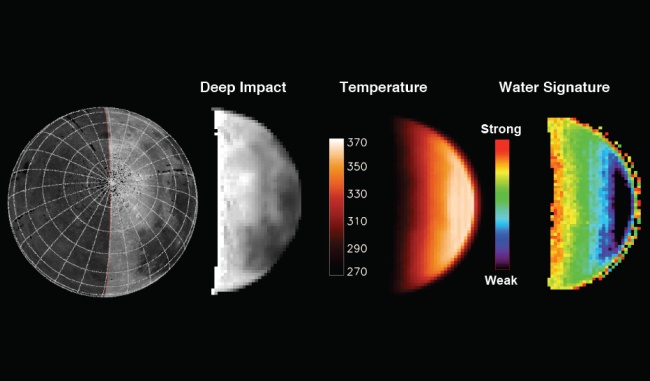
New data from the Deep Impact spacecraft, the Moon Mineralogy Mapper (M3), an instrument aboard India's recently ended Chandrayaan-1 spacecraft, and the Cassini space probe provide, for the first time, clear evidence that water exists on the surface of the Moon.
The Hunt Goes On - Superheavy Element 114 Confirmed
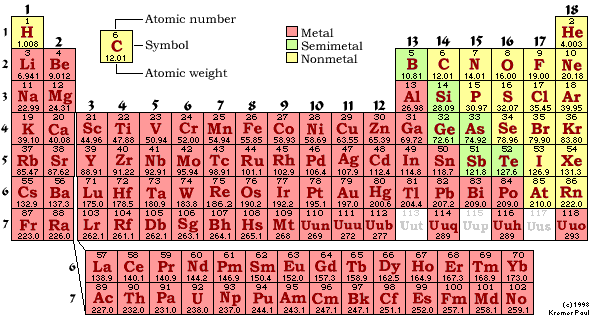
Scientists at the U.S. Department of Energy’s Lawrence Berkeley National Laboratory have been able to confirm the production of the superheavy element 114, ten years after a group at the Joint Institute for Nuclear Research in Dubna, Russia first claimed to have made it. Using Berkeley Lab’s 88-Inch Cyclotron, the researchers were able to confirm the creation of two individual nuclei of element 114, each a separate isotope having 114 protons but different numbers of neutrons, and each decaying by a separate pathway.
There's Something About the DI Herculis Binaries

A pair of unusual stars known as DI Herculis has confounded astronomers for three decades. For most binaries, the theoretical and observed precession rates are in agreement. DI Herculis, however, has resisted explanation for 30 years. The observed precession rate is a factor of four slower than the theoretical rate -- a disagreement that once was interpreted as evidence for a failure of general relativity. Now, new observations by MIT researchers and their colleagues have provided data that solves the mystery once and for all. And the explanation knocks down another possible challenge to Einstein's theory of relativity.
Asteroid Juno Grabs the Spotlight in Late September
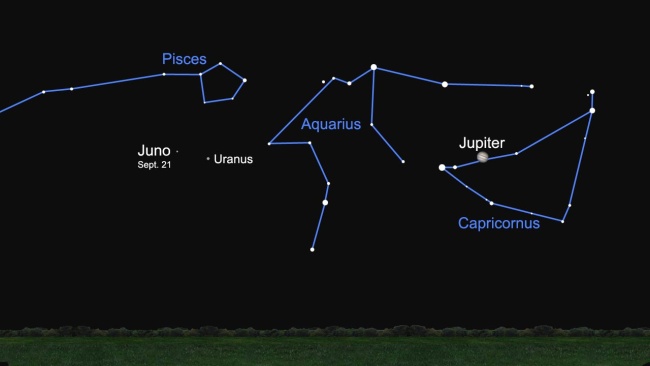
Toward the end of September, the sun will turn a spotlight on the asteroid Juno, giving that bulky lump of rock a rare featured cameo in the night sky. Those who get out to a dark sky will be able to spot the asteroid's silvery glint near the planet Uranus.
NASA's WISE to Look for Dark Asteroids (and Other Sneaky Things in the Dark)

To hunt for the "ninjas" of the cosmos -- dim objects that lurk in the vast dark spaces between planets and stars -- scientists are building the most sensitive set of wide-angle infrared eyes to date, a space telescope called the Wide-field Infrared Survey Explorer (WISE). WISE will scan the entire sky at infrared wavelengths, creating the most comprehensive catalog yet of dark and dim objects in the cosmos: vast dust clouds, brown dwarf stars, asteroids -- even large, nearby asteroids that might pose a threat to Earth.
CoRoT Satellite Finds First Solid Evidence for a Rocky Exoplanet
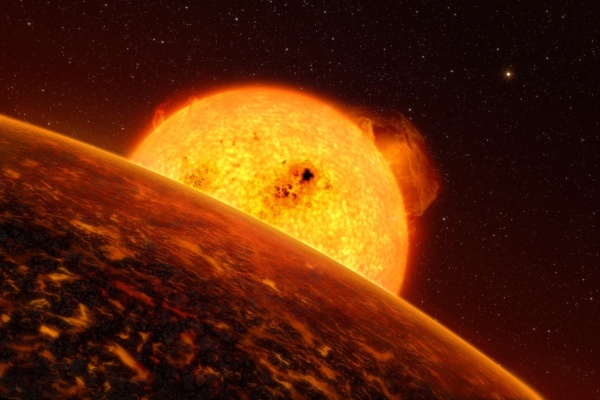
The star CoRoT-7, named after the satellite that first revealed its planets, is located towards the constellation of Monoceros (the Unicorn) at a distance of about 500 light-years. Slightly smaller and cooler than our Sun, CoRoT-7 is also thought to be younger, with an age about 1.5 billion years. It is now known to have two planets, one of which is a small, fast-orbiting exoplanet known as CoRoT-7b, with a mass five times that of the Earth's. CoRoT-7b's known radius, which is less than twice that of Earth, tells us that the exoplanet's density is quite similar to our planet, suggesting a solid, rocky world.
Hubble is Back in Business... And Better Than Ever

NASA's Hubble Space Telescope is back in business, ready to uncover new worlds, peer ever deeper into space, and even map the invisible backbone of the universe. With its new imaging camera, Hubble can view galaxies, star clusters, and other objects across a wide swath of the electromagnetic spectrum, from ultraviolet to near-infrared light. The telescope's new instruments also are more sensitive to light and can observe in ways that are significantly more efficient and require less observing time than previous generations of Hubble instruments.
The Curious Case of the Missing Sunspots

The sun is in the pits of the deepest solar minimum in over a century. Weeks and sometimes whole months go by without even a single tiny sunspot. This quiet period has dragged on for more than two years, prompting some observers to wonder, are sunspots disappearing? Quiet suns come along every 11 years or so -- It's a natural part of the sunspot cycle of magnetic activity related to sunspots, solar flares, and interplanetary storms known as coronal mass ejections (CMEs). However, this year we have experienced an unusually long and deep solar minimum. Scientists from the National Solar Observatory (NSO) in Tucson, Arizona believe they have found the answer. The researchers have discovered that a solar jet stream deep inside the Sun is migrating slower than usual through the star's interior, giving rise to the current lack of sunspots and low solar activity.
Does the Flow of the Oceans’ Salt Water Create the Earth’s Magnetic Field?
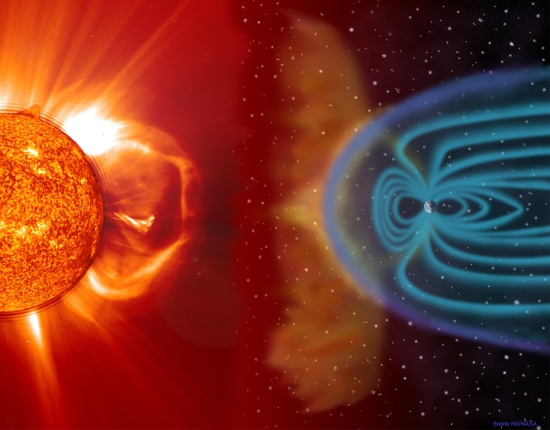
Four hundred years of discussion and we’re still not sure what creates the Earth’s magnetic field. The twentieth century’s answer to the mysteries of geomagnetism and the magnetosphere were electrically-conducting super-hot metallic fluids deep in the Earth’s core acting as a giant dynamo. However, a new study at Northwestern University now suggests that the Earth’s main magnetic fields are induced, instead, by the circulation of electrically-conducting salt water in our oceans. Just when we thought we understood it all, the entire concept of an invisible dynamo operating in the Earth’s core is called into question. Well, back to the drawing boards -- And let the debates begin.
Andromeda is Cannibalizing the Triangulum Galaxy

An international team of astronomers has discovered that our near cosmic neighbour, the Andromeda Galaxy (M31), is swallowing smaller galaxies as it continues to grow. One of its victims, it appears, is the Triangulum Galaxy (M33). Evidence shows that stars are being pulled from Triangulum as it orbits Andromeda. These stars are then being consumed by Andromeda and are contributing to its unstoppable expansion.
Wanted: Amateur Astronomers to Help Solve the Mystery of Epsilon Aurigae
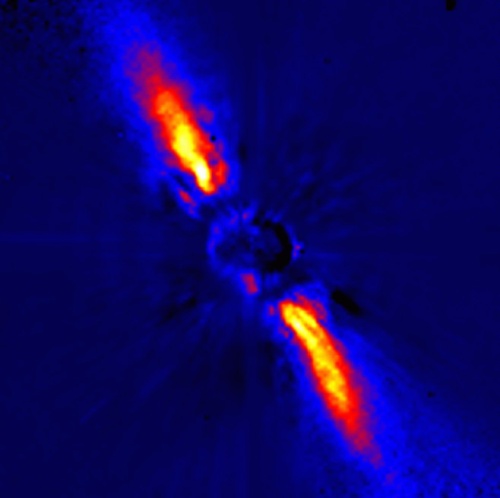
Epsilon Aurigae is an eclipsing binary variable star - a system consisting of two stars orbiting around a common center of mass in a plane along our line of sight. Although epsilon Aurigae has been known as an eclipsing binary for over a century, it isn't yet known what exactly is eclipsing what. The curious light curves of the eclipses have been studied in detail, but they're so infrequent with a period of 27.12 years, that new knowledge is slow in coming -- only three or so occur each century. Although binary star modelers have an idea of what this system is, they are hopeful that a full understanding of this system will come after the next eclipse, which is just starting now. And researchers are looking for amatuer astronomers to help solve the mystery.
Large Bright Cepheids Provide a Viable Standard Candle to 300 Million Light Years

Ohio State University researchers have found a way to measure distances to objects three times farther away in outer space than previously possible, by extending a common measurement technique. They discovered that a rare type of giant star, often overlooked by astronomers, called Ultra Long Period (ULP) Cepheids, could make excellent "standard candles" for distances up to 300 million light years away. Classical cepheids are bright, but beyond 100 million light years from Earth, they lose their effectiveness as their signals gets lost among other bright stars.
Distribution of the Gamma Rays is Not the Long-awaited Evidence of Dark Matter

A team of astrophysicists at the University of California San Diego (UCSD) has solved a mystery that led some scientists to speculate that the distribution of certain gamma rays in our Milky Way galaxy was evidence of a form of undetectable “dark matter” believed to make up much of the mass of the universe. Rather, the random gamma rays can be explained by the ejection of “antimatter positrons” from supernovae and the radioactive decay of elements. When an electron and positron encounter each other in space, the two particles annihilate each other and their energy is released as gamma rays.
Caltech Listens for Cosmic Gravitational Background Waves Created by the Big Bang
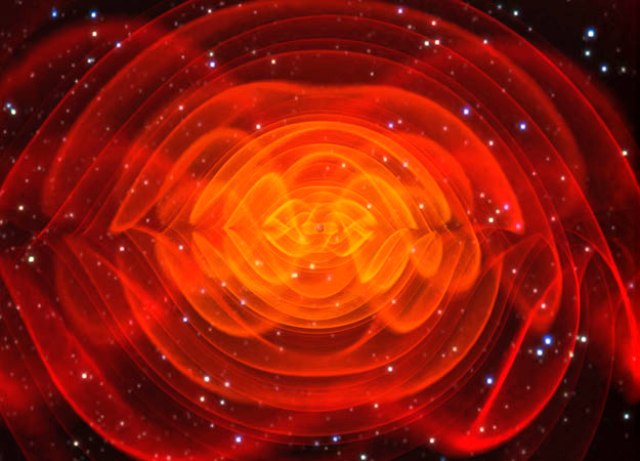
Analysis of data taken over a two-year period, from 2005 to 2007, by Caltech has set the most stringent limits yet on the amount of gravitational waves that could have come from the Big Bang. In doing so, the gravitational-wave scientists have put new constraints on the details of how the universe looked in its earliest moments. The research also constrains models of cosmic strings, objects that are proposed to have been left over from the beginning of the universe and subsequently stretched to enormous lengths by the universe's expansion. The strings, some cosmologists say, can form loops that produce gravitational waves as they oscillate, decay, and eventually disappear.
Crashing Comets Not Likely the Cause of Earth's Mass Extinctions
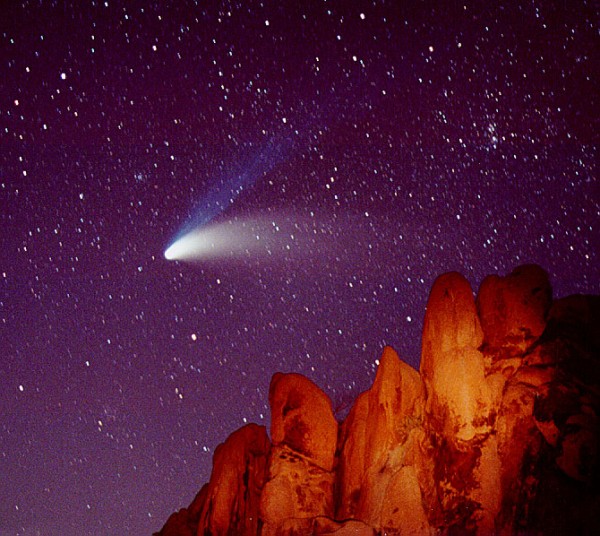
Scientists have debated how many mass extinction events in Earth's history were triggered by a space body crashing into the planet's surface. For example, most agree that an asteroid collision 65 million years ago brought an end to the age of dinosaurs. New University of Washington research indicates, however, that it is highly unlikely that comets have caused any mass extinctions.
Funding Member
