News
Project Plymouth Rock

A manned mission to an asteroid is in the works...
New Type of Supernova Explosion Reported

A new class of supernova was discovered by scientists at Berkeley and may be the first example of a new type of exploding star. A team of astrophysicists at University of California Santa Barbara had predicted this kind of explosion in their theoretical work.
LCROSS Data Confirms Water on the Moon

The argument that the moon is a dry, desolate place no longer holds water. Secrets the moon has been holding, for perhaps billions of years, are now being revealed to the delight of scientists and space enthusiasts alike. The ejecta plume from the LCROSS impact contained at least 100 kilograms of water. But the same data that conclusively identifies water also indicates that the plume contained a surprisingly complex cocktail of other elements and compounds that the team is now struggling to identify. What other secrets will the moon reveal? The analysis continues.
NGC 4755 - Like Opening up a Colorful Cosmic Jewel Box
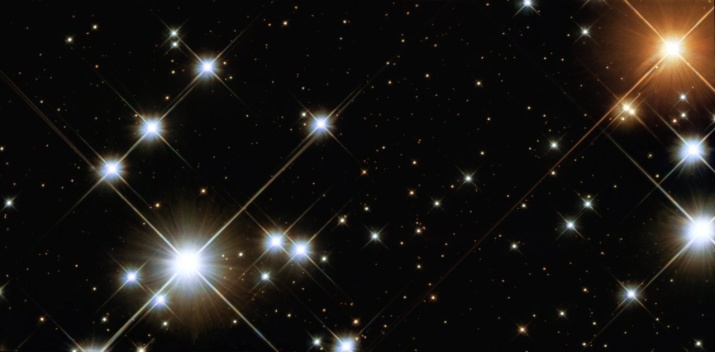
Star clusters are among the most visually alluring and astrophysically fascinating objects in the sky. One of the most spectacular nestles deep in the southern skies near the Southern Cross in the constellation of Crux. Known as NGC 4755, the “Jewel Box” is just bright enough to be seen with the unaided eye. However, when recently imaged through three exceptional telescopes: the ESO Very Large Telescope on Cerro Paranal , the MPG/ESO 2.2-metre telescope at La Silla observatory, and the Hubble Space Telescope, the stunning Jewel Box star cluster is revealed in a whole new light.
M82 Sheds Light on Longstanding Cosmic Ray Mystery

Scientists from the University of Delaware have discovered very high energy gamma rays in the Cigar Galaxy (M82), a bright galaxy filled with exploding stars 12 million light years from Earth. The gamma rays observed by the team have energies more than a trillion times higher than the energy of visible light and are the highest-energy photons ever detected from a galaxy undergoing large amounts of star formation. The findings provide strong evidence that exploding stars are the origin of the cosmic rays that bombard our atmosphere.
Exoplanet House of Horrors

Astronomers may be closer than ever to discovering a planet that’s habitable like our own, but along the way they’ve discovered some very scary exoplanets – places where conditions are far too harsh for life as we know it to exist. Joshua Rodriguez and NASA have rounded up some of the most frightening, deadly exoplanets -- places that make even the scariest haunted house on Earth pale in comparison.
Galaxy Cluster Smashes Distance Record

Galaxy clusters are the largest gravitationally-bound objects in the Universe. The most distant galaxy cluster yet has been discovered by combining data from NASA's Chandra X-ray Observatory and optical and infrared telescopes. The cluster is located about 10.2 billion light years away, and is observed as it was when the Universe was only about a quarter of its present age.
Meteorite Reportedly Hits SUV in Ontario
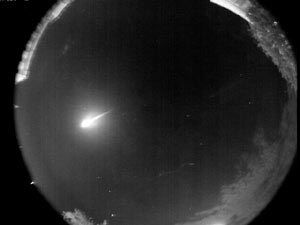
When Tony Garchinski heard a loud crash on the night of September 25, 2009, he didn't think much of it. That is, until he awoke the next morning to find the windshield of his mom's Nissan Pathfinder with a huge crack in it. Garchinski chalked up the incident to vandalism and filed a police report. According to University of Western Ontario scientists, what hit the SUV was a golf ball sized fragment of a freshly fallen 4.6 billion years old meteorite, which had been captured on video as it entered the Earth's atmosphere.
NASA's IBEX Provides First View of Our Place in the Galaxy
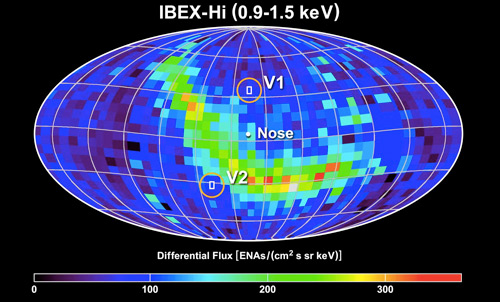
NASA's Interstellar Boundary Explorer (IBEX) spacecraft has made it possible for scientists to construct the first comprehensive sky map of our solar system and its location in the Milky Way galaxy. The new view will change the way researchers view and study the interaction between our galaxy and sun. The sky map was produced with data that IBEX collected during six months of observations. The detectors measured and counted particles scientists refer to as energetic neutral atoms that travel inward toward the sun from interstellar space at velocities ranging from 100,000 mph to more than 2.4 million mph.
2009 Nobel Prize in Physics Goes to the Masters of Light

The Royal Swedish Academy of Sciences has awarded the Nobel Prize in Physics for 2009 to three researchers who changed the world with their manipulation of light: Charles K. Kao, formerly of Standard Telecom Labs in the UK, for breakthroughs in long-haul fiber optics and Willard S. Boyle and George E. Smith of Bell Telephone Labs in the US for the invention of Charge Coupled Devices (CCDs). These scientific achievements have helped shape the foundations of today’s networked societies, created many practical innovations for everyday life, and provided new tools for scientific exploration.
Spitzer Discovers Super-sized Ring Around Saturn

NASA's Spitzer Space Telescope has discovered an enormous donut-shaped ring around Saturn -- by far the largest of the giant planet's many rings. The new belt lies at the far reaches of the Saturnian system, with an orbit tilted 27 degrees from the main ring plane. The bulk of its material starts about six million kilometers (3.7 million miles) away from the planet and extends outward roughly another 12 million kilometers (7.4 million miles). One of Saturn's farthest moons, Phoebe, circles within the newfound ring, and is likely the source of its material. Saturn's newest ring is thick, too -- its more like a donut with a vertical height of about 20 times the diameter of the planet. It would take about one billion Earths stacked together to fill this giant donut.
Mark Your Calendars - LCROSS Lunar Impactor Plume to be Visible from Earth
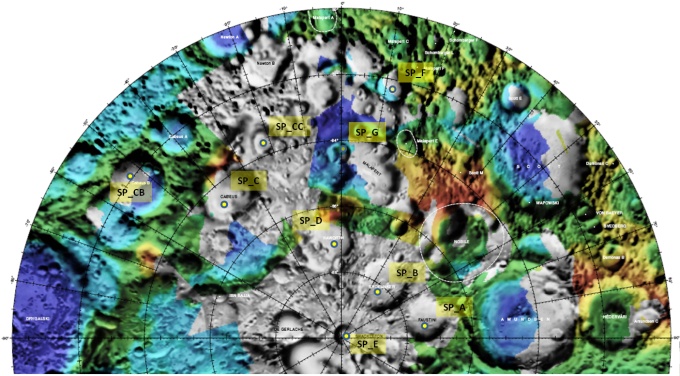
The LCROSS impact into the Cabeus crater near the south lunar pole is scheduled for 4:30 a.m. PDT (7:30 a.m. EDT, 11:30 UTC) on Friday, October 9, 2009. NASA scientists estimate that the Centaur impact debris plume should be in view several seconds after it hits the Moon and will peak in brightness at about 30 to 100 seconds after impact. In the US, the best viewing of the impact plume will be from west of the Mississippi River with telescopes that are larger than 10 inches in diameter.
A-List Speakers at 2009 CSPG Fall Star Party

The speakers list for the 2009 Chiefland Fall Star Party reads like a who's who list of astronomy superstars.
Supernovae are Found to be Super-Efficient Particle Accelerators

Highly energetic particles bombard the Earth's atmosphere continuously. The energy of these particles can be even higher than the energy of particles accelerated by the most powerful accelerator on Earth, CERN’s Large Hadron Collider. Scientists believe that cosmic particles can be accelerated by the energy provided in supernova explosions. The supernova creates a shock wave that heats up the surrounding gas. Scientists think that the outward expanding shock wave is responsible for accelerating these particles, which consist mostly of protons moving at relativistic speeds. Researchers at the Astronomical Institute Utrecht in The Netherlands were able to measure how much energy is removed from the shocked gas in these stellar explosions and used to accelerate the particles, solving a long-standing astronomical question of whether or not stellar explosions do indeed produce these accelerated particles.
Cosmic Ray Levels Jump 19% Beyond Anything Seen in the Last 50 Years
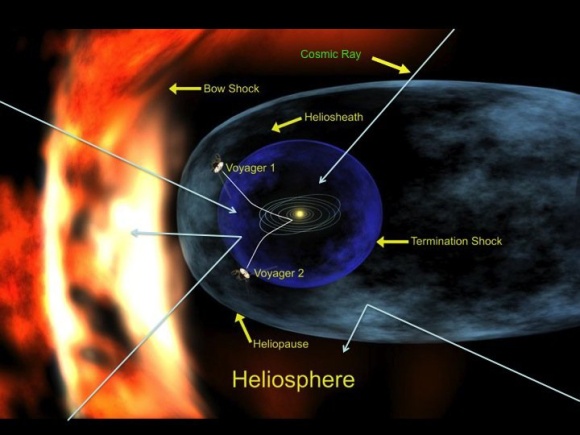
Energetic iron nuclei counted by the Cosmic Ray Isotope Spectrometer on NASA's Advanced Composition Explorer (ACE) spacecraft reveal that cosmic ray levels have jumped 19% beyond anything we've seen in the past 50 years. The cause of the surge is the current solar minimum, a deep lull in solar activity that began around 2007 and continues today. Researchers have long known that cosmic rays go up when solar activity goes down. The sun's magnetic field is our first line of defense against these highly-charged, energetic cosmic particles and right now solar activity is as weak as it has been in modern times.
Funding Member
