News
NASA's Spitzer Runs Out of Coolant and Warms-up to a New Career
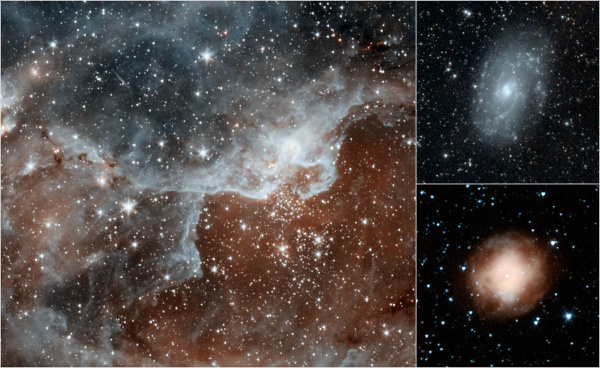
NASA's Spitzer Space Telescope has run out of coolant and is now operating at a still-frosty 30 degrees Kelvin (about minus 406 degrees Fahrenheit). New images taken with Spitzer's infrared detectors at the new warmer temperature demonstrate that the observatory remains a powerful tool for probing the dusty universe.
NASA: Saturn Rings to Pull a Celestial Houdini on August 11, 2009
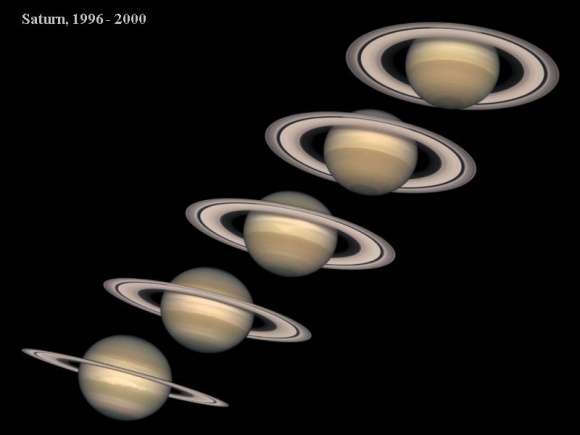
In 1918, Harry Houdini created a sensation when he made a 10,000 pound elephant disappear before a mystified audience of over 5,200 in New York City. But a vanishing pachyderm is nothing compared to the magnificent illusion to be performed by Saturn on Aug. 11, 2009, according to NASA, when Saturn makes its 170,000-mile-wide ring system disappear -- a rare sight that only happens about once every 15 years.
Mars Rover Opportunity Finds a Possible Meteorite
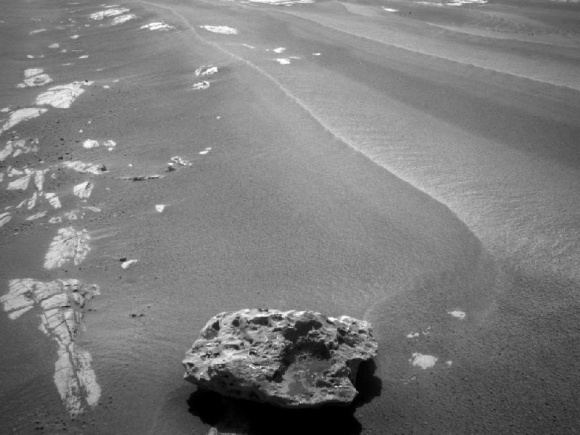
The Mars Rover Opportunity has eyed an oddly shaped, dark rock, which may be a meteorite. Scientists will test the rock with the alpha particle X-ray spectrometer to get composition measurements and to confirm if indeed it is a meteorite.
NASA's Chandra - Designed for Five Year Mission, Still Going Strong at Ten

Ten years ago, on July 23, 1999, NASA's Chandra X-ray Observatory was launched aboard the space shuttle Columbia and deployed into orbit. With its unrivaled ability to create high-resolution X-ray images, Chandra has enabled astronomers to investigate phenomena as diverse as comets, black holes, dark matter and dark energy. Originally designed for five years of service, Chandra has doubled its original mission, ushering in an unprecedented decade of discovery for the high-energy universe. That is not bad for a space telescope that was designed to not be serviced after deployment.
New High Resolution Observations of the Betelgeuse Unveil the True Face of a Gigantic Star
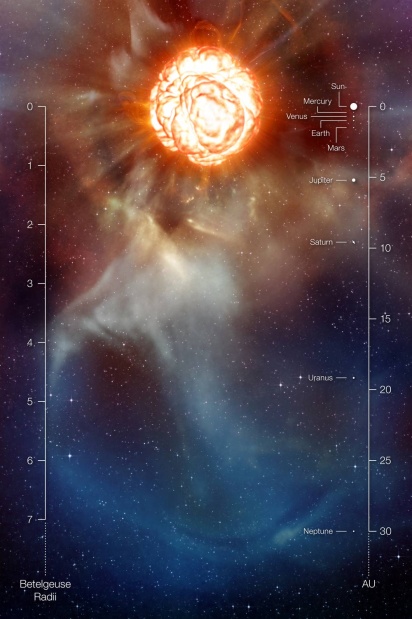
Betelgeuse — the second brightest star in the constellation of Orion is a red supergiant, one of the biggest stars known -- almost 1000 times larger than our Sun. It is also one of the most luminous stars, emitting more light than 100,000 Suns. Such extreme properties foretell the demise of a short-lived stellar king. With an age of only a few million years, Betelgeuse is already nearing the end of its life and is soon doomed to explode as a supernova. When it does, the supernova will be visible from Earth, even in broad daylight.
The Gran Telescopio Canarias (GTC) is Inaugurated
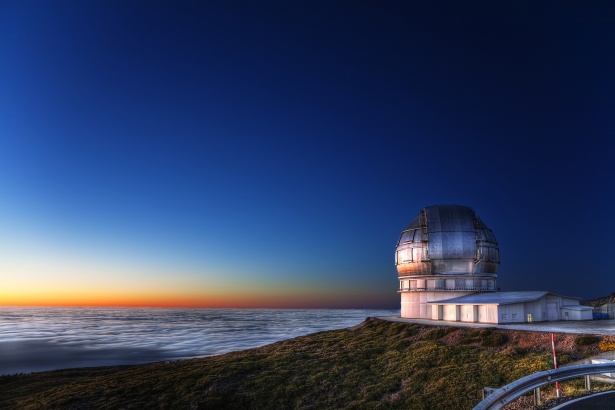
The Gran Telescopio Canarias (GTC) was inaugurated on July 24th, 2009, by their Majesties the King and Queen of Spain. With a 10.4m diameter mirror composed of 36 hexagonal segments, GTC is currently the biggest and also one of the most advanced optical-infrared telescopes in the world.
FermiLab Observes a New Particle -- The Omega-Sub-b Baryon

FermiLab physicist Pat Lukens of the Collider Detector at Fermilab (CDF) experiment announced the observation of a new particle, the Omega-sub-b Baryon. The particle contains three quarks, two strange quarks and a bottom quark (s-s-b). It is an exotic relative of the much more common proton and has about six times the proton's mass.
Thirty Meter Telescope Selects Mauna Kea

The board of directors of the TMT Observatory Corporation has selected Mauna Kea as the preferred site for the Thirty Meter Telescope.
NASA's LRO Gets First Close-up Look at Apollo Landing Sites
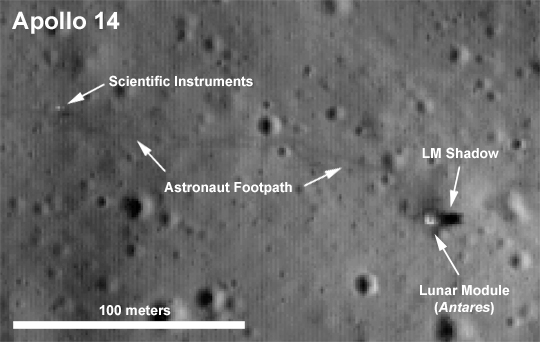
NASA's Lunar Reconnaissance Orbiter (LRO) has returned its first imagery of the Apollo moon landing sites. The pictures show the Lunar Excursion Module (LEM) descent stages, from five of the six Apollo sites, sitting on the moon's surface as long shadows from a low sun angle make the modules' locations evident. The LRO will eventually be able to resolve more remnants of the Apollo missions, however, these first images came before the spacecraft reached its final mapping orbit. Future LRO images from these sites will have two to three times greater resolution.
AUSTRALIAN AMATEUR RECORDS POSSIBLE IMPACT EVENT ON JUPITER
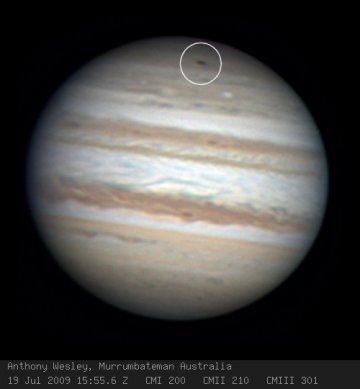
Did something just hit Jupiter? On July 19th, a black "scar" appeared in Jupiter's clouds similar to the Shoemaker-Levy 9 impacts of 1994.
It was 40 Years Ago Today -- The Day We Chose to Go to the Moon

"We choose to go to the moon in this decade and do the other things, not because they are easy, but because they are hard, because that goal will serve to organize and measure the best of our energies and skills, because that challenge is one that we are willing to accept, one we are unwilling to postpone, and one which we intend to win..." President John F. Kennedy, Address at Rice University on the Nation's Space Effort. September 12, 1962
What Lies Inside the Sun?
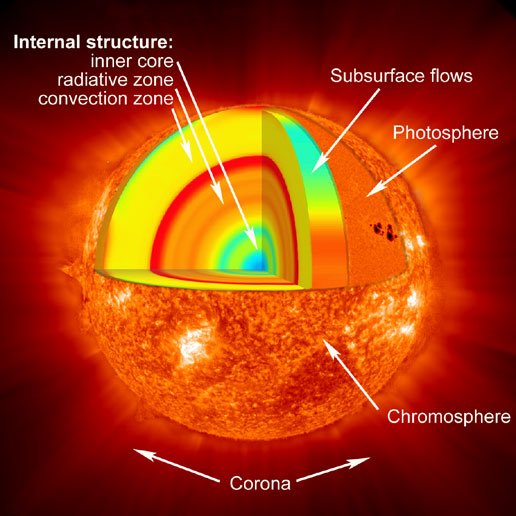
When a pond's surface is calm, you can see more clearly into its depths. As it turns out, the same is true for the sun. Researchers are excited that the sun's surface is calmer now than it's been in almost a century. It's a rare opportunity - the first since the Space Age began - to peer more clearly into the sun's mysterious interior. To take advantage of the opportunity, NASA is about to launch the Solar Dynamics Observatory (SDO).
The National Science Foundation Discovery

Alex Filippenko, A researcher at the University of California at Berkeley "Supernova 2008ha is really a new class.of supernova"
Sixty Symbols — Unravelling the Secret Language of Physics and Astronomy

Physics and astronomy are full of symbols that can seem daunting to the outsider — a secret language that holds non-scientists at arm’s length. Sixty Symbols is The University of Nottingham’s newest project aimed at shedding light on the world of science, explaining the meaning of dozens of symbols and the fundamental part they play in modern life. Sixty Symbols breaks down those barriers with sixty short videos, each just a few minutes long featuring academics chatting about an aspect of the subject they love. This innovative new video project is translating the mysteries of the symbols of science — from Lambda and the Hubble Constant (H) to the speed of light (c), imaginary numbers (j) — into plain English.
Ultracool Subdwarf Stars Take Wild Rides Around the Milky Way
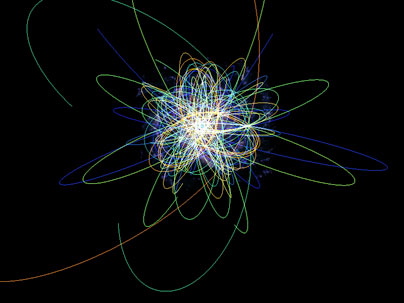
Astronomers at the Massachusetts Institute of Technology (MIT) announced that stars of a recently discovered type, dubbed "Ultracool Subdwarfs" take some pretty wild rides as they orbit around the Milky Way, following paths that are very different from those of typical stars. One of them may actually be a visitor that originated in another galaxy.
