News
Solar 'Current of Fire' Speeds Up

NASA solar physicist David Hathaway reports that the top of the sun's Great Conveyor Belt has been running at record-high speeds for the past five years.
Astronomers Get New Tool for Gravitational-Wave Detection
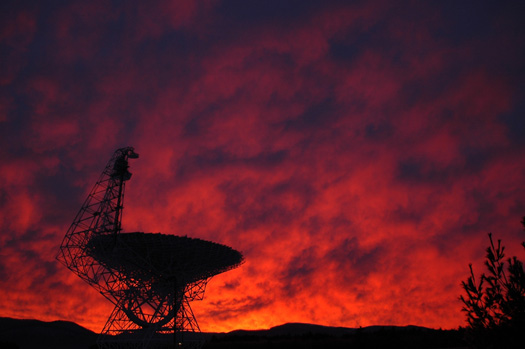
Millisecond Pulsars, rapidly-spinning super-dense neutron stars, can serve as extremely precise and stable natural clocks. Astronomers have recently come up with a method that they believe can be used to detect gravitational waves by measuring tiny changes in the rotation of Millisecond Pulsars. The problem, however, is that after nearly three decades since the discovery of the first Millisecond Pulsar, only about 150 of them have been found -- Simply not enough to test this new method of detecting gravitational waves. But now astronomers have discovered a new technique for finding Millisecond Pulsars that should quickly add to the total. The approach looks first for tell-tale signs of Gamma-Ray emmissions. Astronomers then follow-up with more traditional radio astronomy techniques -- A perfect collaboration between NASA's Fermi Gamma-Ray Space Telescope and the Robert C. Byrd Green Bank Telescope in West Virginia.
Gravitational Lensing Used to Measure the Age and Size of the Universe

By using entire galaxies as lenses to look at other more distant galaxies, a team of researchers at Kavli Institute for Particle Astrophysics and Cosmology, located on the Stanford University campus, have come up with a new way to measure the size and age of the universe. The team used a technique called gravitational lensing to measure the distance that light traveled from a bright, active galaxy to the earth along different paths. By understanding the time it took to travel along each path and the effective speeds involved, the researchers were able to infer not just how far away the galaxies are, but also the overall scale of the universe and some details of its expansion. The results confirm that the age of the universe is 13.75 billion years old, plus or minus 170 million years.
What Happens When a Star Gets So Hot that It Triggers Runaway Anti-matter Production?

A University of Notre Dame astronomer working with a team of collaborators has discovered a distant star that exploded when its center became so hot that a runaway process of matter and antimatter particle pair creation was triggered. At its peak, the star generated energy at a rate 100 billion times greater than the sun’s output. Scientists proposed over 40 years ago that massive stars could become unstable through the production of matter/anti-matter particle pairs, but only recently have large-scale searches of the sky permitted the discovery of these bright, but rare, events.
Most Precise Test Yet of Einstein's Gravitational Redshift

Two of the most important tenets in all of physics are Quantum Mechanics and the General Theory of Relativity. A team of researchers from the University of California at Berkely demonstrated with great precision that gravity changes the flow of time, a concept fundamental to the Theory of General Relativity. The phenomenon, sometimes referred to as "Gravitational Redshifting" because the oscillations of the matter waves slow down or become redder when tugged by gravity, was tested by taking advantage of a principle of quantum mechanics: that matter is both a particle and a wave. While in the past, airplane and rocket experiments have proven that gravity makes clocks tick more slowly — a central prediction of Albert Einstein's General Theory of Relativity — this new experiment utilized an atom interferometer to measured this slowdown 10,000 times more precisely than before.
The Study of Tidal Streams in Andromeda Reveals a Violent History of Galactic Cannibalism
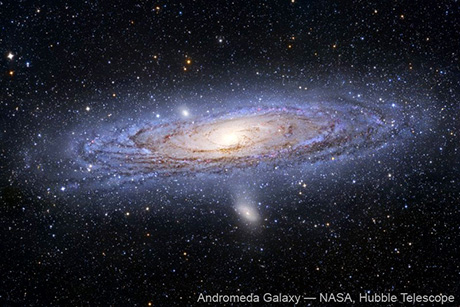
University of California, Santa Cruz astronomers, working in collaboration with an international team of researchers, have identified two new tidal streams in the Andromeda galaxy, which are the remnants of dwarf galaxies that were consumed by our large galactic neighbor. Analysis of the stars in Andromeda's tidal streams and other components of its extended halo is yielding new insights into the violent processes involved in the formation and evolution of massive galaxies like Andromeda and our own Milky Way.
3D Sun for the iPhone
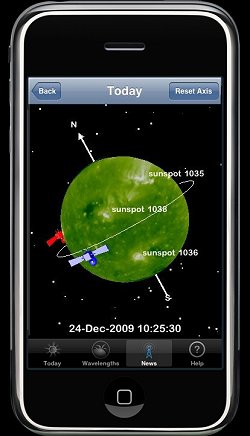
February 17, 2010: Imagine holding the entire sun in the palm of your hand. Now you can. A new iPhone app developed by NASA-supported programmers delivers a live global view of the sun directly to your cell phone.
Magma Plume Feeding the Yellowstone Caldera is Found to be Over 400 Miles Deep
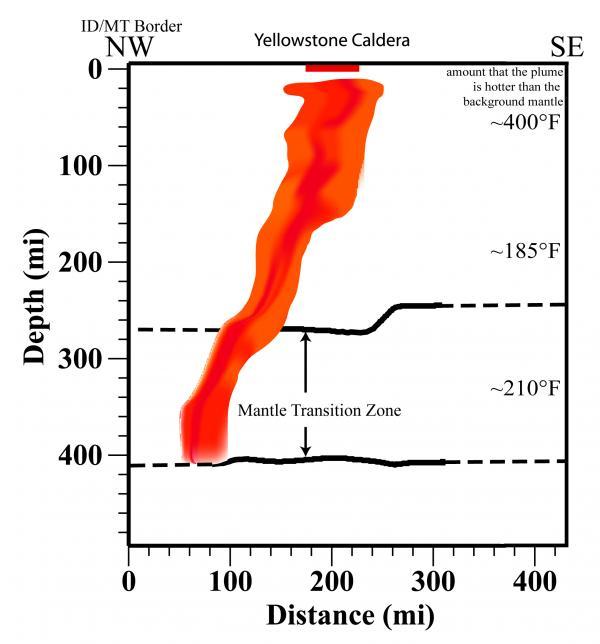
University of Utah researchers have completed the most detailed seismic images yet of the plumbing that feeds the Yellowstone Supervolcano. It shows a plume of hot and molten rock rising from a depth of at least 410 miles, contradicting claims that there is no deep plume, but only shallow hot rock moving like slowly boiling soup. So why should we care? Because when this one blows, it will be big. If geological history is any indication, an eruption of the Yellowstone Supervolcano could be 2500 times bigger than the 1980 eruption of Mount St. Helens and could cover half of the continental United States with several inches to possibly feet of volcanic ash.
Surprise! The Sun is a Variable Star

For some years now, an unorthodox idea has been gaining favor among astronomers. It contradicts old teachings and unsettles many solar observers -- The Sun is a Variable Star. Over long periods of decades to centuries, solar activity waxes and wanes with a complex rhythm that researchers are still trying to figure out. The most famous "beat" is the 11-year sunspot cycle, which really varies in length from 9 to 12 years. Between 1645 and 1715, during a period called the 'Maunder Minimum,' the cycle appeared to stop altogether for about 70 years and no one knows why. In fact right now the sun is climbing out of a century-class solar minimum that no one anticipated. This past Thursday, February 11, 2010, NASA launched the Solar Dynamics Observatory (SDO) to help researchers sort this out.
NASA's WISE Spots First Comet with its Powerful Infrared Eye

NASA's Wide-field Infrared Survey Explorer, or WISE, has discovered its first comet, one of many the mission is expected to find among millions of other objects during its ongoing survey of the whole sky in infrared light.
PCs Around the World Unite To Map the Milky Way
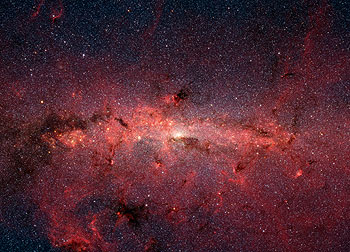
At this very moment, tens of thousands of home computers are quietly working together to solve the largest and most basic mysteries of our galaxy. Enthusiastic and inquisitive volunteers from around the world are donating the computing power of everything from decade-old desktops to sleek new netbooks to help computer scientists and astronomers at Rensselaer Polytechnic Institute (RPI) map the shape of our Milky Way galaxy. Just this month, the collected computing power of these humble home computers has surpassed one petaflop, a computing speed that surpasses the world’s second fastest supercomputer.
Rice Astronomer Recreates Stellar Jet With Laser Blast

Rice University Astronomer Patrick Hartigan and a team of laser scientists, physicists, and technicians used the beams at the University of Rochester's Laboratory for Laser Energetics to recreate, on a small scale, the super velocities at work in newborn stars and simulated the fiery jets that burst from their poles.
Herschel Space Telescope Uncovers Sources of the Cosmic Infrared Background Radiation

A weak cosmic infrared radiation field that reaches Earth from all directions contains not yet deciphered messages about the evolution of galaxies. Using first observations with the PACS Instrument on board ESA¡¦s Herschel Space Telescope, scientists from the Max Planck Institute for Extraterrestrial Physics and other institutions have for the first time resolved more than half of this radiation into its constituting sources. Observations with Herschel open the road towards understanding the properties of these galaxies, and trace the dusty side of galaxy evolution.
Close Encounter with Mars
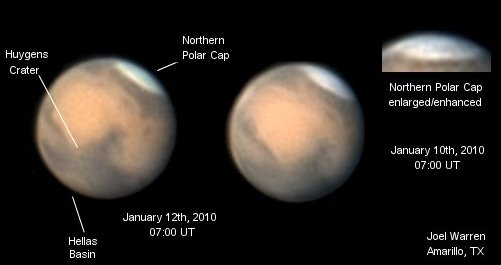
An antidote to those silly emails about Mars looking bigger than the full moon, this is the real deal...
Spirit is Now a Stationary Science Platform
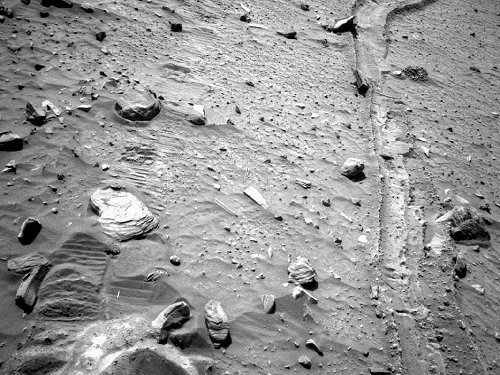
CAPTION: Spirit's last tracks. This view from Spirit's navigation camera shows tracks left by the rover as it drove backward, dragging its inoperable right-front wheel, to the location where the rover became trapped in soft sand in April 2009.
