News
Why are Galaxies Shaped as They Are?
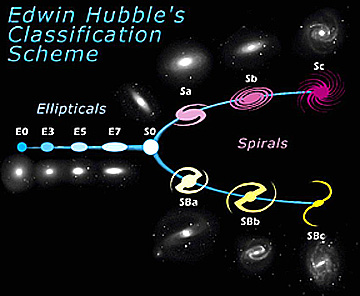
For the first time, astronomers have explained the diversity of galaxy shapes seen in the universe. Two scientists from the California Institute of Technology (Caltech) and Embry-Riddle University in Arizona, tracked the evolution of galaxies over thirteen billion years from the early Universe to the present day. The astronomers built a model based on the ‘Lambda Cold Dark Matter’ model of the Universe. To their surprise, their computations reproduced not only the different galaxy shapes but also their relative numbers.
Shuttle Prices Slashed!

Break out the colored flags, balloons for the kids, hot dogs for Mom and Dad! NASA can now put you behind the wheel for a mere 28 large (ok, make that very large)
Iowa Astronomers Image a Magnetic Field on a Star Other than Our Sun

Two University of Iowa astronomers have made the first direct radio image of a stellar coronal loop on a star other than the sun. The image of the was made of the star Algol, a well-known eclipsing binary star in the constellation Perseus. High resolution radio interferometry over a period of six months allowed the researchers to image features that would otherwise have been undetectable. Coronal loops at are associated with sunspots, which in turn, are associated with space weather. This work will help provide scientists with information that may lead to a better understanding of how such phenomena as space weather affect the Earth.
Flying Telescope Passes Key Test

On Dec. 18th, the Stratospheric Observatory for Infrared Astronomy (SOFIA), flew in a modified Boeing 747 at 15,000 feet for one hour and 19 minutes.
Hubble's Deepest View to Date Unveils Never Before Seen Galaxies

NASA's Hubble Space Telescope has broken the distance limit for galaxies and uncovered a primordial population of compact and ultra-blue galaxies that have never been seen before. The deeper Hubble looks into space, the farther back in time it looks, because light takes billions of years to cross the observable universe. This makes Hubble a powerful "time machine" that allows astronomers to see galaxies as they were 13 billion years ago, just 600 million to 800 million years after the Big Bang.
NASA’s Kepler Space Telescope Bags Its First Five Exoplanets

NASA's Kepler space telescope, designed to find Earth-size planets in the habitable zone of sun-like stars, has discovered its first five new exoplanets, or planets beyond our solar system. Launched on March 6, 2009, from Cape Canaveral Air Force Station in Florida, the Kepler mission continuously and simultaneously observes more than 150,000 stars. Kepler's science instrument, or photometer, already has measured hundreds of possible planet signatures that are being analyzed.
The New Decade Arrives Under a Blue Moon Tonight

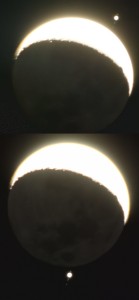
Tonight, New Year's Eve, you should look up because there is going to be a Blue Moon. Will it really be blue? Of course not. But it is still called a Blue Moon. The term “Blue Moon” has had a few different meanings throughout history. However, most commonly nowadays, a Blue Moon is the second full moon in one month. Tonight's moon is the second full moon of December 2009 -- The first one occurred on Dec. 2. So with that little bit of trivia, I wish you all a Happy New Year... and a Happy New Decade.
Did FermiLab Researchers Get a First Glimpse of Dark Matter?
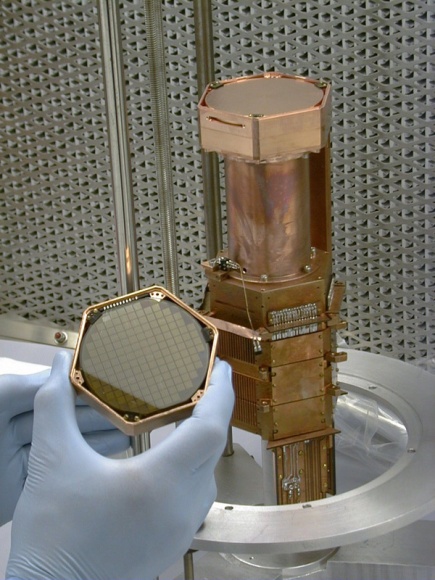
Scientists from the Cryogenic Dark Matter Search experiment (CDMS), managed by the Department of Energy's Fermi National Accelerator Laboratory, have detected two events at a facility located a half-mile underground at the Soudan mine in northern Minnesota, that have characteristics consistent with the particles that physicists believe make up dark matter. However, there is a chance that both events could be the signatures of background particles – other particles with interactions that mimic the signals of dark matter candidates. So whats next? Researchers will boost the size of detectors and then patiently wait for new data sets that will hopefully offer more compelling evidence for dark matter.
An important message...
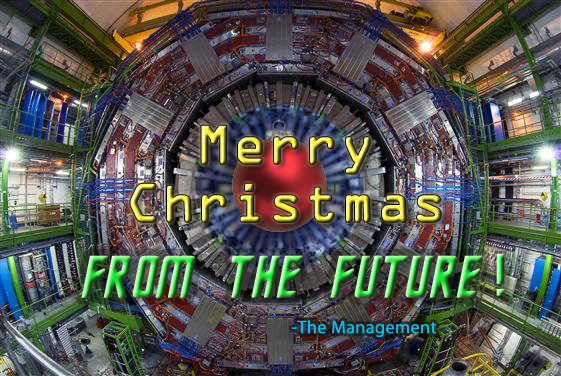
May you all..
200,000 Degree Star Found at Center of NGC 6302
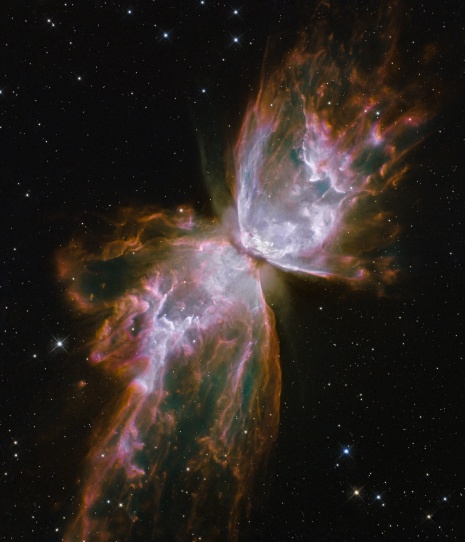
Astronomers at The University of Manchester's Jodrell Bank Centre for Astrophysics have discovered one of the hottest stars in the Galaxy. With a surface temperature of around 200,000 degrees, it is 35 times hotter than the Sun. The star was found at the center of NGC 6302, also known as the Bug or the Butterfly Nebula.
Something Big is Lurking Beyond the Visible Edge of Our Universe

Using data from NASA's Wilkinson Microwave Anisotropy Probe (WMAP), scientists have identified an unexpected motion in distant galaxy clusters. The cause, they suggest, is the gravitational attraction of matter that lies beyond the observable universe. First we had Dark Matter. Then we had Dark Energy. Now we have this mysterious Dark Flow. I suppose that the only thing we can conclusively say at this point is that we are all still in the dark.
Mysterious Spiral of Light in Sky Over Norway

Odd Astral Phenomenon seen by thousands of Norwegians
Space-based solar plant gets go-ahead
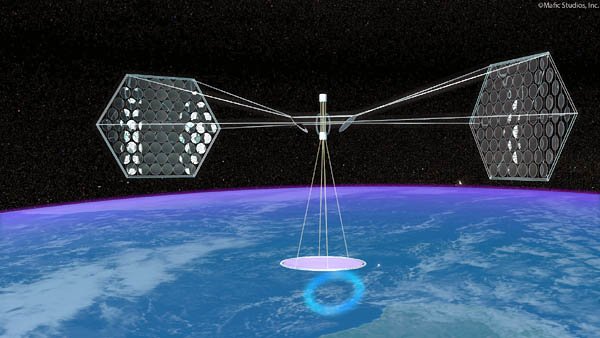
California regulators have given the go-ahead to a project to beam solar energy from space.
Which Came First -- the Black Hole or the Galaxy?

It almost sounds like the beginning of a corny joke -- Something like why did the black hole cross the galaxy... Because it wanted to get to the other side. But it is no joke. Researchers are now really asking themselves which came first, the supermassive black holes at the center of the galaxies or the enormous galaxies where the black holes reside? A brand new scenario has emerged from a recent set of observations: Black holes may actually be “building” their own home galaxies. This could be the long-sought missing link to understanding why the masses of black holes are larger in galaxies that contain more stars.
The Large Hadron Collider Fires Up... Again

Particle beams are once again circulating in the world’s most powerful particle accelerator, CERN’s Large Hadron Collider (LHC). The LHC circulated its first beams in September of 2008, but suffered a serious malfunction nine days after turn-up. A failure in an electrical connection led to serious damage and CERN has spent over a year repairing and consolidating the machine to ensure that such an incident cannot happen again. This week, two beams were circulated simultaneously for the first time, allowing the operators to test the synchronization of the beams and giving the experiments their first chance to look for proton-proton collisions. It is hoped that by Christmas, the LHC should reach 1.2 TeV per beam.
Funding Member
