News
Observatories Worldwide Keep Eyes on a Dying White Dwarf

White dwarfs are stars the size of the Earth and as dense as the sun. A worldwide network of observatories, coordinated by the University of Delaware, is scheduling its observing times to provide round-the-clock coverage of a dying white dwarf located in the constellation Ophiuchus as it dims and cools in the twilight of its life. Astronomers will be measuring the “star quakes” that occur as the final nuclear fuel gets spent to figure out what's going on inside the star.
Space Shuttle Atlantis Imaged in Silhouette Against the Sun
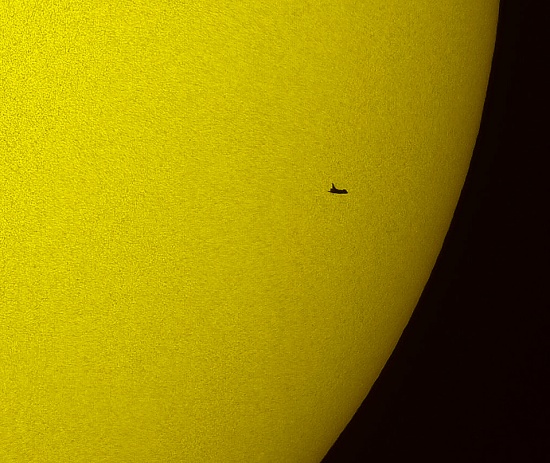
A stunning image of the silhouetted Space Shuttle Atlantis with the Sun as a backdrop was captured by Astrophotographer Thierry Legault of France. The image of the transit of Atlantis across the sun was taken from Vero Beach, Florida on Tuesday, May 12, 2009 with a solar-filtered Takahashi TOA-130 refractor and Canon EOD 5D Mark II camera.
NASA's Swift Detects the Most Distant Object to Date in the Universe

Gamma-ray bursts (GRBs) were discovered by American surveillance satellites in the late 1960s. These satellites were looking for gamma rays coming from possible clandestine Soviet nuclear tests. Instead these satellites found brief but intense flashes of gamma rays coming from random directions in space. To this day GRBs remain one of the greatest mysteries of modern astronomy. Despite lasting only a few milliseconds to several minutes, they are the most energetic phenomena known. An individual GRB can release in a matter of seconds the same amount of energy that our Sun will radiate over its 10-billion-year lifetime. It should be no surprise then that a gamma-ray burst detected last month is the signature of the explosion of the earliest, most distant known object in the Universe. The explosion is believed to have taken place more than 13 billion years ago -- 600 million years after the Big Bang.
Herschel and Planck Will Look Deep Into Space and Time
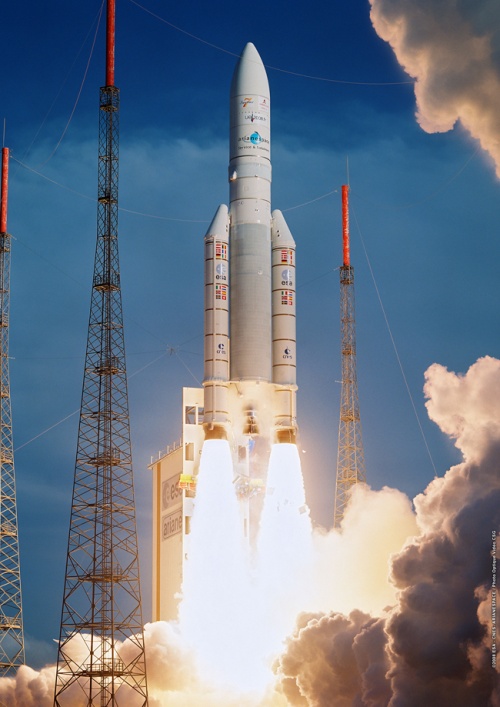
Two of the most sophisticated astronomical spacecraft ever built – Herschel and Planck – will be launched by ESA tomorrow, May 14, 2009, and placed in deep space orbits around a special L2 Lagrangian observation point -- a gravitationally stable Sun-Earth point suspended in space some 1.5 million kilometres from Earth. From there, both observatories will begin a revolutionary campaign that will further our understanding of the Universe. Herschel is a far-infrared space telescope designed to study some of the coldest objects in space, in a part of the electromagnetic spectrum still mostly unexplored. Planck is a telescope that will map the original light of the Universe - light from the Big Bang – with unprecedented sensitivity and accuracy.
Shuttle Atlantis Launches on a Final Mission to Upgrade Hubble
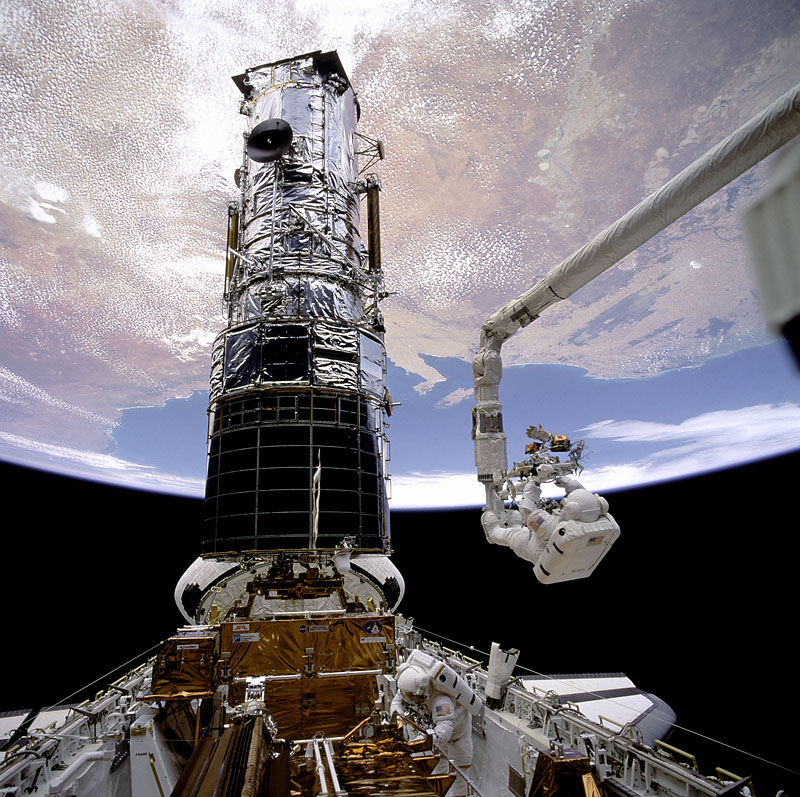
Space shuttle Atlantis with its seven-member crew launched today from Kennedy Space Center on the final Hubble Space Telescope servicing mission. The 11-day mission will include five spacewalks to refurbish Hubble with state-of-the-art science instruments designed to improve the telescope's capabilities by up to 70 times while extending its lifetime through at least 2014.
Light Can Be Obscured, But You Can't Hide Gravity
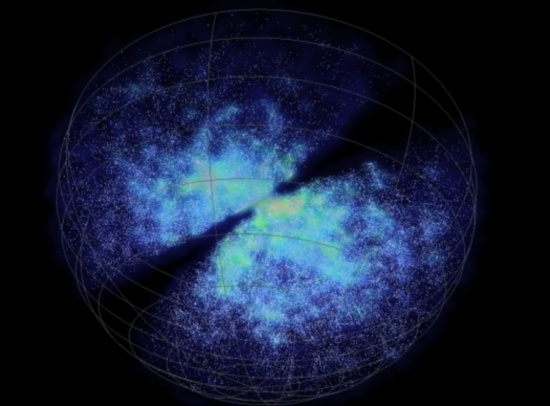
Giant superclusters of galaxies are huge concentrations of mass, but they can't be weighed accurately by looking at their light alone. Astronomers from Australia, the UK, and the US have just completed the most detailed survey of galaxies in the nearby Universe, which will reveal not only where the galaxies are but also where they're heading, how fast, and why. By measuring the galaxies' movements, the researchers can map the gravitational forces at work in the local Universe, and so show how matter, seen and unseen, is distributed.
Cosmic Pile-up Involves Four Clusters of Colliding Galaxies

Galaxy clusters are the largest objects bound by gravity in the Universe. While careening along a 13 million light year long stream of galaxies, gas, and dark matter - known as a filament, a collision of galaxy clusters has been identified by combining information from three different telescopes. This result gives scientists a chance to learn what happens when some of the largest objects in the Universe go at each other in a cosmic free-for-all. Using data from NASA's Chandra X-ray Observatory, Hubble Space Telescope, and the Keck Observatory on Mauna Kea, Hawaii, astronomers were able to determine the three-dimensional geometry and motion in the system MACSJ0717.5+3745 located about 5.4 billion light years from Earth.
ESA Satellites Show How Earth Moved During the Italy Quake
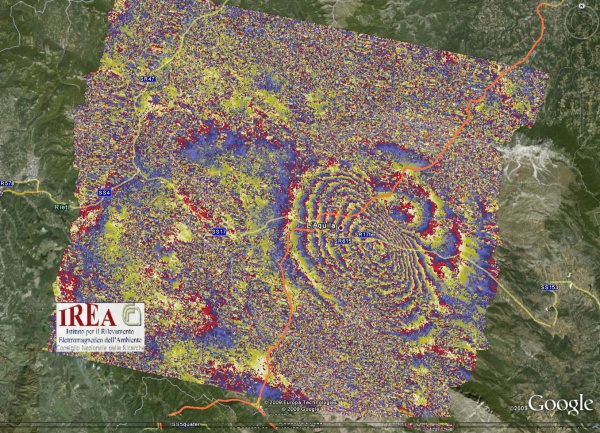
Scientists have analyzed the movement of Earth during and after the 6.3 earthquake that shook the medieval town of L’Aquila in central Italy on 6 April 2009 by studying radar data from ESA’s Envisat and the Italian Space Agency’s COSMO-SkyMed satellites. The scientists used a technique that merged data acquired before and after the earthquake to generate images that appear as rainbow-colored interference patterns. A complete set of colored bands or ‘fringes’ represents ground movement relative to the spacecraft.
Rogue Black Holes May Roam the Milky Way

It sounds like the plot of a B-rated sci-fi movie -- Rogue black holes roaming our galaxy, threatening to swallow anything that gets too close. In fact, new calculations by Astrophysicists at the Harvard-Smithsonian Center for Astrophysics suggest that hundreds of massive black holes left over from the galaxy-building days of the early universe may wander the Milky Way. The good news is that they think (and we hope) that the closest rogue black holes reside thousands of light-years away.
Hubble Captures Image of a Star Eight Years Before it Exploded as a Supernova
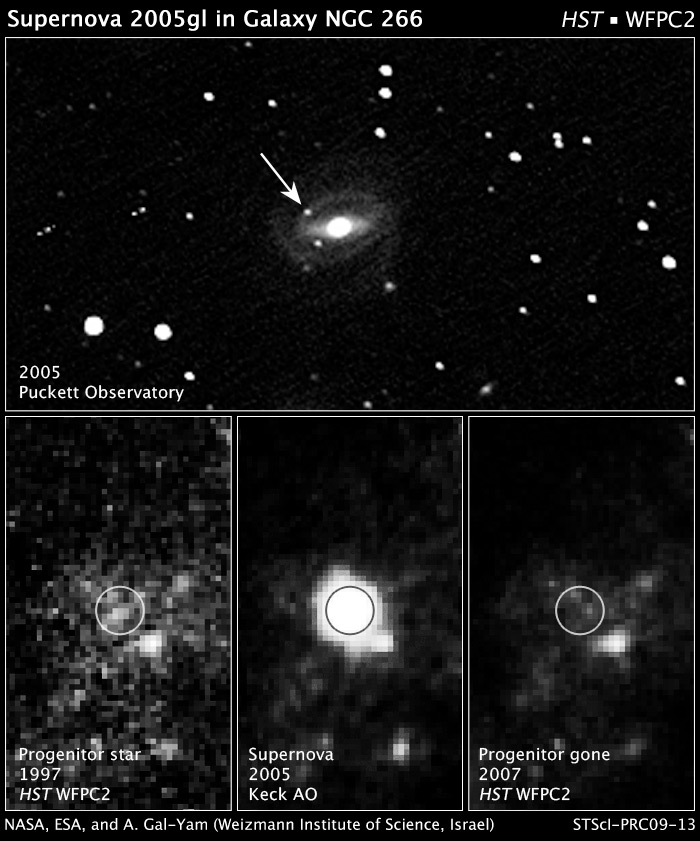
Like a surveillance camera photographing the scene of a crime before it happened, the Hubble Space Telescope has an archival photo of a galaxy with a star as it appeared eight years before it exploded as a supernova. Astronomers have detailed theories about what type of stars self-destruct in supernova explosions. But this discovery has only further confounded supernova mysteries. The progenitor star belongs to a class of Luminous Blue Variables (LBVs) that are not expected to explode at such an early stage of their existence.
Did Dinosaurs Vanish 300,000 Years After the Chicxulub Impact?
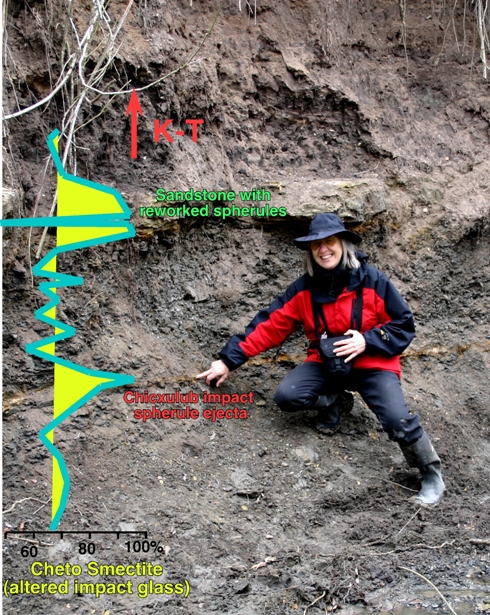
The enduringly popular theory that the Chicxulub crater in Mexico holds the clue to the demise of the dinosaurs, along with around 65% of all other species 65 million years ago, is once agin being challenged. The newest research uses evidence from Mexico to suggest that the Chicxulub impact predates the K-T boundary by as many as 300,000 years, adding more credence to the theory that massive volcanic eruptions at the Deccan Traps in India may have been responsible for the worldwide extinction instead.
Mysterious Space Blob Discovered 12.9 Billion Light Years Away

Using information from a suite of telescopes, astronomers have discovered a mysterious, giant object that existed at a time 800 million years after the Big Bang. Even with superb data from the world’s best telescopes, they are not sure what it is. Because it is one of the most distant objects ever found, its faintness does not allow the researchers to understand its physical origins.
Astronomers Discover a Nearly Earth-sized Planet
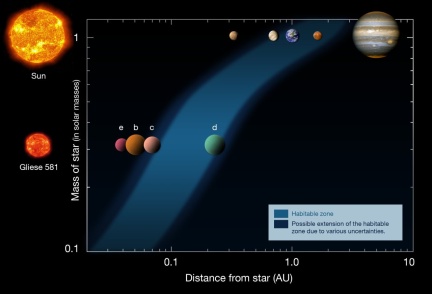
Well-known exoplanet researcher Michel Mayor today announced the discovery of the lightest exoplanet found so far. The planet, “e”, in the famous system Gliese 581, is only about twice the mass of our Earth. The team also refined the orbit of the planet Gliese 581 d, first discovered in 2007, placing it well within the habitable zone, where liquid water oceans could exist. These amazing discoveries are the outcome of more than four years of observations using the most successful low-mass-exoplanet hunter in the world, the HARPS spectrograph attached to the 3.6-meter ESO telescope at La Silla, Chile.
Scientists discover a nearly Earth-sized planet
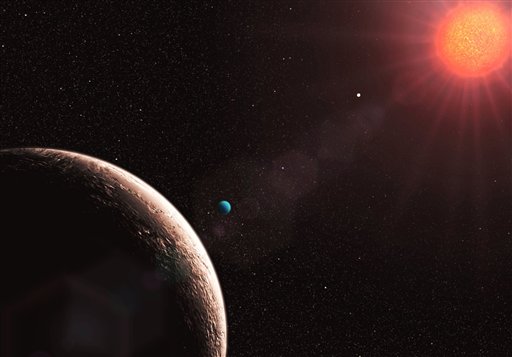
European astronomers said Tuesday that they had discovered the smallest planet yet found orbiting another star. The planet could be as little as only 1.9 times as massive as the Earth and belongs to a dim red star known as Gliese 581, which lies about 20 light-years from Earth in the constellation Libra.
Researchers Pinpoint the Edge of Space -- The Boundary Between Earth’s Atmosphere and Outer Space
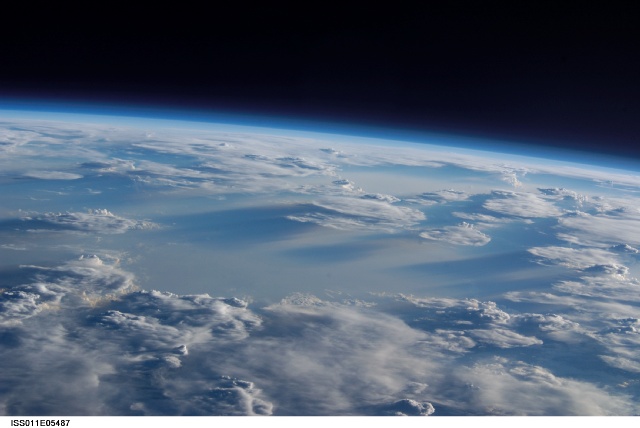
Where does space begin? Scientists at the University of Calgary have created a new instrument that is able to track in unprecedented detail the transition between the relatively gentle winds of Earth’s atmosphere and the more violent flows of charged particles in space -- flows that can reach speeds well over 1,000 km/hr.
Funding Member
