News
Texas-Sized Computer Finds Most Massive Black Hole -- 6.4 Billion Solar Masses
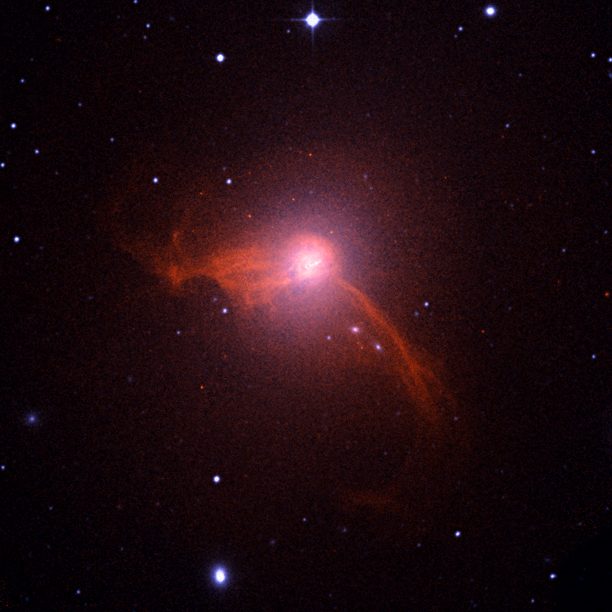
Astronomers at the University of Texas and the Max Planck Institute have used new computer modeling techniques to discover that the black hole at the heart of M87 is two to three times more massive than previously thought. Weighing in at 6.4 billion times the Sun's mass, it is the most massive black hole yet measured and suggests that the accepted black hole masses in nearby large galaxies may be off by similar amounts. This has consequences for theories of how galaxies form and grow.
'Misty caverns' on Enceladus moon
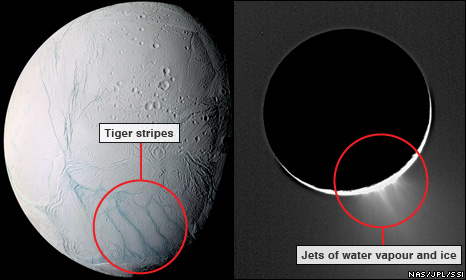
Nasa's Cassini spacecraft has obtained strong evidence that Saturn's tiny moon Enceladus retains liquid water.
NASA Returns to the Moon for the First Time in a Decade
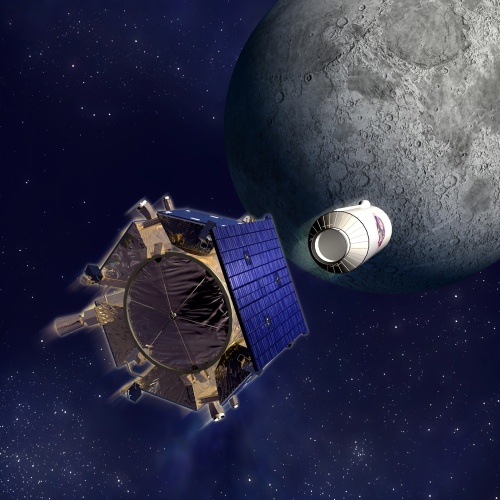
NASA's Lunar Reconnaissance Orbiter launched on June 18, 2009 aboard an Atlas V rocket from Cape Canaveral Air Force Station in Florida. The satellite will relay more information about the lunar environment than any other previous mission to the moon. The orbiter, known as LRO, separated from the Atlas V rocket carrying it and a companion mission, the Lunar Crater Observation and Sensing Satellite, or LCROSS. LRO's objectives during its mission orbiting the moon are to identify safe landing sites, locate potential resources, characterize the radiation environment, and demonstrate new technology. LRO will orbit the poles of the moon during a one-year exploration mission followed by a planned multi-year science mission. In about four months, LCROSS will impact the moon, providing key information about the lunar composition and presence of water ice or hydrated minerals.
Upstate New York Teen is the Youngest Person to Discover a Supernova
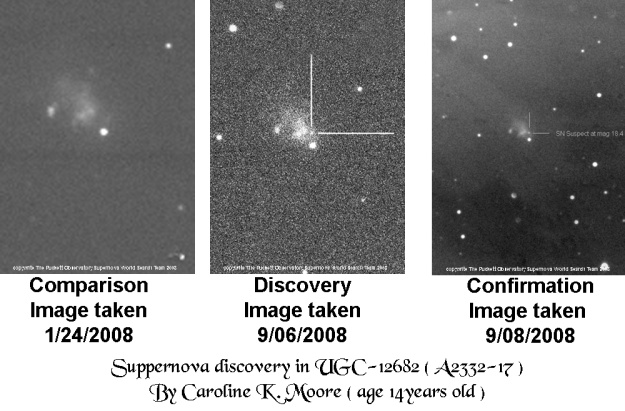
In November 2008, Caroline Moore, a 14-year-old student from upstate New York, discovered a supernova in a nearby galaxy, making her the youngest person ever to do so. Additional observations determined that the object, called SN 2008ha, is a new type of stellar explosion, 1000 times more powerful than a nova but 1000 times less powerful than a supernova. Astronomers say that it may be the weakest supernova ever seen.
14 year old German boy hit by Meteorite.

A schoolboy has survived a direct hit by a meteorite after it fell to earth.
UCSC Astronomers Devise New Technique to Determine the Age of Fast-Spinning Pulsars
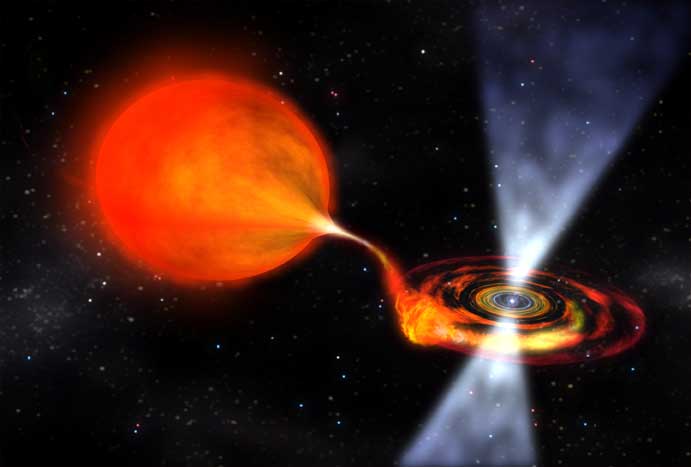
Astronomers at the University of California, Santa Cruz, have developed a new technique to determine the ages of millisecond pulsars, the fastest-spinning stars in the universe. Ordinary pulsars tend to rotate a few times per second, and they gradually slow down with age, eventually becoming too faint to detect. Millisecond pulsars, however, rotate hundreds of time per second. They achieve these extraordinary spin rates by pulling in material from a binary companion star, a process that transfers angular momentum from the companion to the pulsar.
Julian Starfest 2009

This year’s event features more nights and more vendors. Starting on Thursday, August 20th, you can camp and observe for three nights.
JAXA's Suzaku Space Observatory Snaps First Complete X-ray View of a Galaxy Cluster

The Suzaku X-Ray Space Observatory is providing new insight into how assemblages of thousands of galaxies pull themselves together. For the first time, Suzaku has detected X-ray emitting gas at a cluster's outskirts. By looking at a cluster in X-rays, astronomers can measure the temperature and density of the gas, which provides clues about the gas pressure and total mass of the cluster. Suzaku, which means "Red Bird of the South" was developed at the Japan Aerospace Exploration Agency (JAXA) in collaboration with NASA.
An Exploding Star Detected in an "Exploding" Galaxy
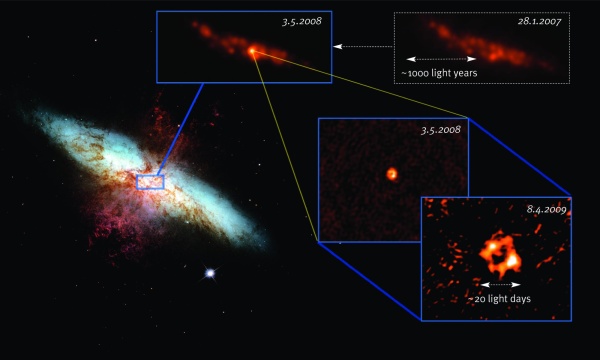
An international team of radio astronomers at the Max Planck Institut fur Radioastronomie (MPIfR) in Germany has discovered the secret explosion of a massive star, a new supernova, in the nearby galaxy M82. Despite being the closest supernovae discovered in the last five years, the explosion is detectable only at radio wavelengths and invisible from Earth in normal light due to the dense gas and dust surrounding the exploding star. Without the obscuration, this supernova would have been visible even with amateur telescopes.
Astronomers Find a SuperMassive Black Hole to be a "Messy Eater"
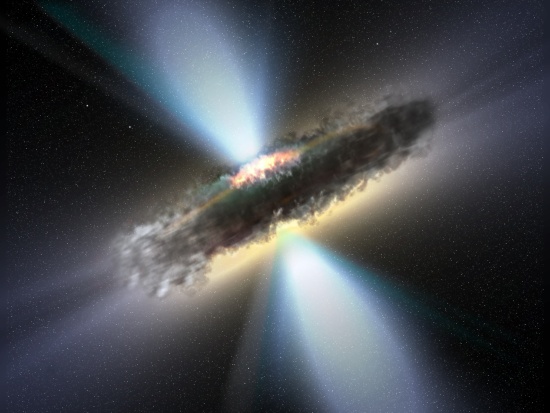
Using new data from ESA’s XMM-Newton spaceborne observatory, astronomers have probed closer than ever to a SuperMassive black hole lying deep at the core of a distant active galaxy. The galaxy was observed during four 48 hour long orbits of XMM-Newton around the Earth. The black hole is eating matter so quickly that it verges on the theoretical limit of its eating ability, swallowing the equivalent of nearly fifty Earths per day.
A Soft Gamma Ray Repeater Erupts with High-Energy Flares

Astronomers using NASA's Swift satellite and the Fermi Gamma-ray Space Telescope have been observing frequent blasts from an object that is 30,000 light-years from Earth. The high-energy fireworks are X-ray and gamma-ray flares coming from a rapidly-spinning and super-magnetic remnant of an exploded star -- an unusual type of stellar cinder called a Soft Gamma Ray (SGR) Repeater.
New Insights into Milky Way Satellite Galaxies Raise Awkward Questions for Newtonian Gravity
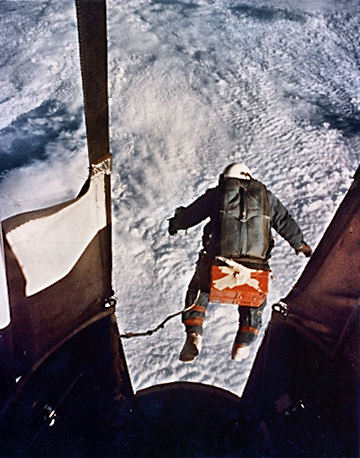
Is it time to modify Newton's Theory of Gravity? Researchers are beginning to make some strong arguments that support this heretical hypothesis as Newtonian Gravity fails to explain so many strange observations. Two new studies conducted by physicists at the University of Bonn, in collaboration with scientists from Austria and Australia, are likely to provide yet more grist for the mill. Their latest results concerning satellite galaxies at the periphery of the Milky Way, if proven correct, could rock the theoretical foundations of standard physics.
Hubble Constant Refined to an Error of Less than 5%
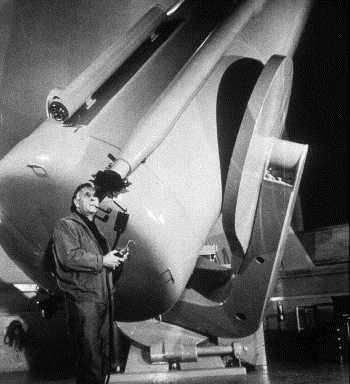
Researchers at Johns Hopkins University have refined the measurement of the universe's present expansion rate to a precision where the error is smaller than 5 percent. The new value for the expansion rate, known as the Hubble constant — named after Edwin Hubble who first measured the expansion of the universe nearly a century ago — is 74.2 kilometers per second per megaparsec with an error margin of ±3.6.
World's Largest Solar Telescope Sees First Light at NJIT’s Big Bear

New Jersey Institute of Technology's (NJIT) new 1.6-meter clear aperture solar telescope — the largest of its kind in the world—is now operational. The unveiling of this remarkable instrument, said to be the pathfinder for all future, large ground-based telescopes, could not have come at a more auspicious moment for science. This year marks the 400th anniversary of Galileo’s telescope that he used to demonstrate that sunspots are indeed on the Sun. The new instrument has three times the aperture of the old telescope. It represents a significant advance in high-resolution observations of the Sun, since it has the largest aperture of any solar telescope in existence.
Giant Galaxy M87 is Finally Sized-up
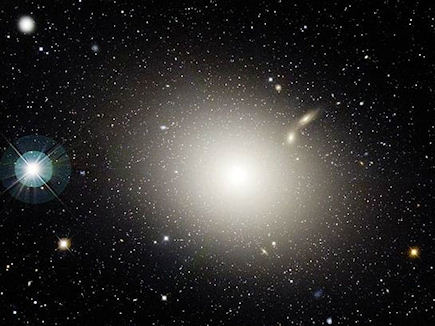
Using ESO's Very Large Telescope, astronomers have succeeded in measuring the size of giant galaxy Messier 87 and were surprised to find that its outer parts have been stripped away by still unknown effects. The galaxy also appears to be on a collision course with another giant galaxy in this very dynamic cluster.
Funding Member
