News
NASA's Carbon Observatory Fails to Reach Orbit
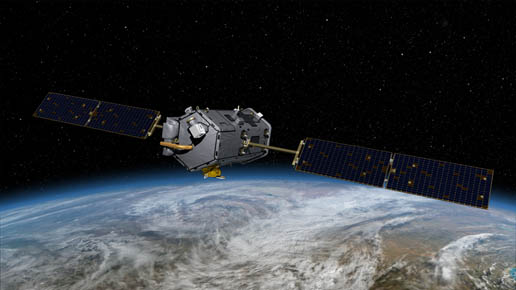
NASA's Orbiting Carbon Observatory (OCO) failed to reach orbit last night (Feb 23, 2009) ending its short journey at the bottom of the ocean near Antarctica. The spacecraft was designed to track the Earth's complex carbon cycle, and was eagerly awaited by scientists studying the process of climate change. OCO's loss is a huge disappointment.
Fermi Spots the Biggest, Baddest Gamma Ray Blast Ever Seen

The first Gamma Ray Burst to be seen in high-resolution from NASA's Fermi Gamma Ray Space Telescope is one for the record books. The blast had the greatest total energy, the fastest motions, and the highest energy initial emissions ever seen. This GRB exceeded the power of approximately 9,000 ordinary supernovae.
A New England Record of 50 Degrees Below Excites Scientists
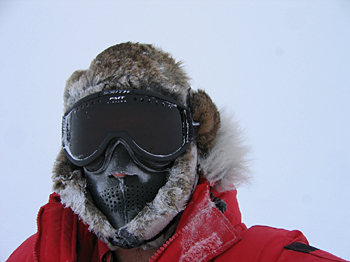
Scientists say a minus 50 degree reading in northwestern Maine last month was accurate, making it the coldest temperature ever recorded in the state. It beats Maine's old record of 48 below zero set in 1925, and ties the record for coldest temperature recorded in New England. That reading was made in 1933 in Bloomfield, Vt. Maine's minus 50 degree reading was made on Jan. 16, 2009 at a remote site along the Big Black River near the Quebec border as the region was in the grip of a blast of arctic air. The reading was confirmed by scientists from the National Weather Service, the US Geological Survey, and NOAA.
One of our own!
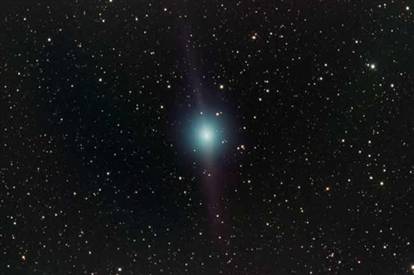
Astromarter Sid Leach's great grab of Comet Lulin has been chosen to grace a Lulin story on MSNBC.COM
Galaxy has 'billions of Earths'
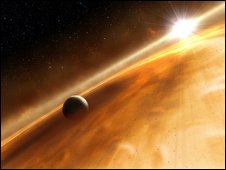
There could be one hundred billion Earth-like planets in our galaxy, a US conference has heard.
Sooner or Later it was Bound to Happen -- Two Satellites Collide in Space
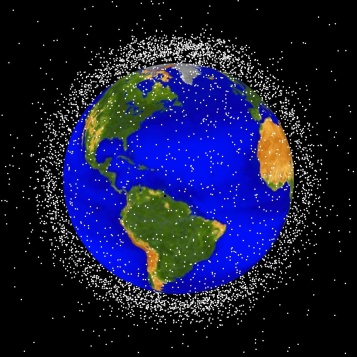
This week Iridium, a provider of mobile satellite service with coverage over the entire globe, lost an operational satellite when it collided with a defunct Russian military satellite. This is believed to be the first time that two satellites have collided in orbit. With roughly 17,000 pieces of manmade debris orbiting Earth, orbital debris is now the biggest threat to a space shuttle in flight, surpassing the dangers of liftoff and return to Earth.
Hubble Reveals Young Runaway Stars Gone Wild
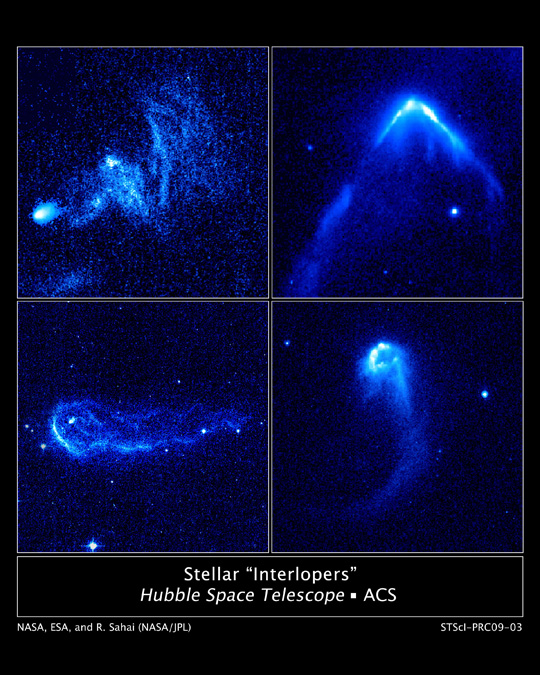
Stars sometimes go ballistic, racing through interstellar space like bullets and tearing through clouds of gas. NASA’s Hubble Space Telescope has revealed 14 young, runaway stars plowing through regions of dense interstellar gas, creating brilliant arrowhead structures and trailing tails of glowing gas. These arrowheads, or bow shocks, form when the stars’ powerful stellar winds, streams of matter flowing from the stars, slam into surrounding dense gas. The phenomenon is similar to that seen when a speeding boat pushes through water on a lake.
Powerful New Technique Measures Size of Small Distant Asteroids
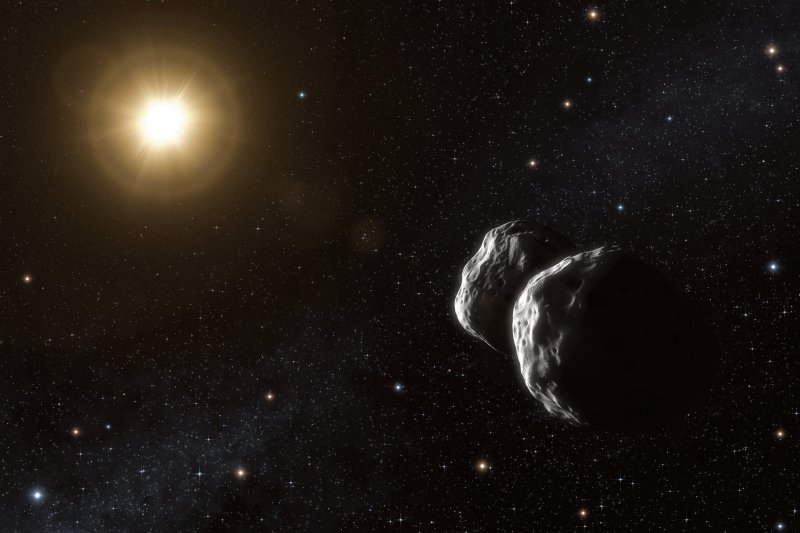
A team of French and Italian astronomers have devised a new method for measuring the size and shape of asteroids that are too small or too far away for traditional techniques, increasing the number of asteroids that can be measured by a factor of several hundred. This method takes advantage of the unique capabilities of ESO's Very Large Telescope Interferometer (VLTI). The new technique is equivalent to being able to measure the size of a tennis ball at a distance of a thousand kilometers.
The 200 Inch Hale Reflector at Palomar Celebrates 60th Anniversary
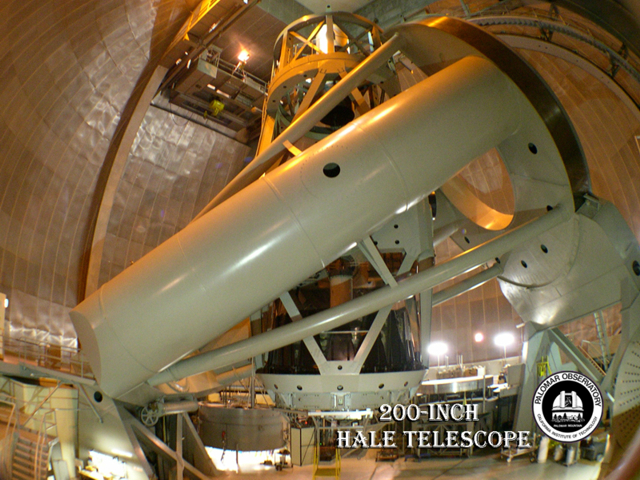
Sixty years ago this week, on January 26, 1949, the 200-inch Hale reflector at Palomar Observatory in California, the largest optical telescope in the world at the time, saw first light. None other than Edwin Hubble took the first astrophotos from the prime focus of this behemoth. After all these years, the 200-inch Hale Telescope is still going strong. New auxiliary equipment for the 200-inch Hale reflector is continually under development to enhance the light-gathering capabilities of the instrument and to keep it as one of the foremost research instruments in astronomy and astrophysics in the world today.
Jodrell Bank Links with Other Observatories to Create Radio Telescope the Size of Earth

Seventeen radio telescopes around the world joined forces last week to carry out a unique observation of three distant quasars. Using an astronomical technique called electronic, real-time Very Long Baseline Interferometry (e-VLBI), the participating telescopes observed the same object simultaneously. Data from each telescope was streamed across the globe through high-speed optical networks to a correlator in the Netherlands that acted as the focus of a giant distributed telescope that was effectively the size of the Earth.
NASA's Fermi Gamma-Ray Telescope Unveils a Dozen New Pulsars
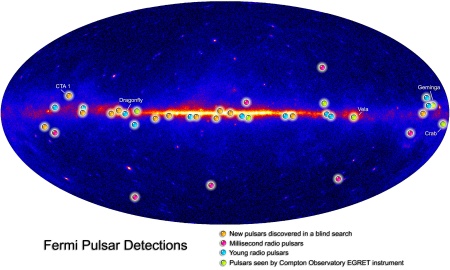
A pulsar is a rapidly spinning and highly magnetized neutron star - the crushed core left behind when a massive sun explodes. NASA's Fermi Gamma-ray Space Telescope, launched into orbit on June 11, 2008, has discovered 12 new gamma-ray-only pulsars and has detected gamma-ray pulses from 18 others. Through processes not fully understood, a pulsar's intense electric and magnetic fields and rapid spin accelerate particles to speeds near that of light. The findings are transforming our understanding of how these stellar cinders work.
World’s Largest Optical Telescope to Go Live in 2018
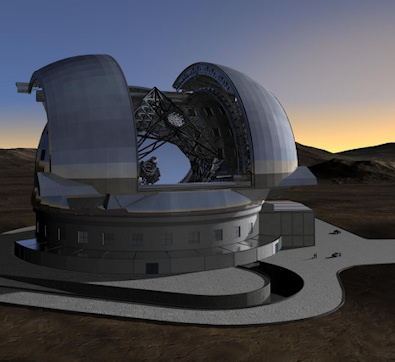
The European Extremely Large Telescope (E-ELT) is a project aiming to provide astronomers with the largest optical-infrared telescope in the world. The project is currently in the detailed design phase and the telescope is expected to take up operations in 2018. With a diameter of 42 m and being fully adaptive from the start, the E-ELT will be more than one hundred times more sensitive than the present-day largest optical telescopes. The E-ELT will vastly advance astrophysical knowledge by enabling detailed studies of planets around other stars, the first galaxies in the Universe, and super-massive black holes.
THEMIS Explorers Discover Giant Breach in Earth's Magnetic Field

The magnetosphere is a bubble of magnetism that surrounds Earth and protects us from solar wind. NASA's five THEMIS spacecraft, equipped with instruments that measure ions, electrons, and electromagnetic radiation in space, have just discovered a breach in Earth's magnetic field that is ten times larger than anything previously thought to exist. Solar wind is flowing in through this large opening and loading up the magnetosphere with a torrent of solar wind particles. This can set the stage for spectacular auroras, power outages, and other disturbances and could also lead to stronger geomagnetic storms than we have seen in many years.
Resilient Mars Rovers, Originally Planned for 90 Days of Service, Mark 5 Years of Exploration

NASA's Mars Rovers Spirit and Opportunity may still have big achievements ahead as they reach the fifth anniversaries of their memorable landings on Mars. Missions that were originally planned for 90 days have now surpassed 5 years, making these rovers the "Energizer Bunnies" of the space program.
Milky Way a Swifter Spinner, More Massive, New Measurements Show
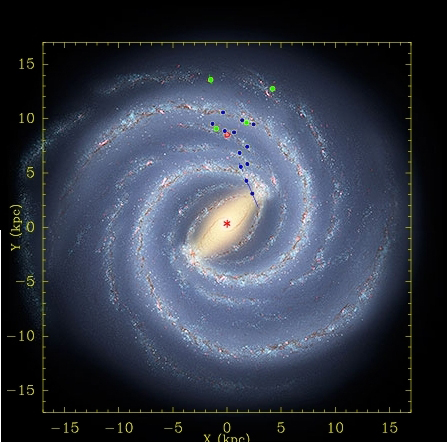
Fasten your seat belts -- we're faster, heavier, and more likely to collide than we thought.
Funding Member
