News
Dark Skies Documentary Debuts This Month
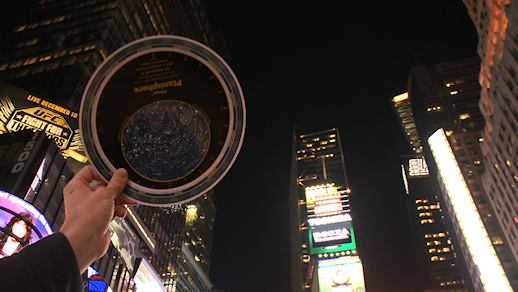
A documentary on the loss of our night sky gets a first shwoing this month in Texas. THE CITY DARK is a feature documentary about light pollution and the disappearing night sky, premiering in competition at the 2011 South by Southwest Film Festival. After moving to New York City from rural Maine, filmmaker Ian Cheney asks a simple question, "Do we need the stars?"
The Cepheid "Standard Candle" is not so Standard After All

Standard candles are astronomical objects that make up the rungs of the so-called cosmic distance ladder, a tool for measuring the distances to farther and farther galaxies. The ladder's first rung consists of pulsating stars called Cepheid variables, or Cepheids for short. Astronomers at Iowa State University and the University of Western Ontario have found the first direct proof that the Cepheid "standard candles" shrink in mass, making them not quite as standard as once thought. The findings, made with NASA's Spitzer Space Telescope, will help astronomers make even more precise measurements of the size, age, and expansion rate of our universe.
Voyager 1 to Determine if Charged Particles at Edge of Solar System Bank to One Side or the Other

In which direction is the sun's stream of charged particles banking when it nears the edge of the solar system? Knowing the strength and direction of the solar wind is critical to understanding the shape of our solar bubble and estimating how much farther it is to the edge of interstellar space. Over the next several days, scientists at JPL will try a series of maneuvers to orient NASA's Voyager 1 spacecraft so that it can act as a "weather vane" and measure the solar wind. Even though Voyager 1 has been traveling through the solar system for 33 years and is 10.8 billion miles away, it is still a limber enough gymnast to perform the necessary acrobatics that it has not been asked it to do in 21 years.
Has NASA Discovered Fossilized Alien Cyanobacteria in a Meteorite?

A NASA scientist claims to have discovered the fossilized remains of an alien life form -- a cyanobacteria in meteorites -- which have been collected on Earth. According to Dr Richard Hoover, an astrobiologist with NASA's Marshall Space Flight Center, the alien life form could explain how life started on Earth. Dr. Hoover fractured small meteorite specimens under a sterile environment and then examined the freshly broken surfaces with a scanning-electron microscope and a field emission electron-scanning microscope, which allowed him to search the surface for evidence of fossilized remains. What he found, he believes, is not from this Earth.
DOUBLE FLYBY ALERT - Today and Tomorrow
DOUBLE FLYBY ALERT: This morning, March 7th, space shuttle Discovery undocked from the International Space Station. This sets the stage for a spectacular series of double flyby sighting opportunities.
NASA'S Chandra Finds Superconducting Superfluid in Neutron Star's Core

Neutron stars contain the densest known matter that is directly observable. One teaspoon of neutron star material weighs six billion tons. The pressure in the star's core is so high that most of the charged particles, electrons and protons, merge resulting in a star composed mostly of uncharged particles called neutrons. NASA's Chandra X-ray Observatory has discovered the first direct evidence for a superfluid, a bizarre, friction-free state of matter, at the core of a neutron star. Superfluids created in laboratories on Earth exhibit remarkable properties, such as the ability to climb upward and escape airtight containers. The finding has important implications for understanding nuclear interactions in matter at the highest known densities.
Giant Magellan Telescope on Track for First Light in 2019

The Giant Magellan Telescope (GMT), which could see first light as early as 2019, will peer more deeply into the universe's hidden history than humans have ever attempted. The GMT will combine seven 8.4-meter primary mirror segments operating together as if they were part of a single, 24.5 meter (80 feet) telescope. Scientists say the instrument's combined mirrors will be sensitive enough to detect a candle on the moon, or to see the face on a dime 200 miles away.
New Solar Cycle Beginning to Ramp Up
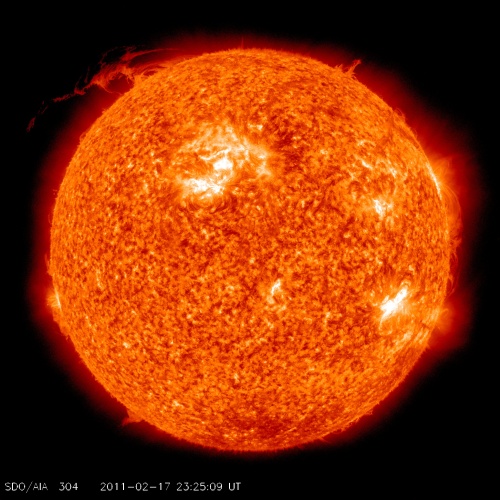
From the events of this past week, it looks like the new solar cycle is beginning to ramp up. The sun emitted its first X-class flare in more than four years on February 14, 2011. On the "Richter Scale" of solar flares, which ranks X1 as a big event, the blast registered X6.6, making it a rather significant solar flare. Fortunately, the Coronal Mass Ejection (CME) produced by the event appears to be rather weak and is not expected to produce any strong effects on Earth other than perhaps some beautiful auroras in the high northern and southern latitudes. X-class flares can trigger radio blackouts and long-lasting radiation storms. A NASA-funded report in 2009 by the National Academy of Sciences found that if a major solar storm comparable to one that occurred in 1859 occurred today, it could cause $1 to $2 trillion in damages to society's high-tech infrastructure and require four to ten years for complete recovery.
Does Jupiter Have a Bigger Brother Hiding in the Oort Cloud?

Two University of Louisiana astrophysicists believe that a huge gas giant, made up mostly of hydrogen and helium that is four times the size of Jupiter, may lie in the outer Oort cloud — the most remote part of our Solar System. The gas giant's existence could explain why many long-period comets come from the wrong direction and why 20 per cent more than expected of the long-period comets observed since 1898 arrive from a band circling the sky at a higher angle than predicted by galactic-tide theory. The two astrophysicists, John Matese and Daniel Whitmire, are proposing that gravity from this yet-to-be discovered planet may be altering the course of comets and causing these anomalies.
The Woolly Mammoth May Walk the Earth Again in Five Years
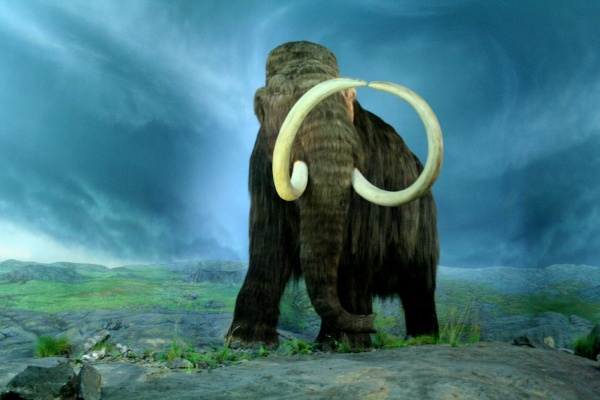
The Woolly mammoth is an extinct species of elephant that populated much of Eurasia and North America until about 10,000 years ago. Along with their living relatives, the African and Indian elephants, mammoths originated in Africa millions of years ago and within the last several hundred thousand years adapted to the numerous ice age periods in the northern hemisphere. But eventually they became extinct when their habitat changed. The plan to clone a woolly mammoth from well-preserved mammoth samples found frozen in Russia is turning out to be a somewhat controversial venture, but that is exactly what a Japanese scientist at Kinki University in Japan intends to do.
Kepler Planet Hunter Finds 1,200 Possibilities
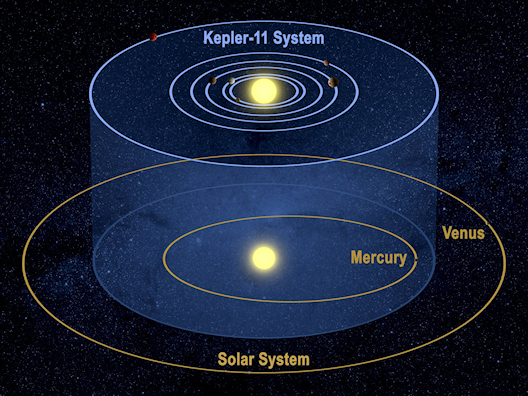
Astronomers have cracked the Milky Way like a piñata, and planets are now pouring out so fast that they do not know what to do with them all.
UCSC Astronomers Push the Limits of Hubble's Capabilities - Find Most Distant Galaxy to Date

Astronomers at the University of California Santa Cruz (UCSC), studying ultra-deep imaging data from the Hubble Space Telescope, have found what may be the most distant galaxy ever seen -- about 13.2 billion light-years away. The study pushed the limits of Hubble's capabilities, extending its reach back to about 480 million years after the Big Bang, when the universe was just 4 percent of its current age. The newly detected galaxy has a likely redshift value ("z") of 10.3.
The End of an Era -- Lights Out for the Tevatron

Tevatron, the second most powerful particle accelerator in the world, surpassed only by the Large Hadron Collider, will cease operations due to budgetary constraints. Fermilab Director Pier Oddone announced that the Tevatron will shut down in the end of September 2011. The present budgetary climate did not permit the Department of Energy to secure the additional funds needed to run the Tevatron. And with that, it is the end of the line for this legendary machine.
NASA's Fermi Detects Streams of Anti-Matter in Thunderstorms on Earth
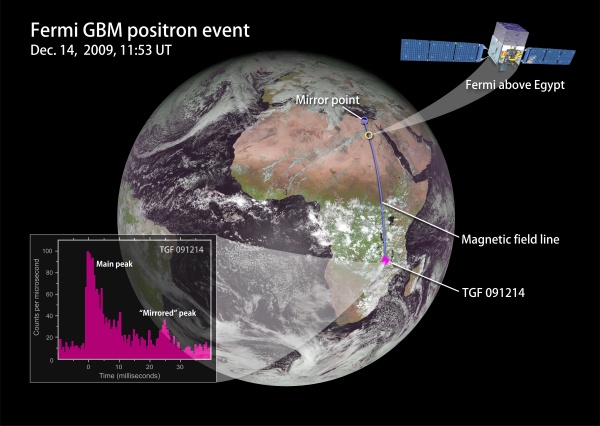
Although NASA's Fermi Gamma-ray Space Telescope is designed to observe high-energy events throughout the universe, it sometimes detects events on Earth. Scientists using Fermi have detected beams of antimatter produced in thunderstorms on Earth, a phenomenon never before seen. Scientists think the antimatter particles were formed in a Terrestrial Gamma-ray Flash (TGF), a brief burst produced inside thunderstorms and shown to be associated with lightning. It is estimated that about 500 TGFs occur daily worldwide, but most go undetected.
Hubble Studies Hanny's Voorwerp - That Green Blob in Space
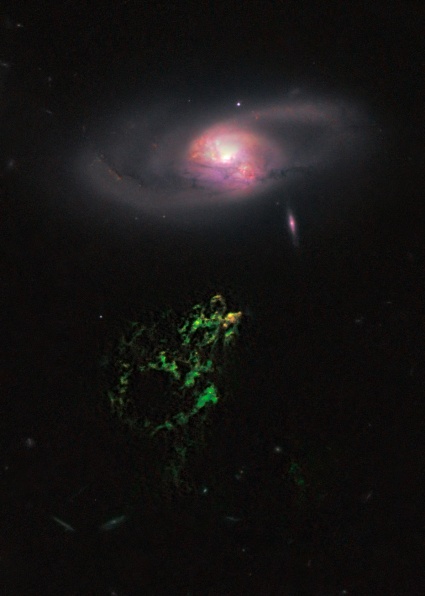
One of the strangest space objects in space has been scrutinized by NASA's Hubble Space Telescope in a study led by a University of Alabama astronomer. The mysterious, glowing green blob of gas is floating near spiral galaxy IC 2497. The object, Hanny's Voorwerp (or Hanny's object in Dutch), was named for Hanny van Arkel, the Dutch school teacher who discovered the ghostly structure in 2007 while participating in the online Galaxy Zoo project. Hubble uncovered delicate filaments of gas and a pocket of young star clusters in the giant object, which to some looks like a flying green frog.
Funding Member
