News
So I Guess I Really Am Part Neanderthal After All

The Neanderthal, the enigmatic Stone Age man who appears to have vanished without a trace 30,000 years ago, lives on in us modern humans. Researchers at the Max Planck Institute in Leipzig decoded the Neanderthal genome and compared it with the Homo Sapiens genome. In the process, the researchers explored a series of questions: What does the Neanderthal genome divulge about us modern humans? Which human capacities and characteristics hark back to Stone Age man? Why did our closest relative become extinct? One thing is now certain: the Neanderthal and modern man mixed - and we are far more closely related than we previously believed. Contrary to the assumption of many researchers, it would appear that some Neanderthals and early modern humans interbred. According to the researchers' calculations, up to four percent of the DNA of many humans living today originate from the Neanderthal.
Helium-Rich White Dwarf Binary Stars Erupt in Violent Flare-Ups

A team of astronomers at the Armagh Observatory in Northern Ireland has spotted violent eruptions from a pair of interacting stars that orbit around each other every 25 minutes. The stars, separated by a distance equivalent to just half that between the Earth and Moon, are both helium-rich white dwarfs -- the compact remnants that are the end state of stars like our Sun. The double system, known as KL Dra, is in the constellation Draco. The new observations were made using the fully robotic Liverpool Telescope located in the Canary Islands and the orbiting Swift observatory. The binary stars are close enough to each other to enable the more massive partner to drag helium off of the smaller one, causing a violent flare-up every two months.
Distant Galaxy is Magnified by a Quasar Acting as a Gravitational Lens -- That's a First

Astronomers using the W. M. Keck Observatory have identified the first known quasar acting as a gravitational lens that magnifies an even more distant galaxy. Hundreds of cases of gravitationally lensed distant quasars with foreground galaxies are known. But, until now, the reverse process - a background galaxy being lensed by a massive foreground quasar - had never been detected. The discovery may provide astronomers with a new technique to study quasars.
NASA's WISE Completes Its First Full Sky Survey in Infrared
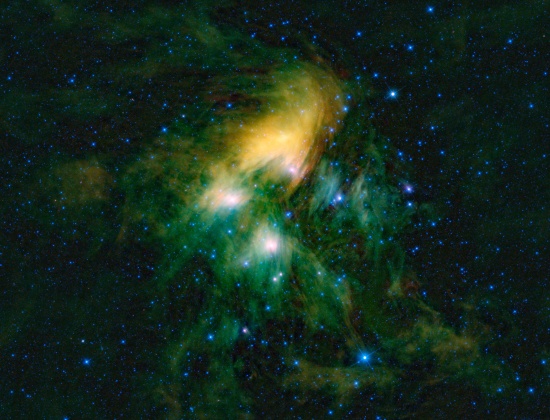
NASA's Wide-field Infrared Survey Explorer, or WISE, completed its first survey of the entire sky today, July 17, 2010. The mission has generated more than one million images so far. WISE is filling in the blanks on the infrared properties of everything in the universe from nearby asteroids to distant quasars. In six months, WISE has discovered more than 90 new Near-Earth Objects. The infrared telescope is also good at spotting comets that orbit far from Earth and has discovered more than a dozen of these too. WISE's infrared vision also gives it a unique ability to pick up the glow of cool stars called brown dwarfs.
Record-Breaking Gamma Ray Burst Temporarily Blinds NASA's Swift

A blast of the brightest X-rays ever detected from beyond our Milky Way galaxy's neighborhood temporarily blinded the X-ray eye on NASA's Swift space observatory earlier this summer, astronomers now report. The X-rays traveled through space for 5-billion years before slamming into and overwhelming Swift's X-ray Telescope on June 21, 2010. The blindingly bright blast came from a gamma-ray burst, a violent eruption of energy from the explosion of a massive star morphing into a new black hole.
Binary Stars -- Born Like Peas in a Pod?
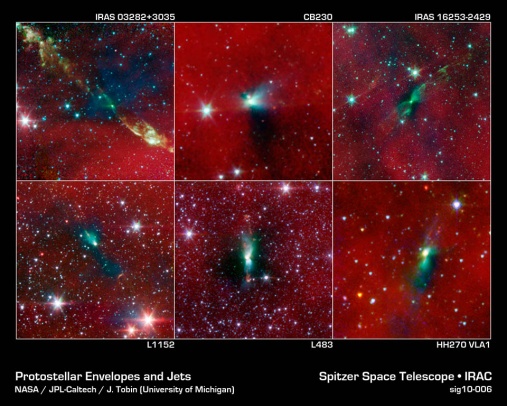
Our sun may be an only child, but most of the stars in the galaxy are actually twins. The sibling stars circle around each other at varying distances, bound by the hands of gravity. How twin stars form is an ongoing question in astronomy. Do they start out like fraternal twins developing from two separate clouds, or "eggs?" Or do they begin life in one cloud that splits into two, like identical twins born from one egg -- like two peas on a pod? New observations from NASA's Spitzer Space Telescope are acting like sonograms to reveal the early birth process of snug twin stars.
M17 -- Much More Complex Than Originally Thought
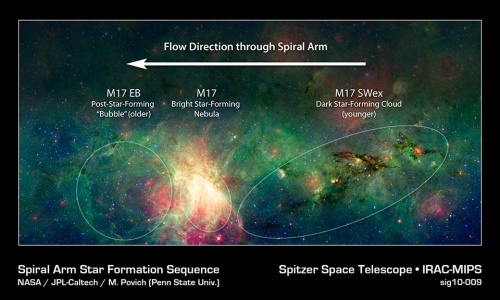
NASA's Spitzer Space Telescope has revealed a cosmic cloud next to M17 that is shaped like a flying dragon. Though appearances deceive, stars are forming in this dark cloud about as fast as in the neighboring, dazzling M17 nebula, which is illuminated by giant stars. But no similar stellar behemoths have yet emerged in this dark cloud (dubbed M17 SWex) to set the dragon's dusty innards aglow. The strange absence of bright stars in this star forming cloud speaks to the mysteries surrounding the birth of the heftiest stars in the universe.
Supermassive Black Hole Gets Booted Out of its Home Galaxy
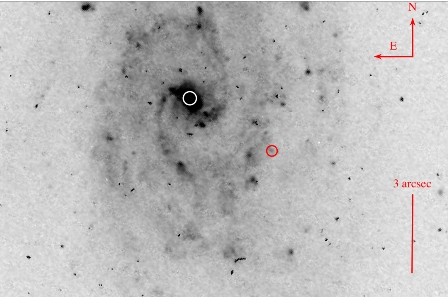
Astronomers at the University of Utrecht in the Netherlands have found what appears to be a supermassive black hole leaving its home galaxy at high speed. Given that these objects can have masses equivalent to 1 billion Suns, it takes a special set of conditions to cause this to happen. The newly-discovered object is probably the result of the collision and merger of two large black holes. The path of the resulting recoiling black hole most likely depends on the direction, speed, and rotation of the two black holes before their collision, but more instances need to be found and studied.
The Large Binocular Telescope Achieves Major Breakthrough -- Sharper than Hubble
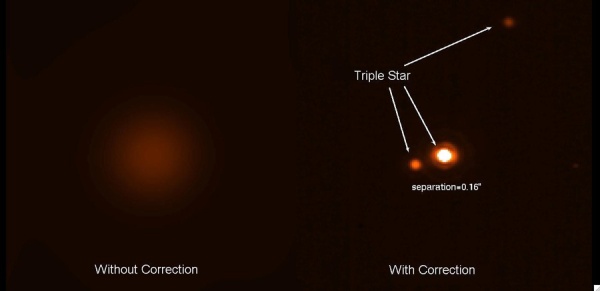
The next generation of adaptive optics has arrived at the Large Binocular Telescope (LBT) in Arizona, providing astronomers with a new level of image sharpness never before seen. Developed in a collaboration between intitutions in Italy, Germany, and the University of Arizona's Steward Observatory, this technology represents a remarkable step forward for astronomy. The LBT, with its two 8.4 meter mirrors, is the largest optical telescope in the world. In the initial testing phase, the LBT's adaptive optics system has been able to achieve jaw-dropping Strehl Ratios of 82 to 84 percent.
Pan-STARRS Asteroid Hunter is Now Fully Operational
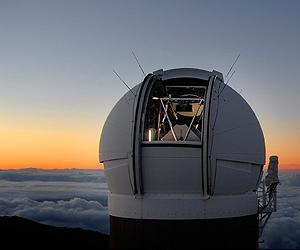
Astronomers have announced that the first Pan-STARRS (Panoramic Survey Telescope and Rapid Response System) observatory, PS1, is fully operational. This innovative facility will be at the front line of Earth's defense by searching for "killer" asteroids and comets. Pan-STARRS features the world's largest digital camera -- a 1.4 Gigapixel monster. Each image, if printed out as a 300-dpi photograph, would cover half a basketball court. Pan-STARRS will map one-sixth of the sky every month. Frequent follow-up observations will allow astronomers to track suspicious objects and calculate their orbits, identifying any potential threats to Earth.
L2 - a Unique Parking Lot in Space Caused by Gravity and Orbital Mechanics

When you ask an astronomer about the James Webb Space Telescope's orbit, they'll tell you that it won't be orbiting the Earth like Hubble, but instead it will be sent almost a million miles out into space to a place called L2. L2 is short-hand for the second Lagrange Point, a wonderful accident of gravity and orbital mechanics, and the perfect place to park the Webb telescope in space. L2 is an area where gravity from the sun and Earth balance the orbital motion of a satellite. Parking a spacecraft in L2 allows it to stay in a fixed position relative to the Earth and sun with a minimal amount of energy needed for course correction.
Was Venus Once Habitable Like Earth?
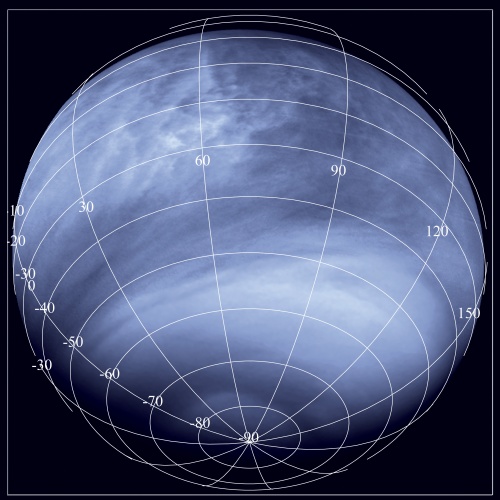
ESA's Venus Express is helping planetary scientists investigate whether Venus once had oceans. If it did, it may even have begun its existence as a habitable planet similar to Earth. These days, Earth and Venus seem completely different. Earth is a lush, clement world teeming with life, while Venus is hellish, its surface roasting at temperatures higher than those of a kitchen oven. But underneath it all the two planets share a number of striking similarities. Could Venus at one time have sustained life?
Dinosaur-Chewing Mammals Leave Behind Oldest Known Tooth Marks - Mmm... Tastes Like Chicken

Paleontologists have discovered the oldest mammalian tooth marks yet on the bones of ancient animals, including several large dinosaurs. Nicholas Longrich of Yale University and Michael J. Ryan of the Cleveland Museum of Natural History came across several of the bones while studying the collections of the University of Alberta and the Royal Tyrrell Museum of Palaeontology. The bones are all from the Late Cretaceous epoch and date back about 75 million years.
The Coolest Stars are Not All in Hollywood

Astronomers have uncovered what appear to be 14 of the coolest stars known in our universe. These failed stars, called brown dwarfs, are so cold and faint that they'd be impossible to see with current visible-light telescopes. Spitzer's infrared vision was able to pick out their feeble glow, much as a firefighter uses infrared goggles to find hot spots buried underneath a dark forest floor.
NASA's Ion-Propelled Dawn Spacecraft Breaks Record for Speed Change

Deep in the heart of the asteroid belt, on its way to the belt's two most massive inhabitants, Vesta and Ceres, NASA's ion-propelled Dawn spacecraft has eclipsed the record for velocity change produced by a spacecraft's engines. The previous standard-bearer for velocity change, NASA's Deep Space 1, also powered by ion propulsion, was the first interplanetary spacecraft to use this technology. The Deep Space 1 record fell on June 5, 2010 when the Dawn spacecraft's accumulated acceleration over the mission exceeded 4.3 kilometers per second (9,600 miles per hour).
Funding Member
