News
Snowball Earth Glaciation Dramatically Changed the Carbon Cycle

For insight into what can happen when the Earth's carbon cycle is altered, scientists are looking at an event that occurred some 720 million years ago, when global glaciers reached the equator. New data from a Princeton University-led team of geologists suggest that an episode called Snowball Earth, which resulted in the continents and oceans being covered in a thick sheet of ice, produced a dramatic change in the carbon cycle. The glaciation was global in scope, literally encasing the planet in ice. Later, after the carbon cycle settled to more of a steady state similar to how it functions today, increased levels of oxygen in the atmosphere provided the conditions that were necessary for the explosive diversification of animal life that started about 540 Million Years ago.
Arecibo Tracks Potentially Dangerous Asteroid
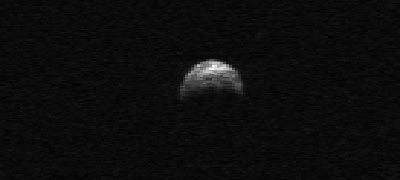
A near-Earth asteroid named 2005 YU55 -- on the list of potentially dangerous asteroids -- was observed by the Arecibo telescope April 19, 2010 as it passed about 1.5 million miles from the Earth (about six times the distance to the moon). Arecibo radar imaging of 2005 YU55 showed that the asteroid is about 1,300 feet (400 meters) in size -- about a quarter-mile long -- and twice as large as previously estimated.
Forty Years Later - Long Lost Soviet Reflector is Found on the Moon

Forty years ago, the Soviet Union sent a laser reflector aboard the unmanned Luna 17 mission, which landed on the moon November 17, 1970. Their intent was to shine laser beams off of the reflector to take accurate measurements of the distance from the Earth to the Moon. Everything was working just fine until they had one slight problem -- They lost it. The Soviet lander and its rover, called Lunokhod 1, were last heard from on September 14, 1971. Now, a team of physicists led by a professor at University of California - San Diego has pinpointed the location of the long lost light reflector by analyzing high-resolution images taken last month from NASA’s Lunar Reconnaissance Orbiter (LRO).
20 Years Ago Today Hubble Revolutionized Astronomy

NASA’s best-recognized, longest-lived, and most prolific space observatory was launched April 24, 1990, aboard the space shuttle Discovery. Hubble discoveries revolutionized nearly all areas of current astronomical research from planetary science to cosmology. To celebrate this historic event, NASA and the Space Telescope Science Institute, or STScI, in Baltimore are celebrating Hubble’s journey of exploration with a stunning new picture and several online educational activities. There are also opportunities for people to explore galaxies as armchair scientists and send personal greetings to Hubble for posterity.
Small Ground-Based 1.5 Meter Telescope Images Three Exoplanets

Astronomers have snapped a picture of three planets orbiting a star beyond our own using a modest-sized 1.5 meter telescope on the ground. The surprising feat was accomplished by a team at NASA's Jet Propulsion Laboratory in Pasadena, California, using a small portion of the Palomar Observatory's Hale Telescope. The astronomy team took painstaking efforts to push current technology to the point where such a small mirror could be used. They combined two techniques -- adaptive optics and a coronagraph -- to minimize the glare from the star and reveal the dim glow of the much fainter planets.
Astronomers Find a Supernova That Resembles a GRB... But With No Gamma Rays

Astronomers have found an unusual supernova explosion with properties similiar to a Gamma-Ray Burst (GRB), but without seeing any gamma rays from it. The discovery was made using the National Science Foundation (NSF) Very Large Array (VLA) radio telescope. The tell-tale clues came when the radio observations showed material expelled from the supernova explosion at speeds approaching that of light.
Yellow Submarine Discovers World's Deepest Known Undersea Volcanic Vents

A British scientific expedition has discovered the world's deepest known undersea volcanic vents, 5000 metres down in the Cayman Trough in the Caribbean. Using a deep-diving remotely controlled yellow-colored submarine from the Royal Research Ship (RRS) James Cook, the scientists found slender spires made of copper and iron ores on the seafloor, erupting water hot enough to melt lead. Scientists are fascinated by the deep-sea vents because the scalding water that gushes from them nourishes lush colonies of deep-sea creatures. This is forcing scientists to rethink the rules of biology on Earth. Studying the life-forms that thrive in such unlikely havens is providing insights into the possibility of life on other planets, and even how life on Earth may have begun.
Are Electroweak Stars Precursors to Stellar Black Holes?
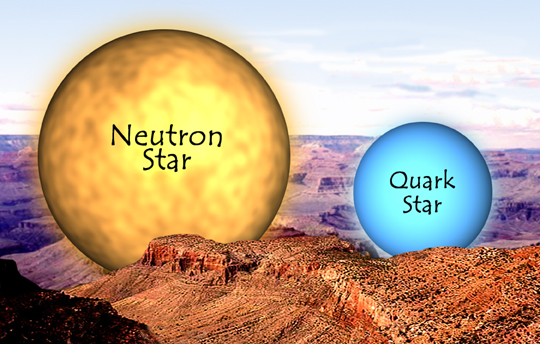
A group of physicists at Case Western Reserve University believe that there may be an intermediary stage in the life of a massive star before it collapses into a black hole. According to Glenn Starkman, a professor of physics at Case Western Reserve University, stars could burn for millions of years as electroweak stars. The energy created by the conversion of quarks into much lighter particles called leptons could halt the implosion of the dying star, essentially granting it somewhat of a reprieve before total collapse into a black hole. In fact, if the electroweak burning is efficient, it could consume enough mass to prevent what's left from the massive star from ever becoming a black hole.
Astronomers Get Sharpest View Ever of Star Factories in Distant Universe

Cambridge, MA - Astronomers have combined a natural gravitational lens and a sophisticated telescope array to get the sharpest view ever of "star factories" in a galaxy over 10 billion light-years from Earth.
Space-time laws broken in bizarre experiment

(Bellevue Journal American 04/1/10) The claim by a team of particle beam specialists to have created a tachyon-variant beam, enabling communication with the past, has prompted a government seizure of their lab and all their equipment.
Amateur Takes Photos From Edge of Space... NASA Wants to Know How
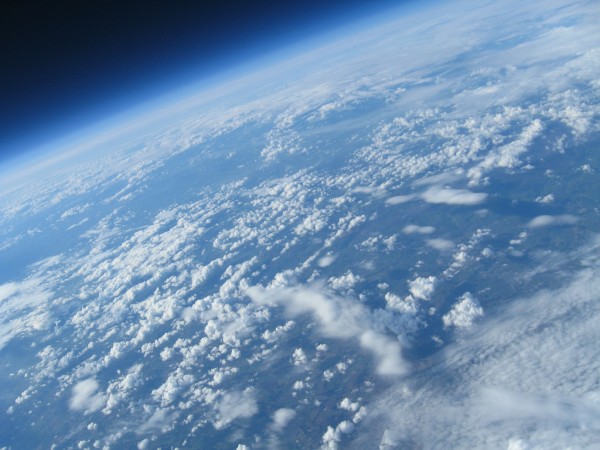
Some pretty impressive images of the Earth from the edge of space have been captured by Robert Harrison, an amatuer photographer in the UK, using a cheap digital camera purchased on eBay, a helium balloon, a texting cellphone with GPS capabilities, and a bunch of duct tape. The rig had experts at NASA scratching their heads.
Sad News
With great sadness news has been received of the death of Mr. Dick Wessling.
Sky Diving into the Unknown from 120,000 Feet

Later this year, Australian Felix Baumgartner will attempt to break the long-standing record for the highest ever parachute jump – ascending in a pressurised gondola attached to a high-altitude balloon to a mind-boggling 120,000ft (36.5km). The current mark, 102,800ft (31.3km) set in 1960, is held by now-retired United States Air Force Colonel Joseph Kittinger. Felix Baumgartner aims to break the American’s 50-year-old record with this most audacious project --dubbed ‘Mission to the Edge of Space.’
Canadian Researcher Solves 37-year-old Space Mystery

A researcher from The University of Western Ontario has helped solve a 37-year-old space mystery using lunar images released yesterday by NASA and maps from his own atlas of the moon. Phil Stooke, a professor at the University of Western Ontario pinpointed the exact location of the Russian rover Lunokhod 2, discovering tracks left by the lunar sampler 37 years ago after it made a 35-kilometre trek.
Did the Chilean Quake Shift Earth's Axis?

Last month's 8.8 magnitude earthquake in coastal Chile was strong. How strong? NASA scientists say it shifted enough material to change the mass balance of our entire planet and in the process may have shifted the axis of Earth itself. Scientists at the Jet Propulsion Laboratory (JPL) in Pasadena, California are studying this and belive that the quake may have moved Earth's figure axis by as much as 3 inches (8 cm).
Funding Member
