News
The Laser Turns 50
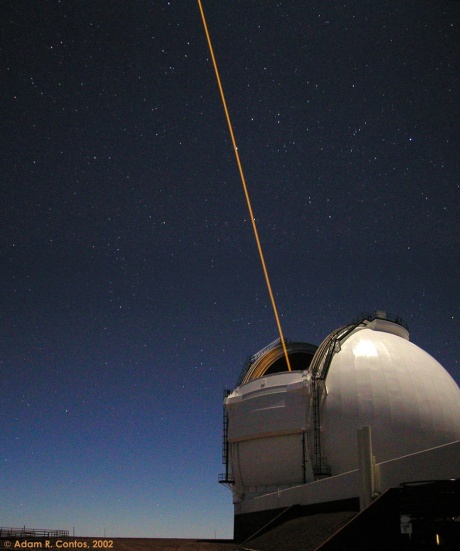
The idea of a LASER (Light Amplification by Stimulated Emission of Radiation) was first contemplated by Albert Einstein when he proposed the theory of stimulated light emission in 1917. It wasn't until more than 40 years later, in 1958, that work by Charles Townes and Arthur Schawlow at Bell Telephone Laboratories (BTL) in New Jersey on the MASER (Microwave Amplification by Stimulated Emission of Radiation) led to Theodore Maiman, at Hughes Research Laboratories in California, building the first ruby Laser in 1960. Maiman's creation was met with an underwhelming response and was described as a solution looking for a problem. Today, on the laser's fiftieth birthday, physicists assert that the discovery's usefulness has much further to go, despite already underpinning some of the last half century's most disruptive technologies (not least, the optical fibers that make today's high speed internet possible).
New Light Shed on an Old Dispute Between Einstein and Bohr

From the early days of quantum mechanics, Albert Einstein did not hide his dissatisfaction with the statistical nature of quantum mechanics and the fact that certain observations such as location and time cannot be simultaneously measured with any accuracy. By the mid 1930s, Einstein had accepted quantum mechanics as a consistent theory for the statistics of the behavior of atoms. Eventually the applications would include transistors, lasers, a new chemistry, and more. Yet Einstein could not accept quantum mechanics as a complete theory, for its mathematics did not describe individual events. Einstein felt that a more basic theory, one that could completely describe how each individual atom behaved, might yet be found. By following the approach of his own general theory of relativity, he hoped to dig deeper than quantum mechanics. The search for a deeper theory was to occupy much of the rest of his life.
Most Potentially Hazardous Asteroids are Still Not Known

Near Earth Asteroids (NEAs) present a clear and present danger to the world's population. Once every 200 years a medium-sized NEA (diameter 40-1000 m) hits the Earth and causes serious local damage. Once every 2 million years a NEA, comparable in size with the one which terminated the era of the dinosaurs, impacts and causes fatal global damage. 85% of the NEAs with diameters larger than 1000 m are known to date; of the potentially hazardous smaller ones, down to 25 m, only 1% is chartered.
Comet McNaught C/2009 R1 is now visible
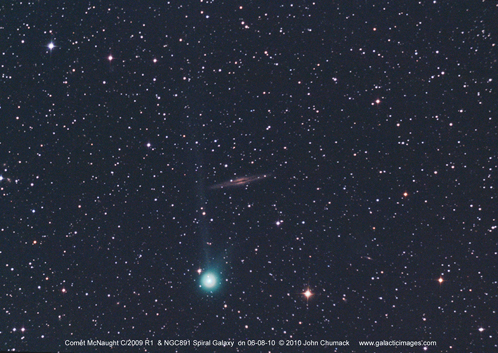
Want to see a comet tomorrow morning?
Is an Alien Life Form Consuming the Hydrogen and Acetylene on Titan?

Two new research efforts based on data from NASA's Cassini spacecraft have scrutinized the complex chemical activity on the surface of Saturn's moon Titan. While non-biological chemistry offers one possible explanation, some scientists believe these chemical signatures bolster the argument for a primitive, exotic form of life or precursor to life on Titan's surface. According to one theory put forth by astrobiologists, the signatures fulfill two important conditions necessary for a hypothesized methane-based life form. To date, methane-based life forms are only hypothetical. Scientists have not yet detected this form of life anywhere, though there are liquid-water-based microbes on Earth that thrive on methane or produce it as a waste product.
Andromeda's Black Hole is Incredibly Feeble

For over 10 years, NASA's Chandra X-ray Observatory has repeatedly observed the Andromeda Galaxy for a combined total of nearly one million seconds. This unique data set has given astronomers an unprecedented view of the nearest supermassive black hole outside our own Galaxy. Astronomers think that most galaxies - including the Milky Way - contain giant black holes at their cores that are millions of times more massive than the Sun. At a distance of just under 3 million light years from Earth, Andromeda is relatively close and provides an opportunity to study its black hole in great detail. Just like the one in the center of the Milky Way, the black hole in Andromeda is surprisingly quiet. In fact, Andromeda's black hole is ten thousand to one hundred thousand times fainter in X-ray light than astronomers might expect given the reservoir of gas around it.
Today's SpaceX Falcon 9 Maiden Flight Seen as a Great Achievement

SpaceX's Falcon 9 rocket enjoyed a successful maiden test flight today, June 4, 2010. The rocket, which could one day carry astronauts, blasted-off from its launch pad at Cape Canaveral, Florida, at 1845 GMT. The California-based firm developed the vehicle with a large contract from NASA. The first launch attempt of the day was aborted at the last second because an engine parameter fell out of limits. But the second attempt went flawlessly, with the vehicle acieving orbit.
Julian Starfest 2010

Don't miss Julian Starfest set for August 5th, 6th, 7th and 8th.
Galaxies Like Grains of Sand - Larger Beyond What We Can Imagine
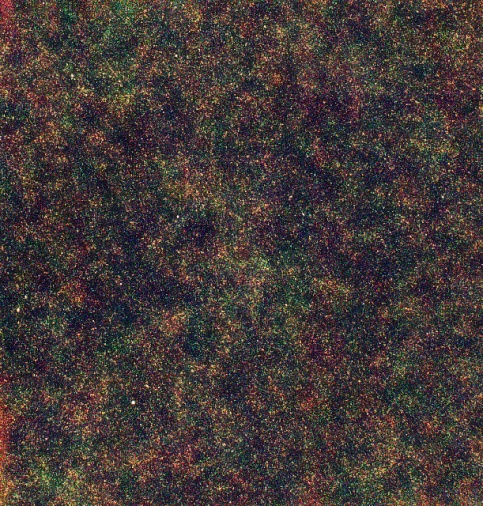
Astronomers using the European Space Agency's (ESA) Herschel telescope have discovered that the brightest galaxies tend to be in the busiest parts of the Universe. This crucial piece of information will enable theorists to fix up their theories of galaxy formation. For over a decade, astronomers have been puzzled by some strange, bright galaxies in the distant Universe that appear to be forming stars at phenomenal rates, making them very hard to explain with conventional theories of galaxy formation. The Herschel Space Observatory, with its ability for very sensitive mapping over wide areas, has been able to see thousands of these galaxies and identify their location, showing for the first time that they are packed closely together in the center of large galaxy clusters.
CERN Cranks up the Large Hadron Collider to 7 TeV

On March 30, 2010, particle beams in the Large Hadron Collider (LHC) were smashed into each other at 7 TeV (Terra Electron Volts), marking the start of a hopefully long and fruitful research program. Now particle physicists around the world are looking forward to a potentially rich harvest of new physics and exotic particles as the LHC begins its first long run at an energy level three and a half times higher than previously achieved in a particle accelerator. Initially, researchers will go through a process of "re-discovering" all of the known Standard Model particles -- a necessary precursor to looking for new particles. Then the real fun will start. The LHC will run continuously for 18 to 24 months with the objective of delivering enough data to make significant advances across a wide range of fronts. The LHC will then be shut down for routine maintenance and preparations will start for its next journey, which will take it up to the design limit of 14 TeV.
Jumpin Jupiter -- Where Did That Stripe Go?

In a development that has transformed the appearance of the solar system's largest planet, one of Jupiter's two main cloud belts has completely disappeared. The loss of such an enormous "stripe" can be seen with ease halfway across the solar system from Earth, even with amateur telescopes or large binoculars.
Cassini to Turn a Double Play on Enceladus and Titan

NASA's Cassini spacecraft will be turning a double play this week, visiting the geyser moon Enceladus and the hazy moon Titan. The alignment of the moons means that Cassini can catch glimpses of these two contrasting worlds within less than 48 hours, with no maneuver in between. The spacecraft will pass within 270 miles of the surface of Enceladus and within 750 miles of Titan.
Adam Block Imaging Workshop

Adam Block of the Mt. Lemmon SkyCenter will be holding a two day imaging workshop at the Fall Star Party in Chiefland, Florida
Houston We Have a Problem -- JPL Engineers Diagnosing Voyager 2 at the Edge of the Solar System

Engineers are diagnosing an unexpected change in the pattern of returning data from the Voyager 2. The spacecraft is now at the edge of the heliosphere, about 8.6 billion miles from Earth. Preliminary engineering data received on May 1, 2010 showed that the spacecraft is basically healthy, and that the source of the issue is an on-board system responsible for formatting data to send back to Earth. It takes nearly 13 hours for signals from Earth, travelling at the speed of light, to reach the spacecraft and 13 hours for signals to return to Earth. Originally designed for a 4 year mission to Saturn, Voyager 2 is still returning data 33 years later.
Carnegie Institution Commits to Construction of Giant Magellan Telescope
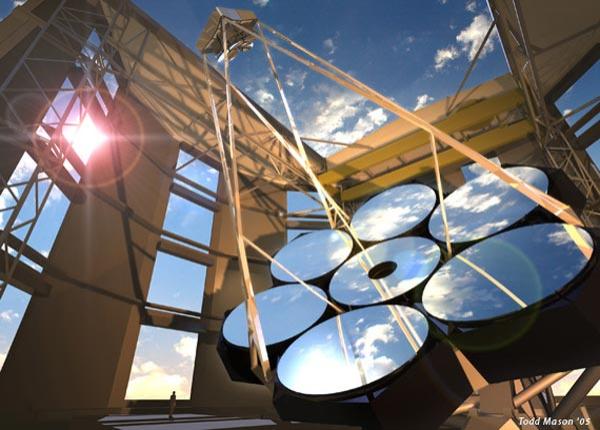
the Carnegie Institution for Science has enthusiastically endorsed the construction of the proposed Giant Magellan Telescope (GMT). The GMT will be the first in the next generation of astronomical observatories. Larger and more powerful than any previous optical telescope, it will have ten times the light-gathering power of current ground-based telescopes and will produce images 10 times sharper than those from the Hubble Space Telescope. The GMT will use the latest in Adaptive Optics technology to remove blurring caused by the Earth’s atmosphere to produce images with unprecedented sensitivity and clarity. The novel design of the GMT will combine seven 8.4-meter primary mirror segments resulting in the equivalent of a 24.5-meter telescope.
Funding Member
